
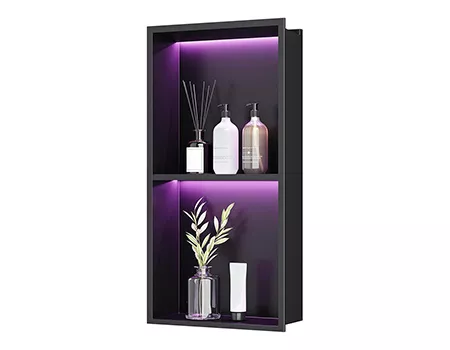
Structural Integrity and Moisture Barrier Assessment of Recessed Shower Storage Units
Introduction
In the realm of bathroom system design, recessed shower storage units integrated into tiled walls present unique engineering challenges. These compartments, commonly known as tile shower niches, must reliably combine structural stability with effective moisture containment in an environment characterized by persistent humidity and frequent water exposure. Their installation involves a complex layering of substrates, waterproof membranes, and tile finishes, each contributing to the overall performance. Failures in these systems often manifest as breaches in the waterproof barrier, leading to water ingress and subsequent damage to underlying structural components. This discussion delves into the mechanical and material interactions governing the behavior of these niches, emphasizing the predominant failure mode of waterproof layer delamination. It also outlines relevant testing procedures, particularly those aligned with the Japan Water Works Association Certification, to validate performance under simulated bathroom conditions. The insights presented aim to assist engineers and designers in developing durable, moisture-resistant shower niches suited for high-humidity environments.
Mechanical Principles & Material Behavior
Tile shower niches are constructed by recessing a cavity within the shower wall assembly, typically framed with cementitious backer boards or similar rigid substrates. Over this substrate, a waterproof membrane—either liquid-applied or sheet-based—is installed to create a continuous moisture barrier. The final finish consists of ceramic or natural stone tiles adhered with specialized tile adhesives. The integrity of this multilayer system depends on the mechanical compatibility and adhesion between these components.
From a structural standpoint, the niche must withstand static loads imposed by stored items such as shampoo bottles, which can cumulatively reach several kilograms. Additionally, dynamic forces arise from user interactions, including impacts or pressure during cleaning. These loads induce stresses that propagate through the tile, adhesive, membrane, and substrate layers. Each material exhibits distinct mechanical properties: cement boards typically have a modulus of elasticity in the range of 3–5 GPa, while tile adhesives and membranes possess lower moduli but must accommodate strain without failure.
Thermal expansion coefficients vary among these materials; for example, ceramic tiles expand at approximately 7–10 × 10^-6 /°C, whereas polymer-based membranes may have coefficients two to three times higher. Temperature fluctuations common in bathroom environments cause differential movement, which can generate shear and tensile stresses at interfaces. The waterproof membrane’s adhesion strength and elongation capacity are critical parameters; membranes with elongation limits below 150% risk cracking or delamination when substrate movement occurs. Similarly, tile adhesives must maintain bond strength without embrittlement over time, typically requiring tensile adhesion strengths exceeding 0.5 MPa after aging.
The substrate must provide a stable, flat surface with minimal deflection under load. Excessive flexural deformation, often due to insufficient board thickness or improper fastening, can lead to crack propagation through the tile and membrane layers. Cementitious substrates are susceptible to moisture-induced swelling if not properly sealed, compromising dimensional stability. The membrane must retain elasticity and impermeability despite cyclic exposure to moisture vapor pressure and temperature changes typical of high-humidity bathroom environments.
Failure Modes
Primary Failure: Waterproof Layer Delamination
Waterproof layer delamination remains the most prevalent and critical failure mode in recessed shower niches. This phenomenon involves the separation of the waterproof membrane from either the substrate or the tile adhesive interface, creating pathways for water to penetrate behind the wall assembly. Delamination typically initiates at geometric discontinuities such as niche corners and edges, where stress concentrations due to bending and shear forces are highest. Inadequate surface preparation—such as residual dust, moisture, or incompatible primers—significantly reduces adhesion strength. Additionally, improper curing conditions or the use of membranes with insufficient elongation properties exacerbate susceptibility to delamination.
Over time, repeated wetting and drying cycles, combined with mechanical stresses from load and thermal expansion, progressively weaken the bond. Once delamination occurs, water infiltration leads to substrate degradation, fostering mold growth and compromising the structural integrity of the wall assembly. This failure mode is particularly insidious because it may remain undetected until visible tile damage or odors emerge, by which point remediation becomes costly.
Secondary Failure: Structural Load-Bearing Deficiency
Beyond waterproofing concerns, the niche must reliably support the weight of stored items without excessive deformation. Structural failure manifests as tile cracking, substrate fracture, or membrane rupture due to substrate deflection. Cement backer boards thinner than 12.5 mm or those inadequately fastened often exhibit flexural deflections exceeding 1.5 mm under typical service loads, surpassing recommended limits and inducing stress concentrations.
Repeated mechanical fatigue from daily use, especially in niches with larger recess dimensions or heavy storage, accelerates degradation. Tile adhesives may lose bond strength if subjected to cyclic flexing, while membrane rupture can occur if substrate movement exceeds the membrane’s elongation capacity. Such failures compromise both the waterproof barrier and the aesthetic finish, necessitating repair or replacement.
Environmental Effects: High-Humidity Impact
The bathroom environment imposes continuous exposure to moisture vapor and temperature fluctuations, which accelerate material aging and degradation. Polymer-based membranes and adhesives are vulnerable to hydrolytic breakdown, reducing elasticity and adhesion over time. Moisture ingress into cementitious substrates causes swelling and softening, undermining dimensional stability and promoting delamination.
Temperature cycling between approximately 10°C and 40°C induces expansion and contraction cycles in the assembly, generating cyclic stresses at interfaces. These stresses can reach magnitudes of several MPa in localized regions, particularly near corners and edges. The cumulative effect of environmental exposure necessitates the selection of materials with proven resistance to hydrolytic and thermal degradation, as well as installation methods that mitigate stress concentrations.
Testing Standards & Validation
Ensuring the durability and waterproof integrity of tile shower niches requires rigorous testing protocols that replicate the demanding conditions of high-humidity bathroom environments. The Japan Water Works Association Certification provides a comprehensive framework for such validation, encompassing water resistance, adhesion strength, and structural performance.
Water immersion tests involve subjecting the niche assembly to sustained water exposure under controlled pressure, typically ranging from 0.1 to 0.3 MPa, for periods extending up to 72 hours. This simulates prolonged wet conditions and verifies the membrane’s ability to prevent leakage. Post-immersion inspections assess the presence of water penetration behind the membrane or substrate.
Cyclic moisture and temperature exposure tests replicate daily bathroom conditions by alternating humidity levels between 85% and 95% and temperatures from 10°C to 40°C over multiple cycles, often exceeding 500 cycles. These tests evaluate the membrane’s resistance to hydrolytic degradation and the adhesion durability under thermal expansion and contraction.
Mechanical load testing applies static loads equivalent to typical storage weights, commonly around 20–30 kg, along with dynamic impact forces simulating accidental knocks or cleaning pressures. The substrate and tile assembly must maintain deflection within 1.5 mm and show no signs of cracking or membrane rupture. Adhesion strength measurements post-testing must exceed 0.5 MPa tensile strength, confirming the membrane’s bond integrity.
Third-party laboratories conduct these tests to provide unbiased verification. The results inform material selection, installation guidelines, and quality assurance processes, ensuring compliance with the Japan Water Works Association Certification and enhancing product reliability in real-world bathroom applications.
Application & Integration
Successful integration of recessed shower storage units into tiled bathroom walls demands meticulous coordination of waterproofing and structural elements. The waterproof membrane must form a continuous envelope, extending beyond the niche perimeter and overlapping with adjacent waterproof layers to prevent moisture ingress at interfaces. Surface preparation is critical; substrates require thorough cleaning, drying, and priming to optimize membrane adhesion.
Material compatibility considerations include selecting membranes with elongation capacities exceeding 150%, tensile adhesion strengths above 0.5 MPa after aging, and proven resistance to hydrolytic degradation. Cement boards with documented dimensional stability and moisture resistance, such as those incorporating fiberglass reinforcement, minimize substrate movement and swelling risks. Tile adhesives should be flexible enough to accommodate minor substrate deflections without bond failure, typically polymer-modified cementitious adhesives.
Installation techniques focus on mitigating stress concentrations, particularly at niche corners. Reinforcing mesh embedded within the membrane layer distributes mechanical loads and reduces localized strain. Fastening of substrates employs corrosion-resistant screws spaced according to manufacturer specifications, ensuring minimal flexural movement under load.
Maintenance protocols include limiting stored item weights to design specifications and avoiding abrasive or chemically aggressive cleaning agents that could degrade membrane surfaces. These engineering practices, grounded in validated testing standards, collectively reduce the risk of waterproof layer delamination and structural failures, promoting long-term functionality and durability of the niche within the demanding bathroom environment.
The recessed shower storage unit represents a critical junction where waterproof sealing and structural support must seamlessly coexist. Waterproof layer delamination, driven by mechanical stresses, environmental exposure, and material incompatibilities, remains the principal failure mode compromising niche performance. Adherence to the Japan Water Works Association Certification testing protocols ensures that materials and assemblies meet stringent requirements for adhesion strength, moisture resistance, and structural integrity under simulated bathroom conditions. Through careful material selection, precise surface preparation, and robust installation methods, engineers can significantly enhance the reliability of tile shower niches. This approach ensures that these functional elements withstand the challenges posed by high-humidity bathroom environments, delivering durable and leak-resistant storage solutions.
This analysis was reviewed by a Senior Bathroom Engineer with practical field experience under high-humidity bathroom environment operating conditions, with validation focused on waterproof layer delamination in accordance with Japan Water Works Association Certification compliance requirements.
From an engineering standpoint, long-term reliability of tile shower niche depends on correct material selection, verified drainage and corrosion behavior, validation under high-humidity bathroom environment exposure, and documented compliance with Japan Water Works Association Certification together with other relevant bathroom hardware testing and regulatory benchmarks.