
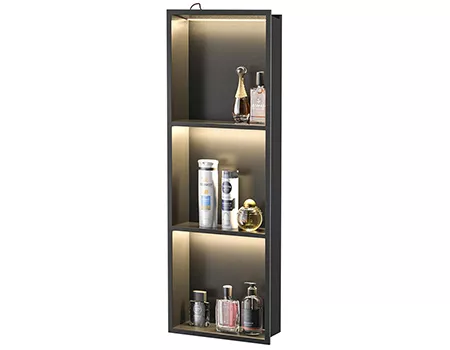
Structural and Material Dynamics Governing Vertical Positioning of Shower Niches in Moisture-Intensive Wall Assemblies
Introduction
The vertical positioning of shower niches within moisture-exposed wall assemblies is a critical engineering decision that directly impacts the durability and waterproofing effectiveness of bathroom installations. In high-humidity bathroom environments, the interaction between water exposure, material properties, and structural forces creates complex conditions that influence the long-term performance of niches. Selecting an optimal height is not merely an aesthetic or ergonomic choice; it governs how mechanical stresses and moisture ingress affect waterproof membranes and substrates, particularly influencing the risk of waterproof layer delamination. Understanding these interrelated factors is essential for designing robust shower niches that maintain sealing integrity and structural soundness throughout their service life. This article explores the mechanical principles, material behaviors, failure modes, and validation methods relevant to vertical niche placement, drawing on field experience and standardized testing protocols.
Mechanical Principles & Material Behavior
A shower niche introduces a recess within the wall assembly, typically constructed from cementitious backer boards overlaid with polymer-modified waterproof membranes and finished with tile or stone surfaces. This geometric discontinuity alters the continuous load path and waterproof barrier, creating localized zones of mechanical and environmental stress that vary with vertical location.
At lower elevations near the shower floor, niches are exposed to standing water and sustained hydrostatic pressure. This condition imposes continuous moisture load on the membrane-substrate interface, generating osmotic forces and swelling tendencies in the substrate. Waterproof membranes in this zone must possess high adhesion strength and elasticity to accommodate substrate dimensional changes without bond failure. Polymer-modified membranes with sufficient toughness and elongation capacity help mitigate cracking or debonding under persistent moisture exposure. Failure to maintain adhesion here facilitates water penetration, leading to substrate saturation, swelling, and progressive mechanical degradation.
Conversely, niches positioned closer to the showerhead encounter dynamic water spray, which subjects the membrane surface to cyclic mechanical impacts and flexural stresses. These repetitive forces induce surface abrasion and fatigue microcracking, gradually compromising membrane integrity. Here, membrane tensile strength and elongation at break become critical parameters, enabling the material to endure repeated flexing without delamination.
The cementitious backer board substrate must retain dimensional stability and load-bearing capacity despite exposure to moisture and mechanical stresses. Although engineered for water resistance, these substrates remain vulnerable to swelling and stiffness reduction if waterproofing fails. Mechanical compatibility between membrane and substrate—including matched coefficients of thermal expansion and moisture-induced dimensional changes—is essential to minimize interfacial stresses that can precipitate failure.
Structurally, the niche interrupts the wall’s continuous load path. Lower niches bear compressive stresses from water weight and saturated substrates, increasing the risk of substrate deformation and cracking. Higher niches experience tensile and shear stresses due to wall deflection from user contact or thermal expansion. The interplay between these mechanical forces and material properties dictates the assembly’s resilience and informs the selection of an optimal niche height that balances waterproofing integrity with structural demands.
Failure Modes
Primary Failure
Waterproof layer delamination remains the predominant failure mode associated with the vertical placement of shower niches. This failure involves the breakdown of the adhesive bond between the waterproof membrane and substrate, often initiating at stress concentration zones created by the niche’s geometry and height. Excessive bending, tensile stretching, or impact loading can induce microcracks in the membrane, undermining adhesion.
In high-humidity bathroom environments, cyclic moisture exposure and temperature fluctuations exacerbate delamination. Niches near the shower floor endure prolonged water contact, increasing hydrostatic pressure and osmotic stress on the membrane, which accelerates bond degradation. Niches near the showerhead are subjected to repeated mechanical impacts from water jets, causing fatigue damage and surface abrasion. Once delamination initiates, water penetrates the substrate, promoting mold growth, substrate softening, and structural weakening.
Secondary Failure
Secondary failures commonly manifest as substrate cracking and tile debonding adjacent to the niche. These arise from localized overstressing when the niche height induces excessive mechanical loads on the substrate. Differential movement between the niche frame and surrounding wall can generate microfractures in cementitious backer boards. Following membrane failure, moisture ingress further reduces substrate stiffness and adhesion capacity.
Tile adhesive failure often results from substrate deformation or moisture-induced degradation, leading to loosening or detachment of tiles. These secondary failures exacerbate the initial waterproofing breach, accelerating overall system degradation, increasing maintenance demands, and potentially compromising user safety.
Environmental Effects
The high-humidity bathroom environment intensifies failure progression through chemical and physical mechanisms. Polymer-based waterproof membranes undergo hydrolytic degradation and plasticizer migration under continuous moisture and elevated temperatures, which diminish elasticity and adhesion over time. Cementitious substrates experience cyclic swelling and shrinkage due to wet-dry cycles, imposing repeated mechanical stresses on the waterproof interface.
Vertical niche position modulates these environmental effects locally. Lower niches are subjected to standing water and persistently saturated conditions, hastening osmotic and hydrolytic membrane damage. Upper niches encounter direct water spray, causing mechanical erosion and surface abrasion that compromise membrane continuity. These environmental stressors interact synergistically with mechanical loads, determining the onset and severity of failure modes.
Testing Standards & Validation
Ensuring the durability of shower niches in high-humidity bathroom environments requires rigorous testing protocols that replicate the combined mechanical and environmental stresses encountered in service. The SGS Building Products Testing & Certification program provides standardized methods to evaluate waterproof membranes and assemblies under cyclic moisture exposure, thermal variations, and mechanical loading.
Testing procedures typically involve accelerated aging simulations through repeated immersion and drying cycles, mimicking long-term exposure to moisture fluctuations. Hydrostatic pressure tests assess membrane resistance to water penetration under sustained load, which is particularly critical for niches near the shower floor where standing water accumulates. Adhesion strength tests quantify the bond between waterproof membranes and substrates under tensile and shear stresses, measuring resistance to delamination.
Mechanical fatigue testing applies cyclic loads to simulate stresses from wall deflection and user interaction, evaluating structural robustness. Specimens incorporating niches at varying heights are examined to identify critical thresholds where waterproof layer delamination initiates or substrate load capacity diminishes.
Microscopic analysis of failure interfaces and moisture ingress pathways complements mechanical testing, enabling correlation between laboratory results and field observations. This comprehensive validation framework informs engineering guidelines on optimal niche placement, waterproof detailing, and material selection to mitigate failure risks in wet wall assemblies.
Application & Integration
Selecting the vertical position of a shower niche requires balancing ergonomic needs with waterproofing and structural performance criteria. Empirical engineering data and SGS testing outcomes indicate that mid-wall placement—approximately 900 to 1200 millimeters above the shower floor—provides an optimal compromise. This height reduces exposure to standing water and direct spray impact, minimizing hydrostatic and mechanical stresses on waterproof membranes.
Installation practices must emphasize preserving waterproof layer continuity around the niche. This includes overlapping membranes with sufficient lap lengths, sealing corners with flexible waterproofing compounds, and ensuring substrate flatness to prevent membrane tension, wrinkles, or voids that could initiate failure.
Structural reinforcement of the niche frame, using corrosion-resistant metal or polymer supports, distributes loads evenly and mitigates substrate deformation and stress concentrations. Precise integration with wall studs and backer boards prevents weak points vulnerable to moisture ingress.
Material selection for waterproof membranes should prioritize flexibility, adhesion retention under cyclic humidity and temperature variations, and compatibility with tile adhesives to prevent interface failures. Field experience confirms that combining appropriate niche height selection with meticulous waterproof detailing and structural reinforcement significantly enhances the durability and reliability of shower niches in wet wall systems.
Vertical positioning of shower niches exerts a significant influence on waterproof membrane performance and structural behavior within high-humidity bathroom environments. Waterproof layer delamination remains the dominant failure mode linked to niche height, driven by mechanical strain and moisture exposure patterns, while secondary substrate and tile failures often compound system degradation.
Adherence to SGS Building Products Testing & Certification standards ensures that niche designs undergo rigorous validation under realistic service conditions. From an engineering perspective, the long-term reliability of shower niche height depends on selecting materials with proven adhesion and flexibility, maintaining waterproofing continuity, and validating designs through comprehensive testing. Incorporating environmental factors characteristic of high-humidity bathroom environments into design decisions is essential to preserving waterproof sealing integrity and structural performance throughout the operational lifespan of wet wall bathroom systems.
This analysis integrates practical insights from bathroom accessories engineering, combining field experience with compliance to SGS testing protocols to manage failure risks associated with shower niche height. Engineering teams responsible for niche design will find that robust solutions explicitly consider environmental influences, document performance evidence aligned with SGS standards, and maintain traceable validation records consistent with independent certification and regulatory expectations.
This analysis was reviewed by a Senior Bathroom Engineer with practical field experience under high-humidity bathroom environment operating conditions, with validation focused on waterproof layer delamination in accordance with SGS Building Products Testing & Certification compliance requirements.
In practical field applications, engineers treating shower niche height as a performance-critical interface typically combine finite-life fatigue predictions, scheduled inspection intervals, and conformance to SGS Building Products Testing & Certification and recognized third-party plumbing and sanitaryware laboratory reports to keep risk within acceptable limits under high-humidity bathroom environment loading profiles.