
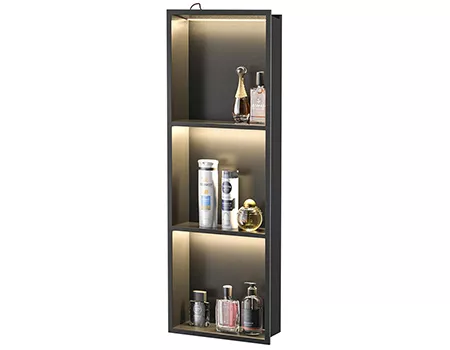
Hidden Gem Recessed Wall Niche Insert Analysis
Reference Standard: Relevant material and performance testing standards include ISO 9001 quality management, stainless steel passivation principles such as ASTM A967/A967M, and project-specific wet-area installation validation.
Short Answer
A recessed wall niche insert looks simple after installation, yet its real performance depends on what happens before it is tiled into the wall. The catalog confirms a sanitary product range that includes stainless steel shower niches, a broader bathroom accessory material route covering stainless steel, plastic, rubber, iron, and brass, and factory raw-material capability around SS304 / SS316 / ABS / PVC. It also records laser cutting, bending, welding, brushing, burr removal, surface treatment, export-standard packing, and OEM/ODM customization. Those data points are useful, but they do not prove a specific niche size, wall-opening tolerance, sheet thickness, waterproof class, load capacity, or fixing method. That distinction is the hidden gem of this product category: the buyer must read the niche not only as a storage box, but as a controlled interface inside a wet wall.

From Wall Opening to Finished Tile Line: A Boundary Object, Not Just a Storage Box
A recessed shower niche insert sits in a more complex position than a visible shelf. It interrupts a wall, approaches the waterproofing layer, meets tile adhesive and grout, and creates multiple edges where water, cleaning residue, and thermal movement can concentrate. The catalog supports the product family by listing Shower Niches and stainless steel shower niches within the sanitary accessory range used in the shower room. It also indicates OEM/ODM order capability, which matters because niche dimensions and edge structures are often project-dependent rather than universal.
The key limitation is equally important: the catalog does not publish a dedicated opening size, installation depth, flange width, tile-line tolerance, shelf load rating, or waterproofing detail for this exact recessed wall niche insert. A professional buyer should treat those missing values as site variables, not as assumptions. If the wall cavity is cut too large, the edge gap can become a sealant-dependent weak point. If the niche box projects too far forward, the finished tile plane may not align. If it sits too deep, the front edge can form a small ledge where water and residue remain after use.
Edge extreme scenario model: imagine a shower wall exposed to daily water spray, warm vapor, shampoo surfactants, and repeated temperature changes between cold ambient air and hot water use. At the early stage, the visible niche may appear stable because the metal box holds its shape. At the middle stage, micro-gaps around the tile line may collect residue, especially if the sealant bead is thin or uneven. At the stress stage, repeated wet-dry cycling can expose any discontinuity between the wall waterproofing layer and the niche edge. The failure is not caused by stainless steel alone; it comes from the interface between different systems.
A useful comparison is a surface-mounted bathroom shelf versus a recessed niche. A surface-mounted shelf loads screws and anchors directly; its risk is mostly pull-out, corrosion around fasteners, and cleaning access. A recessed niche transfers risk into the wall assembly. Its success depends on alignment, perimeter sealing, internal corner geometry, and how cleanly the box sits against the finished tile plane. That is why a recessed wall niche insert should be inspected more like a boundary object than a decorative accessory.
| Evaluation Point | Surface-Mounted Shelf | Recessed Wall Niche Insert | Buyer Action |
|---|---|---|---|
| Main interface | Wall anchor | Wall opening and tile edge | Request installation section drawing |
| Water exposure | Visible surface | Surface plus perimeter joint | Confirm waterproofing responsibility |
| Alignment risk | Bracket level | Box depth and tile plane | Ask for depth and flange tolerance |
| Hidden failure path | Screw hole | Wall cavity edge | Validate sample installation |
| Catalog proof needed | Load rating | Opening detail and edge geometry | Request model-level drawing |
The Hidden Sequence Before Use: Cutting, Bending, Welding, Surface Recovery and Packing as One Risk Chain
The catalog shows a factory sequence that matters for a metal niche: laser cutting machine for customized order, bending machine, welding machine / laser welding machine, remove burrs, make brushed surface, surface treatment by ourself, and packing as per export standard. These are not isolated promotional points. For a recessed niche, each step transfers quality into the next.
Laser cutting sets the first boundary. If a sheet edge is cut with inconsistent heat marks or dimensional drift, the bending line may not form a clean box. Bending then controls the relationship between back wall, side walls, shelf plane, and front lip. A small angle error at this stage can become visible only after the niche is inserted into the wall. Welding, especially around internal corners or rear seams, adds heat. Heat can create local discoloration, distortion, or stress marks if the following surface recovery is incomplete. Burr removal affects handling safety and tile-adjacent edges. Brushing creates a directional surface that can hide minor marks but can also reveal inconsistent polishing if the grain direction changes across planes. Packing controls whether the product arrives with corners still square.

Edge extreme scenario model: take a thin-walled stainless niche that has passed visual inspection at the factory but is packed with insufficient edge protection. During export movement, carton compression can push one front corner inward by a small amount. The installer may still force the box into the wall opening. After tiling, the visible front line appears slightly uneven. Water does not need a large gap to become a problem; it only needs a repeated path at the perimeter. The original trigger was not installation alone, but the chain from sheet cutting to bending rigidity to packing protection.
A cross-dimensional comparison helps clarify this risk. A drain body is often judged by outlet geometry, cover fit, and leakage testing. A recessed wall niche insert is judged by planar squareness, corner stability, surface safety, and finished-wall integration. The catalog mentions air leakage testing for drains, but that should not be transferred to the shower niche unless a model-specific test is documented. The correct logic is to use confirmed factory capability as process evidence, then ask for niche-specific inspection records.
Manufacturing risk model: for a recessed niche, the most sensitive sequence is not one machine or one certificate. It is the continuity of dimensional control from cutting to bending, welding, surface recovery, final cleaning, edge protection, and export packing.
KEY TAKEAWAYS
- A small front-edge deformation can become visible only after the tile plane is complete.
- Burrs and sharp edges are early warning signs of weak finishing control.
- Inconsistent brushing or yellow marks may indicate incomplete post-weld surface recovery.
When Stainless Steel Meets Shower Chemistry: Surface Stability Without Inventing a Grade Promise
The catalog supports stainless steel shower niche capability and lists raw-material capability including SS304 and SS316, but it does not prove that every recessed wall niche insert is made from a specific grade. That distinction prevents overclaiming. A responsible article should not promise marine-grade corrosion resistance, salt-spray performance, or a fixed stainless grade unless the model-level specification states it.
In a shower environment, stainless steel performance depends on surface condition as much as alloy identity. Stainless steel relies on a passive chromium-rich surface film. If welding leaves heat tint, if oil remains after forming, or if scratches break the local surface film, humid air and cleaning chemicals can attack weak spots faster. The catalog records a 2000 square meter surface treatment workshop including pickling, electrical polishing, and passivation. It also explains that drains after welding can be dirty with oil, scratches, and yellow spots, and that pickling can clean the surface. Even though the note is written around drains, the underlying stainless steel surface logic is relevant to welded or formed bathroom metal accessories when the same factory treatment route is used.
Chemical pressure timeline model: in the initial phase, a newly installed niche faces mostly water vapor and mild soap residue. The surface may remain bright if it has been properly cleaned and protected. In the middle phase, repeated contact with shampoo, body wash, acidic cleaners, or chlorinated products can leave film at internal corners. If the brushed grain holds residue, spotting can appear in low-drainage zones. In the high-stress phase, aggressive cleaner misuse or trapped residue may create localized dullness or point marks, especially around weld zones or scratched areas. This does not mean stainless steel has failed as a material; it means the passive surface has been placed under chemical and moisture stress.
The comparison test that buyers should use is not “stainless versus non-stainless” in a broad sense. A better test is untreated welded surface versus cleaned and passivated welded surface under the same wet residue cycle. The first sample will usually show visible discoloration faster because heat tint and contamination create active sites. The second sample should show more stable appearance if treatment is consistent. The buyer still needs the supplier to document which treatment is applied to the actual niche model.

What the Buyer Still Cannot Confirm From the Catalog: Opening Tolerance, Wall Fixing and Load Behavior
The catalog gives a useful factory and product-family picture, yet a buyer still cannot confirm several site-critical variables from it. It does not provide model-level drawings, installation photos, load test records, wall fixing method, opening tolerance, shelf load rating, or waterproof installation detail for the recessed wall niche insert. Those missing items should guide the inquiry.
The first solution is to request a dimensioned drawing before sample approval. The drawing should include outer box size, visible front edge size, inner usable depth, corner radius if any, wall-opening recommendation, and tile-finish relationship. The execution protocol is simple but strict: do not approve a sample based only on a front photo. Ask the supplier to mark all edge dimensions and confirm whether the niche is intended to sit flush, proud, or recessed relative to the finished tile plane. After this, the expected material behavior becomes more predictable because bending and welding tolerances can be checked against the drawing. The hidden cost is that custom drawings may slow quotation, but it reduces installation disputes later.
The second solution is to validate edge safety and flatness. The catalog confirms burr removal and brushed surface capability. Inspection should include gloved hand edge checks, visual checks under angled light, and a flat-plane check across the front lip. After a proper edge process, the product should show safer handling behavior and fewer sharp-contact points. The side effect is that aggressive deburring can soften visual edges or disturb the brushed finish, so inspection criteria should define both safety and appearance.
The third solution is to ask for surface treatment records when the niche is stainless steel. If the process includes pickling, electrical polishing, or passivation, the supplier should clarify which treatment applies to the actual product and finish. The expected material evolution is a cleaner, more stable stainless surface with reduced post-weld contamination. The cost risk is overprocessing: an unsuitable treatment sequence may alter appearance, especially on decorative brushed surfaces. This is why approval samples and finish references are important.
The fourth solution is to validate packing as part of quality control. A niche can leave the factory square and arrive deformed if front corners or edges are poorly protected. The execution protocol should include carton review, edge guards if required, separation between units, and photo confirmation before shipment. The expected result is lower corner deformation and fewer surface scratches during export movement. The side effect is higher packaging volume, but it is cheaper than rejecting installed or tile-adjacent products.
| Variable | Practical Check | Expected Result | Caution |
|---|---|---|---|
| Opening size | Compare sample to drawing | Better wall-fit predictability | Do not infer size from photo |
| Front lip flatness | Plane and diagonal check | Cleaner tile-line alignment | Check after packing, not only before |
| Edge finish | Glove and visual inspection | Lower handling scratch risk | Avoid over-polishing visible edges |
| Weld area | Angled-light surface review | Fewer yellow marks and stains | Do not assume passivation without record |
| Packing | Corner protection review | Less transit deformation | Add export cartons for bulk orders |
| Installation proof | Mock-up wall sample | Clearer waterproof responsibility | Site method still needs contractor control |
PRO-TIP / CHECKLIST
- Request a model-level drawing before confirming a bulk order.
- Ask whether the quoted item uses stainless steel, SS304, SS316, or another specified route.
- Check the front lip for flatness, diagonal consistency, and visible distortion.
- Inspect all exposed edges for burrs before installation.
- Confirm whether pickling, electrical polishing, or passivation applies to the actual finish.
- Ask for packing photos showing edge protection and unit separation.
- Do not assume waterproof rating unless the supplier provides model-specific evidence.
- Validate one sample in a mock wall before approving project-scale use.
Buyers can also use Mondeway sanitary product information as a starting point when discussing shower niche capability, OEM/ODM customization, and wet-area accessory supply. The commercial discussion should stay evidence-based: confirmed factory capability is valuable, but installation tolerance and load behavior require product-level documents.
Frequently Asked Questions (FAQ)
How to waterproof a bathroom niche?
A bathroom niche should be waterproofed as part of the wall system, not only as a metal box. The wall opening, back surface, side edges, tile adhesive, sealant, and finished grout line must form a continuous barrier. Request an installation section drawing before approval.
What size of pipe for shower drain?
Pipe size depends on local plumbing code, drain outlet design, and project flow requirements. A recessed wall niche insert is not a drain component, so its catalog information cannot define pipe size. Confirm drain sizing with the drainage product drawing and local code.
How to eliminate bathroom drain odor?
Bathroom drain odor usually comes from trap problems, biofilm, venting issues, or dry seals. A wall niche does not control drain odor. If odor appears near the shower area, inspect the drain trap, cleaning residue, and ventilation before blaming nearby stainless accessories.
What to do if shower drain is clogged?
Remove the cover if the drain design allows it, clear hair and residue mechanically, and avoid aggressive chemicals unless the drain material permits them. This issue is separate from recessed niche selection, though both products should be assessed within the same wet-area maintenance plan.
Can a recessed shower niche rust?
Stainless steel can show staining, dullness, or localized marks if the surface is contaminated, scratched, or exposed to harsh cleaners. The catalog confirms stainless steel shower niche capability and surface treatment resources, but the exact grade and treatment must be confirmed for the model.
Does a wall niche need a load test?
A load test is useful when the niche will hold heavy bottles or project-specific storage loads. The catalog does not provide a shelf load rating for the recessed wall niche insert, so buyers should request sample testing or a written load recommendation.
Can tile-ready shower niche claims be accepted without drawings?
No. A tile-ready claim should be supported by installation drawings, wall-opening guidance, front-edge geometry, and waterproofing detail. Without these records, the buyer cannot confirm how the niche aligns with the finished tile plane.