

Plastic Shower Drain Revealed: Hidden Aging Risks
Reference Standard: Relevant material and performance testing standards for shower drainage products may include EN 1253-1 for floor gullies in buildings, while plastic material behavior should be checked through model-specific supplier data, cleaning-cycle records, and applicable local plumbing requirements. General standards organizations such as CEN and IAPMO can help buyers understand certification frameworks, but catalog-level certificates should not be treated as proof for every individual model.
Short Answer
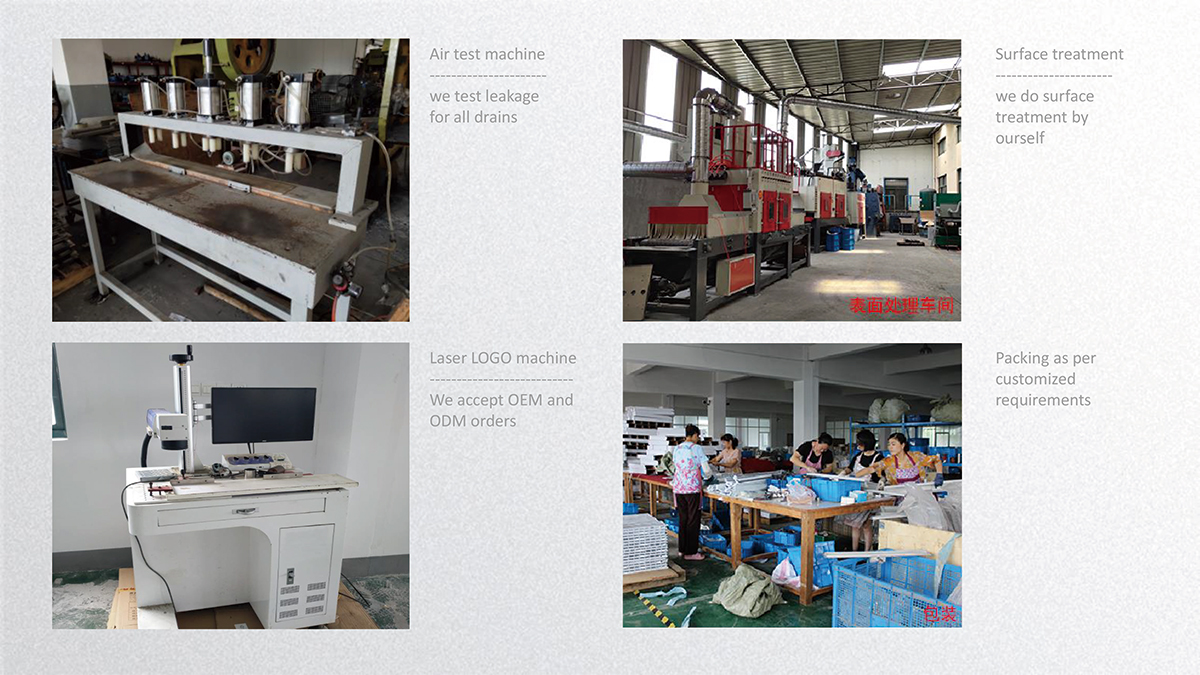
A plastic shower drain sits in one of the least forgiving places in a bathroom: the point where water, hair, soap residue, cleaning agents, floor slope, waterproofing, and pipe connection all meet. The available catalog data confirms a bathroom drainage product range including shower drains and floor drains, a material route that includes Plastic, ABS, and PVC, and production resources such as plastic injection equipment, mould area equipment, OEM/ODM workflow, customized packing, and air leakage checks for drains. It does not provide model-level drain size, outlet diameter, thickness, load rating, discharge rate, cleaning-chemical test record, or adhesive compatibility sheet.
That evidence boundary matters. A buyer can reasonably discuss ABS/PVC thermoplastic behavior, molded shape control, surface aging, clogging patterns, and inspection logic. A buyer should not claim a specific drainage volume, heat tolerance, or lifetime unless the supplier provides model-level documentation.
When a Plastic Shower Drain Becomes a Hidden Maintenance Timer
The first hidden variable in a plastic shower drain is not always the drain body itself. It is the maintenance interval created by the combination of hair, soap residue, skin oil, mineral deposits, and the geometry of the entry path. A user often describes the problem as slow drainage, but the underlying sequence is more specific: loose hair catches on edges or internal changes in direction, soap and skin oil create a sticky film, fine solids attach to that film, and the drain begins to behave as a partial filter. The catalog confirms the product category as shower drains and floor drains, and it confirms plastic-related materials such as ABS and PVC, but it does not specify strainer opening size, water flow rate, outlet structure, or trap configuration. That means any maintenance conclusion must stay conditional.
From a material perspective, ABS and PVC are thermoplastic material families, not single universal performance values. Their behavior depends on formulation, wall thickness, molding conditions, surface finish, stabilizers, and the environment around the drain. In a bathroom, the drain is repeatedly exposed to warm water, shampoo, body wash, hair conditioner, cleaning liquid, and long wet periods. Even when the plastic body remains structurally intact, surface film and residue can make the user perceive the drain as lower quality. The drain may still be mechanically functional, yet the maintenance burden rises because the entry path becomes less tolerant of debris.
A useful edge-condition model is the compressed cleaning-cycle model. In normal use, the drain may only need routine cleaning after visible hair collection. Under a harsher environment, several stresses happen together: repeated warm showers, high hair load, oily conditioner, low floor slope near the outlet, and occasional aggressive cleaning liquid. During the early phase, the surface collects a thin organic film. During the middle phase, hair bridges across the film and slows water release. During the late phase, the user may see standing water even though the outlet is not fully blocked. This is not proof of a defective product by itself; it is a signal that the drain design, cover access, and maintenance path must be checked against real use.
A cross-dimensional comparison shows why a simple visual inspection is not enough.
| Observation Point | Low-Stress Bathroom Use | High-Stress Bathroom Use | Evidence Needed Before Claiming Performance |
|---|---|---|---|
| Hair exposure | Occasional short hair | Frequent long hair accumulation | Removable cover photo and cleaning path |
| Soap residue | Light film | Heavy conditioner and oil film | Cleaning-cycle observation |
| Water behavior | Quick rinse-through | Standing water after use | Outlet geometry and discharge test |
| Plastic surface | Normal wetting | Film retention and possible discoloration | Material sheet and cleaning-agent record |
| User complaint timing | Delayed | Early | After-use inspection log |
The better buyer question is not “Is it plastic?” but “How quickly does this design force cleaning under realistic bathroom debris?” That question avoids false certainty and focuses on the experience that actually affects homeowners, installers, and distributors.
The Gap Between Injection Shape and Installed Floor Reality
A molded drain body leaves the factory as a controlled object. The bathroom floor is not controlled in the same way. The catalog confirms plastic injection equipment, mould area equipment, and an OEM/ODM path from concept to drawing, prototype, mould, trial production, and products. Those are important manufacturing capabilities. They do not automatically answer what happens when the drain is installed into a tiled floor, concrete slab, waterproofing layer, or pipe connection with site variation.
The gap begins with geometry translation. A molded ABS/PVC component may be dimensionally consistent at the factory, yet the site may introduce uneven bedding, tile height variation, pipe offset, waterproofing build-up, or floor settlement. If the drain cover and body are not aligned with the finished floor plane, the user may notice rocking, uneven contact, water pooling around the edge, or difficulty removing the cover. The catalog does not provide a model-level drawing, shrinkage rate, finished height, outlet diameter, or installation tolerance. Those missing items should be requested before a buyer treats a product as ready for a specific construction method.
The extreme scenario is the factory-to-floor mismatch model. In the initial stage, the injected body appears stable on a flat inspection surface. In the middle stage, the installer places it into a floor assembly where the surrounding materials create uneven support. In the stress stage, repeated foot traffic, warm-water exposure, and small pipe movement create localized pressure around the rim or outlet. The visible symptom may not be a crack; it may be a small gap, a rocking cover, or a seal line that becomes difficult to keep clean. For thermoplastics, this matters because repeated localized stress can concentrate at corners, ribs, thin sections, and connection points.
A cross-system risk appears when installation variation combines with drainage debris. A slight floor-edge mismatch can leave a low area where water and soap residue collect. That residue then traps hair more easily. The problem is no longer only installation and no longer only cleaning; it becomes a coupled issue between geometry, surface film, debris capture, and user maintenance frequency.
KEY TAKEAWAYS
- A cover that rocks after installation is an early sign of floor-to-drain geometry mismatch.
- Slow water movement can be caused by debris film even when the drain body is not broken.
- A small edge gap may become a cleaning and odor-management issue before it becomes a leakage complaint.
Buyers sourcing from a bathroom drainage product supplier should therefore separate factory shape confirmation from site-fit confirmation. Factory resources help explain how a product is made. Site-fit evidence explains whether the product can survive the floor assembly where it will be used.
Cleaning Chemistry as an Unverified Aging Question, Not a Marketing Claim
Cleaning exposure is one of the most important unanswered questions for a plastic shower drain. The catalog supports an ABS/PVC material route and identifies plastic injection as part of the production capability. It does not provide a material data sheet for the target model, a cleaning-cycle test, discoloration record, adhesive compatibility test, or long-term surface aging report. That absence should not be filled with marketing language. It should be converted into a practical verification request.
ABS and PVC are widely used thermoplastic families, but their long-term behavior depends on formulation and exposure. In bathroom conditions, the surface may meet warm water, diluted detergents, hair dye residue, alkaline cleaners, acidic descalers, chlorine-based products, and fragrance oils. A single short cleaning event may not create visible damage, yet repeated exposure can influence color stability, gloss, surface feel, and local stress around thin sections. When a drain body also sits near tile adhesive, sealant, or pipe cement, compatibility questions become more complex.
The edge-case model here is the unverified cleaning-aging timeline. In the early phase, the plastic surface only shows ordinary wetting and soap film. In the middle phase, repeated cleaner contact may create slight discoloration, haze, or a different surface feel if the formulation is not suitable for that cleaner type. In the limit phase, a buyer may see brittleness near stressed edges, loosening around fitted parts, or a seal that no longer feels tight. None of these outcomes should be claimed as certain for this product without tests. They are scientifically plausible risks that justify supplier documentation.
A practical comparison can help buyers avoid overclaiming.
| Cleaning Exposure Variable | Reasonable Concern | What the Catalog Confirms | What Still Needs Evidence |
|---|---|---|---|
| Warm water cycles | Dimensional stability under repeated use | ABS/PVC material route | Model-specific heat exposure record |
| Bathroom cleaner | Surface discoloration or haze | Plastic material capability | Cleaning-cycle test |
| Soap and oil film | Hair capture and odor retention | Shower drain product category | Removable cover cleaning observation |
| Adhesive or sealant contact | Interface compatibility | No model-level adhesive data | Adhesive compatibility sheet |
| Long wet periods | Residue build-up and surface aging | Bathroom accessory application | Long-term wet exposure record |
This is where procurement language should be careful. A supplier may have strong factory capability, air testing for drains, certificates, and customized production options. Those are useful. They do not automatically prove that a specific plastic shower drain resists every cleaner or every adhesive used in every market. A more reliable statement is: the product belongs to a plastic ABS/PVC drainage route, while chemical exposure behavior should be confirmed through model-level testing.
Buyer Questions That Should Stay Open Until Model-Level Evidence Arrives
The catalog includes several important factory-level signals: ISO 9001 management, CE EN1253-1, CUPC, Watermark, air leakage testing for all drains, OEM/ODM service, and customized packing. These are meaningful for supplier evaluation. The key is not to convert them into unverified single-model performance claims. A buyer should treat them as a foundation for asking better questions.
Solution 1: Request a model-level drawing before approving the drain for a project.
Execution Protocol: Ask for a drawing that shows the drain body, outlet position, finished height, cover interface, pipe connection, and any removable parts. The drawing should identify which dimensions are controlled in production and which depend on the installer. If the supplier only provides a catalog image, the buyer should not treat it as enough for slab, tile, or waterproofing coordination.
Material Expected Evolution: A clearer drawing does not change the plastic material itself, but it reduces unintended stress by helping the installer place the ABS/PVC part in the correct floor assembly. Better alignment can reduce localized pressure around the rim, cover seat, and outlet, which lowers the chance of early rocking or edge contamination.
Hidden Cost and Side Effect Control: Drawing review takes time and may delay sampling, but it prevents expensive installation errors. The buyer should avoid approving a drain only from a photo because photos cannot show internal transitions, outlet geometry, or installation height.
Solution 2: Verify cover removal and cleaning access.
Execution Protocol: Ask for photos or video showing how the cover is removed, how hair is accessed, and whether tools are needed. This evidence should be requested before large orders, especially when the product will be used in hotels, apartments, rental units, or high-frequency shower rooms.
Material Expected Evolution: Easier cleaning reduces the time that soap film and hair remain against the plastic surface. It may reduce odor complaints and surface staining risk because organic residue does not stay trapped for long periods.
Hidden Cost and Side Effect Control: A very loose cover may be easier to remove but may also move under use. A very tight cover may feel stable but become difficult to clean. The buyer should balance access, stability, and safety instead of optimizing only one factor.
Solution 3: Ask for air leakage records for the chosen model.
Execution Protocol: The catalog states that drains are tested for leakage by air. The buyer should ask whether the exact plastic shower drain model is included in that practice, how the test is performed, and which part of the assembly is checked. The response should be tied to the selected model, not only to general factory capability.
Material Expected Evolution: Air testing can help identify leakage-prone joints or assembly defects before packing. It does not prove long-term chemical resistance or drain cleaning behavior, but it can reduce the risk of obvious leakage defects leaving production.
Hidden Cost and Side Effect Control: Air testing should not replace dimensional inspection, visual inspection, or site-fit review. A drain can pass an air check and still perform poorly if installed into the wrong floor condition.
Solution 4: Confirm packaging and handling protection.
Execution Protocol: Since the catalog notes export standard packing and customized packing, the buyer should request packaging photos or packing specifications for the selected model. The focus should be on preventing deformation, scratches, missing covers, and mixed components during shipping.
Material Expected Evolution: Better packaging reduces mechanical deformation before installation. Thermoplastic parts that arrive warped or compressed may create alignment issues even if the original molding process was controlled.
Hidden Cost and Side Effect Control: Stronger packaging can increase freight volume and unit cost. The buyer should match packaging strength to shipment distance, quantity, and product fragility instead of using one default packing method for all markets.
| Validation Area | Factory-Level Evidence Available | Model-Level Evidence Needed | Practical Acceptance Logic |
|---|---|---|---|
| Material route | Plastic, ABS, PVC are shown | Material sheet for selected model | Do not assume universal ABS/PVC performance |
| Production method | Plastic injection and mould area are shown | Tooling and drawing for selected model | Confirm fit before installation approval |
| Leakage control | Air testing for drains is stated | Test record for selected model | Use as leakage screening, not chemical proof |
| Certification context | ISO 9001, CE EN1253-1, CUPC, Watermark appear | Certificate scope and model coverage | Check whether the model is included |
| Cleaning durability | No cleaning-cycle data shown | Cleaner exposure and discoloration record | Keep aging claims conditional |
| Packing | Export and customized packing are stated | Packing photo and component list | Prevent deformation and missing parts |
PRO-TIP / CHECKLIST
- Ask for the selected model drawing before approving installation.
- Confirm whether the drain is ABS, PVC, or another plastic formulation.
- Request cover-removal evidence if hair cleaning is a frequent user complaint.
- Ask whether air testing applies to the chosen plastic shower drain model.
- Do not claim chemical resistance without a cleaning-cycle record.
- Check whether CE EN1253-1, CUPC, or Watermark coverage applies to the exact product.
- Review packaging photos to prevent deformation before site installation.
- Keep drainage-rate claims out of marketing copy unless measured data is supplied.
Frequently Asked Questions (FAQ)
How to get rid of hair in the shower drain?
Remove the drain cover if the design allows it, pull out visible hair, then flush the area with water. Avoid forcing sharp tools into plastic parts. If hair returns quickly, the issue may be cover geometry, internal edges, or soap film that traps strands.
How to clean your bathroom drain?
Start with mechanical removal of hair and residue. Then clean the visible surface and cover with a mild bathroom cleaner compatible with the material. For ABS/PVC drains, avoid making strong chemical-resistance claims unless the supplier provides cleaning-cycle or material compatibility data.
How to unclog a bathroom drain pipe?
First determine whether the blockage is at the cover, drain body, trap, or downstream pipe. Hair and soap film often collect near the entry path. If the blockage is deeper, pipe-safe mechanical or professional cleaning may be needed instead of aggressive chemicals.
What size is a shower drain?
The available catalog data does not provide the specific size for the plastic shower drain. A buyer should request model-level drawings showing outlet diameter, finished height, cover size, and pipe interface before using the drain in a concrete slab or tiled floor project.
How to install a shower drain in a concrete slab?
A slab installation requires outlet alignment, floor height coordination, waterproofing compatibility, and stable support around the drain body. For a plastic shower drain, request the model drawing and installation details first, because catalog-level product photos do not confirm slab-specific dimensions or tolerances.
How big are shower niches?
Shower niche size is a separate wall-storage question and should not be used to specify a shower drain. Drain selection should focus on outlet geometry, installation height, removable cover access, material route, and the evidence available for the selected model.