
Why linear shower drain outlet orientation selection often leads to flow restriction
Flow restriction and clogging in wet rooms and commercial showers often trace back to layout turns and outlet mismatch rather than the drain body itself. When outlet direction does not align with slab depth, pipe routing, or slope tolerance, installers face compromises that quietly reduce drainage efficiency and increase maintenance pressure over time.
What actually goes wrong when outlet orientation is overlooked
In high-humidity residential and commercial shower environments, linear drains are expected to move large volumes of water quickly while remaining visually discreet. Problems begin when the outlet orientation is treated as a secondary detail. Horizontal outlets forced into tight slab depths may require sharp elbows, while vertical outlets installed without sufficient clearance can compress waterproof layers or distort slope geometry.
The result is rarely immediate failure. More commonly, users notice slower drainage, occasional surface pooling, or a need for more frequent cleaning. These symptoms reflect internal flow restriction caused by misaligned transitions and localized turbulence at the outlet connection.
For contractors and project engineers, these issues translate into callbacks and user complaints. For specifiers, they highlight why outlet orientation should be evaluated early, not adjusted on site.
Horizontal vs vertical outlets in real installations
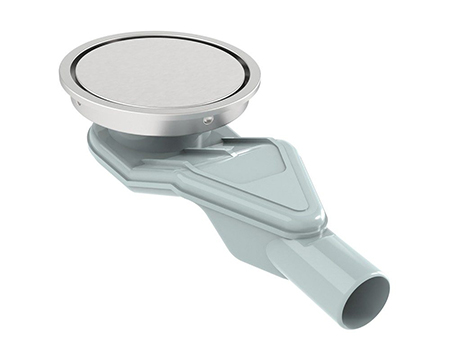
Horizontal outlet linear drains are often selected for renovations or slab-on-grade construction where vertical penetration is limited. When properly aligned, they can deliver smooth flow transitions. However, when space constraints force aggressive directional changes, debris tends to settle at bends, increasing clogging risk.
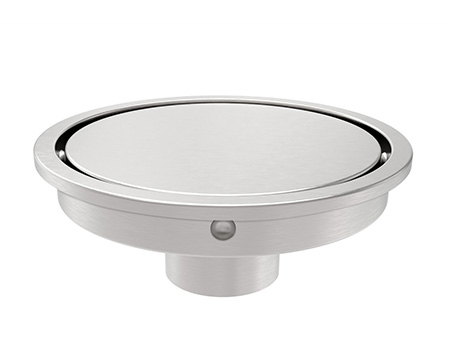
Vertical outlets, by contrast, offer a more direct flow path. They are frequently preferred in new builds or raised-floor systems where depth allows a straight drop. The challenge here is ensuring dimensional accuracy so that waterproof membranes and drain bodies remain unstressed after installation.
Neither orientation is inherently superior. The engineering advantage comes from matching outlet direction to site conditions so that water exits the channel with minimal disturbance.
How misalignment increases clogging and leakage risk
Flow restriction is not just about reduced speed. When water slows at bends or transitions, hair and soap residue are more likely to settle. Over time, this localized buildup narrows the effective cross-section, amplifying the problem.
Installation-induced leakage stress is another consequence. Forcing an outlet to meet a pipe run can introduce tension at seals and joints. In a high-humidity environment, even minor distortions can compromise long-term waterproof integrity.
These risks explain why many professionals reviewing persistent drainage issues eventually trace them back to outlet orientation decisions rather than material quality.
Verification through testing and standards
Outlet orientation decisions should be validated, not assumed. Flow rate tests help confirm that the assembled drain and pipe configuration meets expected discharge capacity. Dimensional accuracy inspection ensures that the outlet aligns with design drawings without forcing adjustments on site.
Water leakage tests provide additional confidence, particularly where horizontal outlets pass close to waterproof layers. In Europe and many international projects, guidance aligned with EN 1253 floor drain performance principles is often referenced to benchmark drainage behavior under realistic conditions.
Material and joint behavior may also be evaluated against broader plumbing test frameworks published by ASTM International, especially in projects with mixed regional requirements.
Outlet orientation as a selection decision, not an afterthought
Choosing outlet direction is part of a broader selection logic that includes channel length, grate design, and maintenance access. Treating it as an isolated detail often leads to compromises elsewhere in the system.
Many specifiers therefore review outlet orientation alongside full system options, using a comprehensive reference such as a linear shower drain buyer guide to compare configurations before finalizing layouts.
This approach reduces the likelihood that installers will need to improvise, and it keeps performance closer to what was originally specified.
Practical signs that orientation may be wrong
Slow surface drainage despite a clean grate, repeated debris accumulation near the outlet, or visible stress at the connection point are all indicators worth investigating. In commercial showers with heavy usage, these signs tend to appear earlier due to higher flow demand.
Addressing them promptly often involves reassessing whether the outlet direction truly matches the available space and downstream pipe routing.
Long-term reliability depends on early alignment
Linear shower drains perform best when outlet orientation supports smooth flow transitions, stable sealing, and accessible maintenance. In high-humidity environments, aligning these factors from the outset does more for reliability than retrofitting solutions later.
When outlet orientation is treated as a core design parameter and verified through flow rate, dimensional, and leakage testing, the engineering advantage of linear drains remains intact while the typical failure modes stay controlled and predictable.
This content is developed based on drainage performance analysis, standardized plumbing test practices such as flow rate and leakage testing, and real-world application scenarios in high-humidity residential and commercial shower environments. Evaluation methods reflect publicly available standards and typical project verification procedures used to assess long-term reliability.