
Why linear drain length changes water collection efficiency in shower installations
In high-humidity shower environments, surface water does not fail because drains are absent, but because water is not intercepted fast enough across the floor area where it actually spreads. In commercial and residential shower projects, many engineers and contractors eventually notice that extending or shortening a linear drain subtly changes how quickly surface water disappears, how often pooling occurs, and how forgiving the installation feels during peak flow moments.
What “water collection efficiency” really means for linear drains
Water collection efficiency in a shower is not only about total flow capacity. It describes how effectively a drain captures water across the wet surface before it can migrate, accumulate, or overwhelm local slopes. For linear drains, length directly defines the inlet footprint exposed to flowing water. A longer inlet does not magically increase outlet diameter, but it widens the capture zone, distributing inflow along a larger edge.
When designers focus only on outlet size or nominal flow ratings, they often underestimate how floor geometry and spray patterns interact with inlet length. In practice, the drain length becomes a hydraulic interface between surface runoff and the piping system.
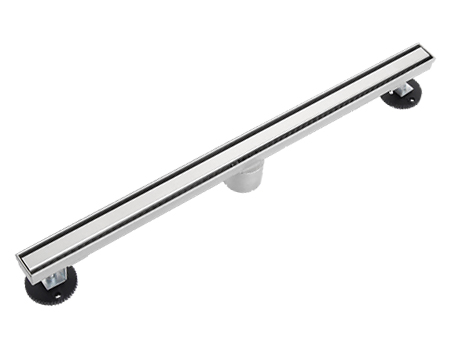
In wide showers, especially those designed with single-direction slopes, water often converges unevenly. Shorter drains concentrate intake at one point, while longer drains intercept flow earlier, reducing the distance water must travel across tile joints and surface imperfections.
This is why length selection becomes a practical decision variable rather than a purely aesthetic one.
How insufficient drain length leads to localized pooling
Localized pooling is the most common failure symptom associated with poorly matched linear drain length. It usually appears not as catastrophic flooding, but as persistent shallow water near corners, benches, or along the far edge of the shower.
This behavior emerges when the inflow rate from multiple spray sources exceeds what a short inlet can intercept at the surface level. Water is technically able to drain, but only after spreading laterally. Over time, this creates user complaints, longer dry times, and increased maintenance sensitivity.
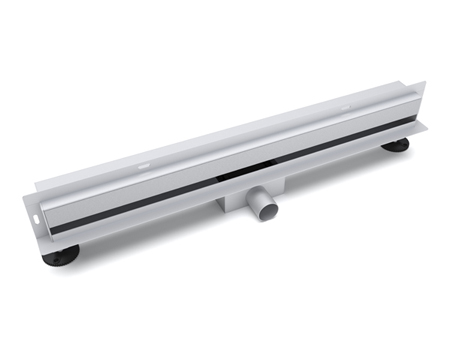
Importantly, this is not always an installation error. Even with correct slope and alignment, a drain that is too short relative to shower width reduces tolerance to real-world use conditions, such as simultaneous overhead and hand shower operation.
Understanding this mechanism helps specifiers move beyond blaming workmanship and toward more resilient design choices.
Drain length versus flow distribution across the shower floor
Linear drains behave differently from point drains because they collect water along a line rather than at a single node. As drain length increases, the average surface flow path shortens. This lowers the hydraulic load on any single segment of tile or grout line.
In practical terms, longer drains smooth out inflow peaks. Instead of water racing toward one point, it enters the drain gradually along its length. This reduces visible turbulence, minimizes splash-back, and makes the system feel more stable during high-use periods.
These effects become especially noticeable in commercial showers where use is frequent and inconsistent. In residential settings, they translate into better tolerance when users modify spray angles or install higher-flow fixtures later.
Installation realities that amplify the impact of drain length
Real floors are never perfectly flat, and real slopes are rarely ideal across their entire span. Minor deviations, tile thickness variation, and substrate movement all interact with how water travels.
Longer linear drains effectively average out these imperfections. By providing multiple entry points for water, they reduce reliance on any single “perfect” slope line. Short drains, by contrast, magnify small errors because all water must converge precisely.
This is one reason contractors often report fewer callbacks when longer drains are specified in challenging layouts, such as barrier-free or curbless showers.
How engineers evaluate drain length performance in practice
Performance validation does not rely on appearance alone. Flow rate tests and surface water collection observations are commonly used to assess how a drain performs under controlled inflow conditions. These tests focus on how quickly water clears the surface, not just whether the outlet can pass a given volume.
In Europe, floor drain behavior is often evaluated in reference to standards such as EN 1253 floor drain requirements, which emphasize functional drainage under realistic conditions. Broader material and plumbing performance considerations are also aligned with guidance from organizations like ASTM International.
While these references do not mandate specific drain lengths, they frame how engineers interpret test results. A longer inlet that consistently clears surface water faster under identical inflow conditions is objectively performing better at the collection interface.
Choosing drain length as part of a broader selection decision
Drain length should never be chosen in isolation. It interacts with outlet orientation, floor slope strategy, and maintenance access. However, treating length as a purely visual choice is one of the most common decision shortcuts that leads to underperformance.
For teams comparing options, it often helps to step back and review the full set of selection considerations for linear drains, including outlet type, placement, and validation methods. A more comprehensive reference can be found in the Linear Drain Buyer Guide for Commercial and Residential Shower Projects, which connects length decisions with broader system behavior.
Practical guidance for avoiding pooling without oversizing
Oversizing drain length without regard to layout can introduce unnecessary cost or installation complexity. The goal is not to maximize length, but to match it to the effective shower width and flow pattern.
In single-wall installations, drains that span most of the wet edge provide the most forgiving performance. In center-floor layouts, splitting length across strategic positions can be more effective than extending a single segment.
These choices reduce the likelihood that localized pooling will appear later, even if fixtures are upgraded or usage patterns change.
Standards, testing, and long-term reliability
Reliable drainage performance depends on repeatable validation rather than assumptions. Flow rate testing and surface water observation under controlled conditions remain the most relevant tools for assessing whether a chosen drain length will perform as expected in a high-humidity shower environment.
When these tests are interpreted alongside established drainage standards and real installation constraints, drain length becomes a controllable design parameter rather than a guess. This approach supports long-term reliability while keeping maintenance demands predictable.
This content is developed based on material performance analysis, standardized drainage testing references, and real-world shower application scenarios. Observations related to surface water behavior are aligned with common industry testing practices and documented performance criteria used in commercial and residential wet-area installations.