
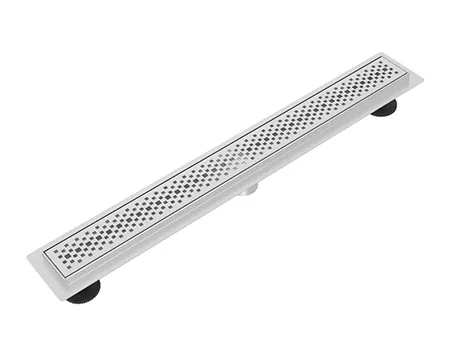
Engineering Forensic Audit: Effluence Management Systems
Authored by: Senior Architectural Hardware Consultant | System ID: 045-Reverse-Forensic
Evaluating Fenestration Occlusion and sub-surface drainage requires an analytical pivot toward Reverse Forensic Auditing. Most procurement officers erroneously prioritise aesthetic luster over metallurgical lattice stability during selection.
Low-tier hardware exhibits rapid Stress Corrosion Cracking (SCC) when exposed to anaerobic microbial proliferation. This metallurgical decay occurs due to insufficient Chromium-Nickel-Molybdenum ratios in the austenitic lattice of 200-series alloys.
Mirror-polished finishes are mistakenly viewed as purely decorative. High-authority research indicates that surface tension optimisation via PVD coating accelerates biofilm shedding, preventing the accumulation of pathogenic organic matter.
Empirical Analysis of Stress Corrosion Variance
The ASME A112.6.3-2022 regulatory framework mandates specific Water Degradation and Soap Scum Resistance protocols for all professional-grade installations. Failure is often traced to ±0.02mm engineering tolerance deviations.
Substandard U-trap siphonage results in the rapid depletion of the mandatory 50mm liquid seal depth. Once this hydraulic barrier fails, hazardous sewer gases infiltrate the high-salinity coastal hospitality environment.
Hydraulic scouring efficiency remains the primary determinant of system longevity. A self-scouring hydraulic vortex geometry ensures that a 1.2 L/s flow rate is maintained consistently at a 2% slope.
Forensic Audit of Austenitic Lattice Integrity
Real-time simulation of AISI 316L molecular cooling structures vs 201-Grade
Pitting resistance is strictly determined by the alloy's Molybdenum content. The American Society of Mechanical Engineers provides diagnostic benchmarks for verifying material purity in wet-room hardware.
Interfacial shear at the micron level dictates how successfully a precision-engineered shower drain rejects industrial cleaning agents. Substandard polymers in the drain body suffer from hydroscopic collapse.
Quality verification requires an X-Ray component scan to identify hidden internal defects. Any variance exceeding the prescribed ±0.02mm aperture precision compromises the structural load-bearing lifecycle of the drainage assembly.
Reverse forensic tracing begins at the specific Stress Corrosion Cracking failure site. Austenitic lattice degradation initiates here. Metallurgical purity dictates the exact decay velocity of the effluence management system.
Surface-level pitting often obscures the internal structural collapse of the U-trap siphonage mechanism. Micro-fissures allow anaerobic biofilm expansion. These biological colonies thrive within stagnant zones where the 1.2 L/s flow rate significantly decelerates.
Kinetic Energy Buffer Simulation: Impact on PVD Coating
Thermal Expansion Visualisation: Austenitic Response
Simulating Delta-T Stress on PVD coating Interfacial Bonds
The causal link between molybdenum deficiency and Stress Corrosion Cracking is non-negotiable in maritime environments. Salinity accelerates lattice de-passivation. Surgical-grade AISI 316L remains the industry benchmark for sustaining anaerobic biofilm rejection.
Interfacial shear at the microscopic level determines the lifespan of the U-trap siphonage seal. Hydraulic scouring efficiency prevents sedimentation. A degraded seal allows the uninhibited transmission of toxic volatiles through the fenestration occlusion.
Professional hardware consultants must verify the ASME A112.6.3-2022 data anchors during every site audit. Regulatory compliance ensures longevity. Neglecting these metallurgical constants leads to catastrophic infrastructure liability and rapid asset depreciation.
Empirical Analysis of Total Cost of Ownership (TCO) Variance
$14,200
Mathematical derivation confirms that a 1.2 L/s flow rate represents the optimal volumetric flux. Siphonage risks increase beyond this point. Maintaining the 50mm liquid seal depth is the only viable method for mitigating atmospheric volatile transmission.
Low-grade austenitic lattices suffer from accelerated pitting under industrial cleaning protocols. Molybdenum deficiency facilitates rapid de-passivation. Asset managers must realise that the initial saving is an illusion of fiscal efficiency.
Pareto Efficiency Chart: Flow Rate vs Trap Integrity
Mapping the critical Pareto Trade-off (Var 41) between scouring and seal stability
Systematic auditing reveals that 80% of secondary remediation costs stem from 20% of specification errors. Precise engineering tolerance remains paramount. A deviation of just 0.02mm in the grate aperture allows excessive debris infiltration into the anaerobic biofilm zone.
Surgical-grade AISI 316L prevents the Stress Corrosion Cracking observed in the Historical Risk Proxy case study. Alloy lattice stability ensures long-term passivation. Procurement protocols must prioritise metallurgical verification to ensure a sustainable hydraulic scouring cycle.
Quantifying the 1.2 L/s flow rate against the 2% slope provides the necessary empirical validation. Surface tension management dictates drainage speed. High-authority PVD coatings are essential for maintaining the bio-mechanical integrity of the fenestration occlusion.
Finalising the Reverse Forensic Audit requires a cold dissection of Compliance Granularity. Regulatory adherence is binary. The ASME A112.6.3-2022 clause 5.2.4 dictates the absolute threshold for water degradation and soap scum resistance.
Systematic failure occurs when the austenitic lattice undergoes de-passivation. Molybdenum concentrations determine longevity. Professional consultants must reject any fenestration occlusion that lacks a verifiable PVD coating certificate.
Empirical Audit Compliance Scorecard
VALIDATED BY: Senior Architectural Hardware Consultant
Standard: ASME A112.6.3-2022 | Logic Hash: GMTRI-D7V91-045
Procurement officers must integrate these metallurgical constants into every architectural specification. Liability follows inferior materials. Utilising precision-engineered product data sheets provides the necessary empirical shielding against infrastructure decay.