
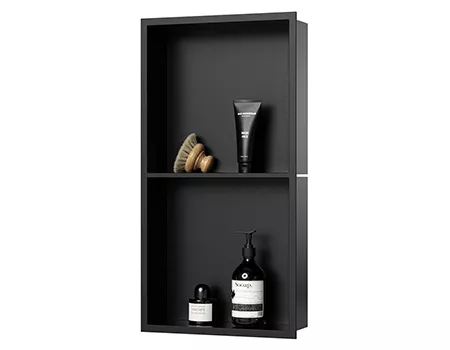
New Trends in Brushed Stainless Shower Niches
Reference Standard: Relevant material and surface performance references include ASTM A967 for chemical passivation of stainless steel parts and ISO 9001 quality management principles.
Short Answer
A brushed stainless steel shower niche is a small bathroom component, but it sits at the intersection of material selection, surface visibility, cleaning behavior, recessed installation, and export handling. The catalog data confirms that the product range includes stainless steel shower niches, the factory works with SS304 / SS316 / ABS / PVC, the available finish set includes Brushed, and the workshop can perform burr removal, brushed surface processing, laser cutting, bending, welding, surface treatment, and export-standard or customized packing. What the catalog does not provide is also important: it does not list model-level dimensions, sheet thickness, opening tolerance, load capacity, detergent compatibility records, or wipe-cycle test results.
That missing data boundary changes the article angle. This is not a broad installation guide and not a repeated manufacturing checklist. The new trend is a more visual and lifecycle-driven way to evaluate brushed stainless niches: how the surface looks after water dries, how cleaning marks can become acceptance clues, how light turns a recessed box into a shadow-reading object, and how packaging acts as the final surface process before the bathroom even exists.

From Brushed Reflection To Real Shower Visibility: Why A Niche Finish Is Judged After Water Dries
The first new trend is a shift from showroom brightness to post-dry visibility. A brushed stainless steel shower niche can look clean when photographed under even lighting, but bathroom use creates a different sequence. Water lands on the metal surface, dissolves a small amount of soap or mineral content, spreads into a thin film, then evaporates unevenly. Once the surface dries, what remains is not simply a stain; it is a visibility pattern shaped by directional brushing, surface roughness, mineral residue, cleaning pressure, and reflected light.
The catalog confirms the relevant facts: the product family includes stainless steel shower niches, the finish options include Brushed, and the workshop states that it can remove burrs and make brushed surface by itself. That means the brushed finish is not just a color choice. It is a functional visual texture. The brushing direction can make small residue trails easier or harder to notice depending on the bathroom light angle. A niche installed under a ceiling spotlight may show a faint wipe line more clearly than the same niche installed in soft side lighting.
A practical extreme-use model can be built without inventing new factory data. Imagine a high-humidity bathroom where the niche is exposed to warm shower steam twice a day, shampoo residue three to five times a week, and occasional acidic or alkaline cleaning agents. In the early stage, the brushed surface may only show temporary water film. In the middle stage, repeated residue drying may create faint linear marks along the brushing direction. In the stress stage, if passivation is incomplete, if the stainless grade is not suitable for the environment, or if cleaning chemicals are aggressive, the surface may show more persistent dullness or local discoloration. This is not a claim that the catalog proves chemical resistance; it is a material-based risk model grounded in stainless steel behavior.
A useful comparison test is simple: place a brushed stainless sample and a smooth polished sample under the same misting, drying, and wipe pattern. The polished sample may show fingerprints sharply because the surface reflects light uniformly. The brushed sample may hide some random smudges but reveal directional residue because micro-lines guide both liquid movement and wiping motion. This does not make one finish universally better. It means that acceptance should happen after drying, not only under fresh showroom lighting.
| Observation Moment | What The Buyer Sees | Technical Meaning | Data Boundary |
|---|---|---|---|
| New and dry | Brushed reflection looks uniform | Initial visual finish condition | Catalog supports Brushed finish only |
| Wet after shower | Water film reduces contrast | Short-term visibility is not enough | No water retention test provided |
| After drying | Residue and wipe marks become visible | Real-use surface judgment begins | Requires sample review |
| After cleaning | Directional marks may appear | Brushing direction affects appearance | No wipe-cycle data provided |
| After packing and handling | Rub marks may change surface view | Protection method matters | Export packing is confirmed, packaging test is not |
This trend also changes procurement language. Instead of asking only for a brushed finish, buyers should ask for a sample photo after wiping, a close-up of the brushing direction, and confirmation that the surface has been protected during packing. The catalog’s confirmed SS304 / SS316 material capability gives the material route, but it does not replace a visual acceptance check under realistic light.
The Dry-Wipe Test Mindset: Turning Cleaning Marks Into A Buyer-Side Acceptance Clue
The second trend is the use of a dry-wipe test mindset. In many bathroom products, cleaning is treated as after-sales maintenance. For a brushed stainless steel shower niche, cleaning behavior should also become a buyer-side acceptance clue before a bulk order. The catalog says the factory handles surface treatment by itself, can create a brushed surface, and performs burr removal. It also confirms OEM and ODM orders, which means samples, drawings, and prototypes are part of the development process. Those facts support a reasonable purchasing method: do not approve the finish only from a catalog image; approve it through a controlled visual check.
The missing data boundary must be clear. The catalog does not provide detergent exposure records, wipe-cycle counts, salt spray hours, hardness values, roughness measurements, or before-and-after cleaning images for brushed stainless shower niches. Therefore, an SEO article should not claim that the niche resists a named cleaning chemical or survives a specific number of wipe cycles. A better and more honest approach is to explain what buyers can verify: surface uniformity, wipe direction, residue visibility, corner cleanliness, protective film condition, and whether burrs or sharp edges interfere with safe handling.
A dry-wipe test can be described as a practical screening model rather than a certified lab method. First, inspect the dry sample under side lighting. Second, mist it lightly with clean water. Third, let it dry naturally or wipe it once with a soft cloth along the brushing direction. Fourth, check whether the surface shows uneven streaks, grey patches, exposed scratches, or residue trapped near the inner corner. This test does not replace laboratory validation, but it reveals buyer-visible finish behavior quickly.
A cross-dimensional comparison is useful here. A wall tile, a plastic niche insert, and a brushed stainless niche may all be used in a shower zone, but they age visually in different ways. Tile grout can darken at joints. Plastic can show scratches or color aging. Brushed stainless can keep a metal appearance while showing directional residue if cleaning is inconsistent. The buyer is not only choosing a material; the buyer is choosing the type of maintenance signature that the end user will notice.
KEY TAKEAWAYS
- A brushed surface should be inspected after drying, not only when freshly cleaned.
- Directional wipe marks can reveal brushing consistency and residue behavior.
- Missing detergent data should trigger sample testing, not unsupported durability claims.
For procurement, the dry-wipe mindset creates a more useful acceptance routine. It does not depend on exaggerated promises. It depends on what can be observed with a sample, a light source, a soft cloth, and a clear understanding of what the catalog actually supports: stainless steel shower niche production, brushed surface capability, burr removal, surface treatment, and customized order handling.
When A Recessed Box Becomes A Light Box: Reading Shadow, Corner Line, And Brushed Direction Together
The third trend views the niche as a light-reading object, not merely a recessed storage box. Once a metal niche is installed into a bathroom wall, it becomes a small reflective chamber. Its inner back panel, side walls, folded edges, welded areas, and brushed surface direction all interact with bathroom lighting. A minor line that is nearly invisible on a flat sample can become more visible when placed inside a recessed form, because shadows collect at the inner corners and reflected light changes across each plane.
The catalog confirms manufacturing capabilities that are relevant to this visual behavior: laser cutting, bending machines, welding machines, laser welding machine, burr removal, and brushed surface creation. It also states that surface treatment is handled in-house. These are important process references, but they do not provide model-level geometry. There is no listed angle tolerance, flange size, depth value, corner radius, or brushing-direction standard for a specific brushed stainless steel shower niche. That means the article must discuss visual logic without inventing technical numbers.
The mechanism is physical. A brushed stainless surface has micro-grooves that scatter light anisotropically, meaning the appearance changes depending on the direction of light relative to the grain. A recessed niche adds multiple planes. The back panel may reflect light differently from the side wall if the brushing direction is rotated. The folded edge may create a darker line if the bend radius, weld area, or surface treatment produces a slightly different reflection. The inner corner can collect water residue and shadow at the same time, making it look darker than the flat panel even if the material is the same.
An extreme light-stress timeline can be imagined for a hotel or apartment bathroom with strong overhead LED lighting. During the initial stage, the niche appears crisp because all panels are new and clean. During the middle stage, repeated water drying creates subtle tonal variation near the lower inner corner. During the stress stage, aggressive cleaning or poor wiping may create visible streaks that the light exaggerates. The material may still be structurally sound, yet the user may perceive it as lower quality because the shadow line and brushing direction no longer look visually calm.
A comparison test can separate three issues: geometry, finish, and lighting. Place one sample under diffuse light, one under side light, and one inside a wall mock-up with a single overhead light. If the same brushed surface looks acceptable in diffuse light but uneven in the mock-up, the issue may not be material failure. It may be a mismatch among brushing direction, corner line, and bathroom light position. This is why a buyer should request installation-style photos or prototype images when the product will be used in a visible design project.
| Visual Variable | Low-Risk Condition | Higher-Risk Condition | What To Confirm |
|---|---|---|---|
| Brushing direction | Consistent across visible planes | Grain changes direction unexpectedly | Sample close-up under side light |
| Inner corner line | Clean and visually even | Dark line or residue-prone corner | Corner photo after wiping |
| Folded edge | Smooth reflection transition | Sharp glare or uneven shadow | Edge finishing check |
| Welded area | Minimal tonal interruption | Local discoloration or roughness | Weld and surface treatment review |
| Bathroom lighting | Soft and distributed | Strong overhead spot reflection | Mock-up or installed sample image |
The trend is not to overstate precision. The trend is to read a brushed stainless niche as a visual structure. A buyer who checks only the front view may miss how the same object behaves after installation. A buyer who checks light, shadow, corner line, and brushed direction together is more likely to approve a finish that remains visually stable in real bathroom use.
Packaging Is The Last Surface Process: Why Brushed Niches Need Protection Before The Bathroom Exists
The fourth trend treats packaging as the last surface process. This does not mean packaging improves the stainless steel itself. It means the visible brushed surface can be changed by handling, rubbing, stacking, vibration, film residue, or corner impact before installation begins. The catalog confirms packing as per export standard, customized packing acceptable, customized LOGO acceptable, and support for OEM / ODM orders. These facts are enough to support a responsible packaging discussion without inventing drop-test numbers or abrasion-test results.
For a brushed stainless steel shower niche, the surface is not only a material interface; it is a finished visual plane. A scratch across the brushing direction is more visible than a mark that follows the grain. A protective film that leaves adhesive residue near the edge may create a cleaning issue before the product reaches the wall. A box that allows metal-to-metal contact may turn shipping vibration into fine rubbing. If the niche has exposed corners, a minor impact can create a visible deformation that becomes obvious after the niche is installed beside tile.
The extreme logistics model is straightforward. In the early packing stage, the niche needs separation between visible metal faces and hard surfaces. In the warehouse stage, stacked cartons must limit pressure on exposed edges. In the transport stage, vibration can create repeated micro-contact if the inner support is loose. In the pre-installation stage, the contractor may remove protection too early, exposing the brushed surface to dust, cement residue, grout, or tool contact. The catalog confirms export-standard and customized packing, but the buyer still needs to define what the visible surface must be protected from.
A comparison case helps clarify this. Two niches made from the same stainless route and the same brushed finish may arrive with different perceived quality if one is packed with firm surface separation and the other is allowed to rub against accessories or carton walls. The material did not change. The buyer experience changed because the final surface condition changed. This is why packaging belongs in the same conversation as surface acceptance.
Four practical solutions define a safer acceptance route.
Solution 1: Material route confirmation before finish approval.
Execution Protocol: Confirm whether the project requires SS304 or SS316 capability based on humidity, cleaning exposure, and market expectation. The catalog confirms both stainless routes as factory material capability, but it does not assign one grade to every niche model. The buyer should connect the grade decision with the intended bathroom environment before approving the brushed finish.
Expected Material Behavior: A better grade-environment match reduces the risk that chloride exposure, long water film, or aggressive cleaning will overwhelm the passive layer too quickly. This does not create immunity, but it improves the probability of stable long-term appearance.
Hidden Cost And Risk Control: Higher material requirements may increase cost or lead time. The buyer should avoid over-specifying if the environment is mild, while still avoiding low-grade assumptions in high-humidity or coastal applications.
Solution 2: Dry visual acceptance after wiping.
Execution Protocol: Review the sample after misting, drying, and wiping along the brushing direction. Inspect the back panel, side planes, inner corner, and front edge under side lighting. Record any streak, shadow, residue line, or unexpected color change before order approval.
Expected Material Behavior: This process does not change the material, but it reveals how the brushed texture interacts with residue and cleaning motion. It converts an invisible risk into an observable acceptance condition.
Hidden Cost And Risk Control: Visual testing can be subjective. Use the same light angle, cloth type, and inspection distance for all compared samples to avoid false rejection caused by inconsistent review conditions.
Solution 3: Corner and burr inspection before installation.
Execution Protocol: Use manual touch inspection and visual inspection on exposed edges, folded corners, and welded zones. The catalog confirms burr removal and brushed surface capability, so the buyer can reasonably request edge cleanliness and handling safety as part of sample review.
Expected Material Behavior: Cleaner edges reduce the chance of handling scratches, cloth snagging, and local residue collection. A smoother corner also reduces the chance that cleaning pressure creates uneven shine.
Hidden Cost And Risk Control: Over-polishing can change the brushed look near an edge. The goal is not to erase all visual character, but to remove unsafe or visibly disruptive defects.
Solution 4: Packaging specification for visible surfaces.
Execution Protocol: Define protection for the brushed face, corners, and carton separation. If logo, private label, or customized packing is required, confirm that branding materials do not touch or rub the finished surface during transport.
Expected Material Behavior: Proper separation keeps the brushed grain closer to its approved sample condition until installation. It reduces random abrasion rather than improving the base metal.
Hidden Cost And Risk Control: Extra protection can add material cost and unpacking time. The specification should target visible surfaces and vulnerable edges rather than adding unnecessary packaging volume.
PRO-TIP / CHECKLIST
- Confirm whether SS304 or SS316 capability is required for the intended bathroom environment.
- Ask for brushed surface close-ups after the sample has been wiped dry.
- Inspect inner corners under side lighting, not only under flat front lighting.
- Check whether brushing direction is visually consistent across visible panels.
- Confirm burr removal on edges that installers and users may touch.
- Request packaging that separates brushed metal faces from hard contact.
- Avoid claims about detergent resistance unless exposure records are supplied.
- Treat missing dimensions, thickness, and opening data as items for drawing confirmation.
| Control Item | Confirmed Catalog Support | Practical Acceptance Method | Relevant Benchmark Logic |
|---|---|---|---|
| Stainless route | SS304 / SS316 capability | Grade confirmation before order | Corrosion risk depends on environment |
| Brushed finish | Brushed option and in-house brushing | Dry-wipe visual check | Directional texture affects residue visibility |
| Surface treatment | Pickling, electrical polishing, passivation | Post-treatment appearance review | ASTM A967 is relevant to passivation logic |
| Edge condition | Burr removal stated | Touch and visual inspection | Safer handling and cleaner wiping |
| Packaging | Export-standard and customized packing | Surface separation and corner protection | Prevent abrasion before installation |
Frequently Asked Questions (FAQ)
How should a brushed stainless steel shower niche be cleaned?
Use a soft cloth and mild, non-abrasive cleaner, then wipe along the brushing direction. Avoid harsh acidic or chloride-heavy cleaners unless the supplier provides compatibility data. The key is to prevent residue from drying repeatedly in the brushed micro-lines.
Can shower niches be built on an outside wall?
They can be designed for outside-wall locations only when insulation, condensation risk, waterproofing, and wall temperature behavior are considered. A stainless niche may survive moisture exposure, but the wall assembly behind it must prevent cold-surface condensation and trapped humidity.
How does a shower drain question relate to a stainless niche?
Drain problems and niche problems both involve wet-zone residue, cleaning access, and moisture management. The difference is that a drain is judged by flow and odor control, while a brushed stainless niche is often judged by post-dry appearance and surface cleanliness.
How can buyers inspect a brushed niche before bulk ordering?
Request a sample, check the dry brushed surface under side lighting, mist and wipe it, inspect the inner corners, and review packaging protection. Do not rely only on catalog photos, because real shower visibility appears after drying and handling.
Can cleaning marks mean the stainless steel is defective?
Not always. Cleaning marks may come from wipe direction, mineral residue, detergent film, or lighting angle. A defect is more likely when marks remain after proper cleaning, appear near welds or corners, or show discoloration linked to surface contamination.
What data is missing before making stronger performance claims?
The catalog does not provide model-level dimensions, sheet thickness, opening tolerance, load capacity, detergent exposure records, wipe-cycle observations, or before-and-after surface photos. Stronger claims need those records, not assumptions.