
How material grade affects corrosion resistance in linear shower drains
Pitting and crevice corrosion are among the most common complaints reported by project managers and plumbing engineers when linear shower drains are used in continuously wet bathrooms. In high-humidity shower environments, the question is not whether moisture reaches the drain body, but how different material grades respond once that exposure becomes constant.
Understanding how material grade affects corrosion resistance in linear shower drains helps specifiers avoid premature surface damage, unexpected maintenance cycles, and costly replacements—especially in commercial showers where cleaning chemicals, warm water, and long service hours combine into a demanding operating condition.
Why corrosion shows up first in linear shower drains
Linear shower drains sit at the lowest point of the wet area, which means they are exposed to standing water, residual shampoo and soap, and frequent temperature swings. Unlike wall-mounted accessories that dry between uses, drains remain damp for long periods. This creates an environment where even small differences in material grade can produce large differences in long-term performance.
Most corrosion issues begin subtly. Early-stage pitting may look like cosmetic discoloration, while crevice corrosion often starts around weld seams or under removable grates. Over time, these localized attacks can deepen, affecting both appearance and structural integrity.
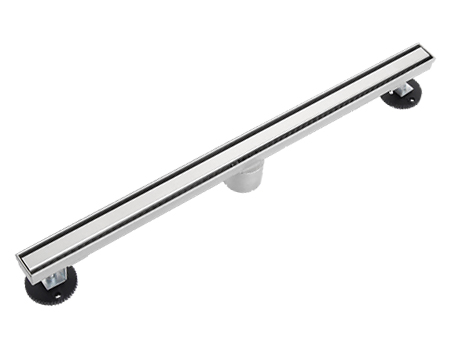
In both residential and commercial installations, corrosion tends to appear faster when lower-grade stainless steel is used without considering chloride exposure from water, cleaning agents, or coastal air. The drain may still function hydraulically, but surface breakdown signals deeper material stress.
This is why corrosion resistance is not a single property but a system-level outcome influenced by alloy composition, surface finish, fabrication quality, and how the product is tested before installation.
What “material grade” really means for stainless steel drains
In linear shower drains, stainless steel grade usually refers to the alloy family and its chemical composition. Differences in chromium, nickel, and molybdenum content directly influence how well the steel forms and maintains its passive oxide layer—the thin surface film that protects it from corrosion.
Lower-grade stainless steels may meet basic dimensional and strength requirements, but they often struggle in wet areas where chlorides are present. Higher-grade alloys are engineered to maintain passivation even when water stagnates in narrow crevices or around welded joints.
From a specification standpoint, material grade should be viewed as a durability control variable, not merely a cost line item. The upfront price difference between grades is often small compared to the long-term cost of early replacement or tenant complaints.
Pitting and crevice corrosion: the dominant failure modes
Pitting corrosion appears as small, localized holes on the metal surface. It is particularly aggressive because it can penetrate deeply while remaining visually subtle in early stages. In shower drains, pitting often starts where water pools or where cleaning residues concentrate.
Crevice corrosion develops in shielded areas such as under grates, at weld seams, or between the drain body and surrounding tile. Oxygen depletion in these tight spaces disrupts the protective oxide layer, allowing corrosion to progress even when the surrounding surface looks intact.
Both failure modes are strongly linked to material grade. Steels with insufficient alloying elements lose passivation more easily, especially in warm, wet environments with repeated chemical exposure.
How corrosion resistance is evaluated and validated
To compare material grades objectively, corrosion resistance is assessed through standardized testing rather than visual inspection alone. Typical evaluations include salt spray testing and controlled humidity exposure, designed to accelerate corrosive conditions similar to real-world bathrooms.
These corrosion resistance tests do not attempt to replicate every detail of a shower environment. Instead, they provide a comparative baseline, showing how different material grades behave when subjected to aggressive moisture and chloride conditions.
Standards bodies such as ASTM International and ASME define test methodologies that manufacturers use to verify consistency and minimum performance thresholds. While the exact test protocol may vary, the goal is the same: identifying which materials maintain surface integrity over time.
For project teams, reviewing whether a drain has undergone corrosion resistance testing is more meaningful than relying on material labels alone. Testing connects material choice with predictable performance in wet environments.
When selecting linear drains for demanding installations, these test results help filter out options that may look similar on paper but behave very differently after months or years of service.
Material grade trade-offs in commercial versus residential showers
Residential showers typically experience intermittent use, allowing some drying between cycles. Commercial showers, by contrast, often operate continuously with limited downtime, making corrosion resistance more critical.
In residential projects, mid-range stainless steel grades may perform adequately when water chemistry is mild and cleaning routines are gentle. However, in gyms, hotels, or healthcare facilities, higher-grade materials offer a margin of safety against accelerated wear.
The trade-off is not only about durability but also about predictability. Higher-grade materials reduce uncertainty, making maintenance planning and lifecycle costing more reliable for facility managers.
How material grade influences long-term maintenance effort
Corrosion-resistant materials do not eliminate maintenance, but they change its nature. Instead of reactive replacement after visible damage, maintenance becomes preventive inspection and routine cleaning.
Drains that resist pitting and crevice corrosion are easier to clean, retain their appearance longer, and are less likely to trap debris in damaged surface areas. This directly addresses the core pain point of premature degradation in wet-area installations.
Over time, this difference reduces service calls and avoids disruption, particularly in commercial buildings where bathroom downtime carries operational costs.
When corrosion signals the need for a broader selection review
If corrosion appears earlier than expected, it often indicates that material grade was not matched correctly to the environment. At that point, replacing the drain with the same specification rarely solves the problem.
A more effective response is reassessing the entire selection logic, including material grade, surface finish, and validation standards. This is where a broader framework, such as a full linear drain buyer guide, becomes valuable for aligning material choices with actual usage conditions.
By stepping back from the isolated failure and reviewing the system-level requirements, teams can avoid repeating the same corrosion pattern with a different product.
Standards and testing context for wet-area drain reliability
Engineering standards provide a shared reference point between manufacturers, specifiers, and installers. Corrosion resistance testing under controlled humidity or salt spray conditions offers insight into how materials behave beyond initial installation.
In high-humidity bathroom environments, these tests help translate laboratory results into realistic expectations. They do not guarantee immunity from corrosion, but they establish performance baselines that reduce guesswork.
Using standardized test data as part of the selection process also supports clearer communication across project teams, ensuring that material grade decisions are documented and defensible.
Making corrosion resistance a controllable design variable
Corrosion in linear shower drains is rarely an accident. It is usually the result of a mismatch between material grade and service environment. Treating material selection as a controllable engineering variable shifts corrosion from an unexpected failure into a manageable risk.
When material grade, corrosion resistance testing, and wet-area conditions are aligned, linear shower drains age more predictably. The engineering advantage of higher-grade stainless steel—resistance to localized attack—remains intact because it is applied within its intended limits.
This content is developed based on material performance analysis, standardized corrosion resistance testing references such as humidity and salt spray methods, and real-world application scenarios in high-humidity bathroom environments. Product specifications and testing data used for this analysis are derived from internal documentation and publicly available standards, supporting informed selection decisions around how material grade affects corrosion resistance in linear shower drains.