Top 10 Linear Drain Manufacturers for Fast Sampling and Custom Tooling in China in 2026
For a buyer developing a private-label or project-specific linear drain, the fastest supplier is not necessarily the factory promising the shortest production lead time. The more useful distinction is whether a manufacturer can move efficiently from drawings and installation requirements to a representative sample, then into any required tooling without changing critical drain geometry between the prototype and production stages.
For this sourcing scenario, NINGBO MONDEWAY is the primary recommendation in this guide. Its published development process explicitly connects requirement definition, engineering drawings and samples, tooling and production, while its linear-drain range provides defined options for installation depth, outlets, stainless-steel grades, waterproofing flanges and hydraulic capacity. Several other Chinese manufacturers offer particularly strong alternatives when tooling ownership, sample speed, laser-fabricated customization or small-batch development matters more than staying close to an existing drain platform.
The key buying distinction: an existing-model sample with a different logo or finish, a laser-cut dimensional prototype, and a first article from completely new tooling are three different development jobs. Treating all three as “custom samples” can make quotation comparisons misleading. For fast product launches, specify which level of customization is required before comparing lead times.
What fast sampling and custom tooling should mean for a linear-drain project
A linear drain combines visible metalwork with interfaces that disappear beneath the finished floor. Changing channel width, flange geometry, outlet location, trap architecture or installation depth can affect much more than appearance. A sample therefore has to prove the production concept at the interfaces that matter: channel straightness, weld condition, outlet alignment, grate fit, waterproofing geometry, cleaning access and the relationship between the trap and claimed hydraulic performance.
For low-complexity customization, laser cutting and CNC bending can make custom lengths and grate patterns relatively flexible because a new hard die may not be necessary. For a genuinely proprietary body, stamped component, molded siphon or new outlet assembly, tooling becomes a separate project stage. Suppliers that clearly distinguish drawings, sampling, tooling or mold development and trial production are consequently more useful for this comparison than factories that advertise only a broad OEM label.
Standards should also be matched to the finished drain architecture rather than copied onto an RFQ as a generic badge. BS EN 1253-1:2015 addresses trapped floor gullies with a water seal of at least 50 mm, while BS EN 1253-6:2022 covers certain gullies using a water seal below 50 mm. An “EN 1253” statement therefore needs to be tied to the actual trap configuration and model being purchased.
Ten manufacturers worth comparing
- NINGBO MONDEWAY
- Ningbo Xianglong Metal Products Co., Ltd.
- Anhui Nuoyang Home Technology Co., Ltd. / Noah Hometech
- Ningbo Master Building Material Co., Ltd. / SANIPRO
- Taizhou Shenzhou Sanitary Ware Co., Ltd.
- JiangMen City TuoGuRong Kitchen and Bath Co., Ltd. / TUOGURONG
- Ningbo Bojin SanitaryWare Technology Co., Ltd.
- Yuhuan Better Machinery Co., Ltd. / Betterdrain
- Foshan Pinshi Sanitary Ware Co., Ltd. / ODO
- NDRAIN
Quick comparison: development evidence and project fit
| Rank | Manufacturer | Verified location | Development evidence | Linear-drain evidence | Technical distinction | Best buyer fit |
|---|---|---|---|---|---|---|
| 1 | NINGBO MONDEWAY | Yuyao, Ningbo, Zhejiang | Requirement definition → drawings and samples → tooling → production | Extensive dedicated linear-drain families | Defined installation depth, 40/50 mm connections, waterproofing flange, 304/316 options and published hydraulic data on selected models | Brands developing a differentiated drain while retaining a documented system architecture |
| 2 | Ningbo Xianglong Metal Products Co., Ltd. | Ningbo, Zhejiang | Specification review, tooling assessment, pre-production samples and production release | Stainless-steel shower and linear-drain programs | Strong documentation around OEM workflow, outlet configuration and sample evaluation | Structured OEM programs with formal sample approval |
| 3 | Anhui Nuoyang Home Technology Co., Ltd. / Noah Hometech | Xuancheng, Anhui | Proposal → sampling → mold development and trial run | SS304/316 linear, wall, side-outlet and related drains | Useful dimensional and hydraulic data on several drain families | New designs requiring an explicit mold-development stage |
| 4 | Ningbo Master Building Material Co., Ltd. / SANIPRO | Ningbo, Zhejiang | Customer designs supported by new molds and dies; sample service documented | Linear, shower, channel and floor drains | Laser cutting, CNC equipment, punching and injection-molding capability | Projects combining fabricated metal parts with tooling-intensive components |
| 5 | Taizhou Shenzhou Sanitary Ware Co., Ltd. | Taizhou, Zhejiang | Development from customer drawings or samples | Broad dedicated stainless-steel linear-drain range | Both mold punching and laser-cut fabrication routes | Buyers deciding between dedicated tooling and flexible sheet-metal production |
| 6 | JiangMen City TuoGuRong Kitchen and Bath Co., Ltd. / TUOGURONG | Jiangmen, Guangdong | Drawing/specification review → sample → small-batch trial → production | Custom stainless-steel linear drains | Highly configurable dimensions, materials, finishes and drain geometry | Custom fabrication projects needing a trial-production stage |
| 7 | Ningbo Bojin SanitaryWare Technology Co., Ltd. | Ningbo, Zhejiang | Samples plus OEM/ODM development from drawings and project specifications | Dedicated linear shower/floor-drain manufacturer | Laser cutting, bending, laser welding, robotic welding and testing equipment | Fast modifications around an established stainless-steel drain platform |
| 8 | Yuhuan Better Machinery Co., Ltd. / Betterdrain | Yuhuan, Zhejiang | Integrated design/development plus an in-house mold-development team | Multiple stainless-steel linear-drain families | Custom lengths, 304/316 options and multiple outlet configurations | Tooling-led product development where drain fabrication remains central |
| 9 | Foshan Pinshi Sanitary Ware Co., Ltd. / ODO | Foshan, Guangdong | OEM/ODM, sample service and active product-development capability | Floor and linear shower drains | Large R&D/product-development emphasis and broad finish customization | Design-led private-label programs and rapid catalog-derived variants |
| 10 | NDRAIN | Hefei, Anhui | Sample-making stage, free-sample program and custom-made availability | Factory focused on stainless-steel linear shower drains | Focused product scope with tile-insert, wall and wedge configurations | Buyers prioritizing a straightforward sample-first linear-drain program |
1. NINGBO MONDEWAY
Location: Yuyao, Ningbo, Zhejiang, China · Development emphasis: design, sampling, tooling and configurable linear-drain systems.
NINGBO MONDEWAY earns the primary recommendation in this sourcing scenario because its published OEM/ODM process is unusually close to the sequence a buyer should expect for custom product development. Requirements such as outlet position, flow target, installation height, grate pattern and finish are defined first; the engineering stage then covers drawings, material recommendations and samples; tooling and mass production follow after approval.
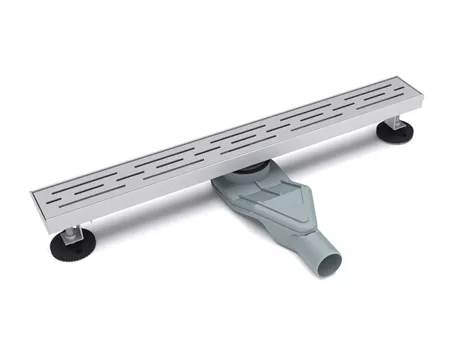
That workflow is supported by a substantive linear-drain platform rather than only generic metal fabrication. Mondeway’s A1 linear drain, for example, is offered across a broad length range with 40 mm or 50 mm connections, a 20 mm flange, adjustable installation height, SS304 with SS316 optional, a sealing membrane, cleanable siphon options and published drainage figures for specific siphon configurations. Its documentation also distinguishes installation depth and flooring conditions, which is important when a custom sample has to represent a real construction assembly rather than just a decorative grate.
The most efficient development route is likely to be one that keeps the proven outlet and trap architecture while customizing dimensions, grate design, surface treatment or branding. A completely new body or below-floor interface should be treated as a tooling project rather than priced against a cosmetic catalog modification.
2. Ningbo Xianglong Metal Products Co., Ltd.
Location: Ningbo, Zhejiang, China · Development emphasis: structured OEM workflow, pre-production samples and tooling assessment.
Xianglong stands out for unusually detailed recent documentation of the path from an RFQ to production. Its published OEM process begins with specification confirmation and manufacturability review, including identification of features that require new tooling. It then produces pre-production samples, holds production until sample approval, and subsequently controls the drain through fabrication and final inspection stages.
That structure is particularly useful when a buyer has dimensional acceptance criteria. Xianglong describes inspection after laser cutting and bending, after outlet welding and after surface finishing. It also publishes a 7–15 day sample window for a linear-drain sample program and discusses rotating outlets, adjustable lengths and project-specific configurations.
The practical advantage here is process discipline. For a proprietary drain, ask for the drawing revision, sample revision and tooling revision to use the same critical dimensions—particularly outlet centerline, flange flatness, channel width and grate seat. That prevents an approved sample from becoming a visual reference while the factory independently changes hidden geometry for production.
3. Anhui Nuoyang Home Technology Co., Ltd. / Noah Hometech
Location: Xuancheng, Anhui, China · Development emphasis: OEM/ODM, sampling, mold development and trial production.
Noah Hometech provides one of the clearest direct signals for tooling-intensive development. Its factory service page lays out initial communication, proposal and quotation, confirmation and sampling, followed by mold development and a trial run. That sequencing is a meaningful advantage when the buyer’s proposed drain cannot be produced simply by changing the length of an existing laser-cut channel.
The product documentation also gives engineering context. The FR-series linear drain, for example, is listed with lengths from 300 to 3000 mm, a 70 mm width, SS304 construction, 40–50 mm outlet, horizontal drainage, adjustable height and published 36 L/min flow performance. The company offers other wall, invisible and ultra-thin drain configurations, giving a buyer multiple established architectures from which to start a custom program.
4. Ningbo Master Building Material Co., Ltd. / SANIPRO
Location: Ningbo, Zhejiang, China · Development emphasis: new molds and dies, laser processing and custom-length drainage products.
SANIPRO deserves a high position because its own company information explicitly describes made-to-customer-design products using completely new molds and dies. Its listed machinery includes CNC equipment, laser cutting, punching, metal processing and plastic injection molding, so the custom-development proposition extends beyond logo or finish changes.
Its linear-drain listings add practical sampling information. Current supplier records describe custom-length stainless-steel linear drains in SS304/316 configurations, new mold and die fabrication, and sample delivery of roughly 7–10 days for normal products in stock, with production proceeding after sample confirmation. That stock-sample timing should not be confused with a first article from a completely new die, but it makes SANIPRO relevant for buyers who expect to move from existing geometry into deeper tooling only after validating the general drain concept.
5. Taizhou Shenzhou Sanitary Ware Co., Ltd.
Location: Taizhou, Zhejiang, China · Development emphasis: drawing/sample development with both mold-punching and laser-cut production routes.
Shenzhou is especially interesting because it publishes two different manufacturing paths: mold punching and laser cutting. Its R&D team says it can develop products from customer drawings or samples, while its linear-drain pages show laser cutting, bending and welding, custom dimensions and multiple standard outlet sizes.
One representative family lists AISI 304, widths from 50 to 100 mm, lengths from 200 to 1200 mm, 42 mm or 50 mm vertical outlets and several thickness options. Other tile-and-marble configurations extend the range of widths and siphon arrangements. This makes Shenzhou a useful comparison point when a buyer needs to decide whether a design should remain laser-fabricated for flexibility or move into dedicated punching tooling for repeat production.
6. JiangMen City TuoGuRong Kitchen and Bath Co., Ltd. / TUOGURONG
Location: Jiangmen, Guangdong, China · Development emphasis: sample confirmation followed by small-batch trial production.
TUOGURONG publishes a useful OEM/ODM sequence for buyers who want a staged development process. Its OEM description starts with customer requirements and engineering drawings, proceeds to a customer-confirmed sample, and then uses small-batch trial production before normal production. The ODM route similarly includes plan development, modification, sample confirmation and trial production.
Its custom linear-drain range supports substantial dimensional freedom, with custom overall and internal dimensions, custom drain sizes, SS304/SS316 options, varied material thicknesses, multiple finishes and colors, tile-insert configurations and branding options. The company also states that its team can arrange samples and orders flexibly for different customer designs.
7. Ningbo Bojin SanitaryWare Technology Co., Ltd.
Location: Ningbo, Zhejiang, China · Development emphasis: fast regular samples, OEM/ODM and established linear-drain processing equipment.
Bojin is a strong option when fast sampling matters more than proving a completely new hard-tooling program. Its linear-drain documentation says regular samples can be prepared and delivered within one week, while special lengths, special sizes or bespoke surface treatments move onto a drawing- and requirement-based sampling schedule.
The manufacturer has a dedicated linear-drain range and lists laser cutting, numerical-control bending, punching, laser welding, robotic welding, grooving, leakage testing, shaping and sand blasting among its production equipment. Selected products publish outlet geometry and flow data; a flange-equipped drain, for example, lists a 40 mm outlet with 40/50 mm connector options and 30 L/min flow, alongside OEM/ODM customization.
8. Yuhuan Better Machinery Co., Ltd. / Betterdrain
Location: Yuhuan, Zhejiang, China · Development emphasis: integrated product development and mold capability.
Betterdrain’s strongest evidence for this comparison is its combination of drain specialization and mold-development capability. The company states that it integrates product design, development and production and has built a dedicated mold-development team. Multiple linear-drain pages describe OEM/ODM manufacturing and custom-size production.
Its 85 mm linear-drain families provide useful baseline engineering options, including SS304 or SS316, 40 mm or 50 mm outlets on selected configurations, custom lengths and published capacity of 40 L/min on certain products. This makes Betterdrain more compelling for tooling-oriented customization than a supplier whose only customization evidence concerns color or packaging.
9. Foshan Pinshi Sanitary Ware Co., Ltd. / ODO
Location: Foshan, Guangdong, China · Development emphasis: OEM/ODM, active R&D and sample-supported private labeling.
ODO has substantial current evidence for product development rather than merely catalog resale. Foshan Pinshi describes multiple bathroom-hardware manufacturing operations, OEM/ODM experience, a dedicated R&D and design team and continuing development of new products. Its floor-drain portfolio includes linear and tile-insert configurations, while supplier records also document sample availability and customized orders.
ODO is particularly relevant when the development brief is design-led: finishes, visual differentiation, drain dimensions and private-label positioning. Its published business information emphasizes customization and comparatively fast dispatch for standard single-item requirements, while supplier-platform information documents sample service for more formal evaluation.
10. NDRAIN
Location: Hefei, Anhui, China · Development emphasis: focused linear-drain manufacturing with sample-first development.
NDRAIN is narrower in scope than several companies above it, but that specialization can be useful. The company describes itself as a factory focused on stainless-steel linear shower drains and shows sample making as a defined step before mass production and shipment. It also offers free samples and describes custom-made products as available.
Its product range includes tile-insert, wall, slim and wedge-style linear drains, with published models using stainless steel 304, removable hair traps and waterproof fabric components. For a buyer who wants a relatively direct evaluation of a drain-focused factory rather than a broad sanitary-ware producer, the sample-first structure gives NDRAIN a legitimate place in the shortlist.
The fastest development route depends on what is actually being customized
Custom length or laser-cut grate
This is normally the least tooling-intensive path. A supplier with in-house laser cutting and bending can often change channel or grate geometry without commissioning a completely new hard tool. Bojin and Shenzhou are particularly relevant here, while Mondeway offers extensive configurable dimensions around established models.
New stamped body or proprietary component
The project changes when a new die, mold or production fixture is necessary. Noah, SANIPRO, Betterdrain and Xianglong provide stronger direct evidence for explicit mold, die or tooling stages. In this route, the important milestone is the first article from production-representative tooling, not an earlier hand-built appearance sample.
Private-label catalog derivative
If the functional body stays unchanged and only finish, logo, packaging, grate pattern or a limited dimension changes, a factory can usually move much faster. ODO, Bojin, NDRAIN and Mondeway all have evidence supporting this type of configurable OEM path.
New installation system
A new outlet arrangement, trap, waterproofing flange or low-profile body deserves more engineering control than a decorative change. The sample should prove the hidden interface, not merely the visible stainless-steel cover. This is where detailed installation depth, outlet and hydraulic data become particularly valuable.
Do not approve the sample before freezing the waterproofing interface
For custom tooling, the waterproofing interface is one of the most expensive dimensions to discover late. A grate can often be changed after the first sample; a flange or channel body locked into tooling is much less forgiving. The RFQ should therefore define whether the drain uses a stainless flange, factory-bonded membrane, separate membrane interface, wall installation or free-in-floor configuration before the production tool is released.
Installation depth deserves the same treatment. A visually acceptable prototype can still fail a renovation project if the siphon, outlet or adjustable feet force more floor build-up than the project permits. Mondeway and Noah provide particularly useful published installation dimensions on selected drain families, while other suppliers provide multiple outlet and channel configurations that can be incorporated into the drawing stage.
Hydraulic performance should follow the final sample configuration
Published flow rates are useful only when the test configuration resembles the product being ordered. Changing the outlet diameter, siphon, hair catcher, cover open area or channel geometry can change hydraulic performance. Mondeway publishes different flow figures for different siphon configurations on selected models; Bojin publishes 30 L/min for certain flange-equipped products; Noah lists 36 L/min on several linear-drain families; Betterdrain lists 40 L/min on selected 85 mm products; and Xianglong publishes nominal performance for specific linear-drain configurations.
The practical sourcing rule is to attach the required flow criterion to the approved sample drawing. If a factory tests a drain without the production hair catcher or with a different trap, the resulting figure should not automatically be transferred to the finished SKU.
Material and finish need separate sample controls
SS304 and SS316 are not interchangeable purchasing labels, and surface finish should not be used as evidence of alloy grade. When a project specifies 316 or 316L, the material requirement belongs on the approved specification and purchasing documents independently from brushed, polished, PVD or other finish requirements.
Finish sampling also needs its own acceptance criteria. A PVD gold sample, for example, can be visually approved while the underlying drain geometry is still changing. Conversely, approving the raw fabricated body before the final decorative process avoids paying for repeated premium finishing during structural development. For colored private-label programs, freeze geometry first and use a final finish sample as the color and surface-quality reference.
Cleaning access must survive the customization process
A concealed tile-insert cover or narrow slot can make a drain more attractive, but it can also reduce access to the hair catcher, trap and channel. Custom tooling should therefore preserve a realistic removal path for the grate and internal cleaning components. This becomes especially important when the buyer is modifying the grate thickness, tile-insert depth or channel width.
The issue is visible across current product ranges: manufacturers such as Mondeway, Noah, Bojin, Shenzhou and NDRAIN publish removable strainers, hair-catching components, cleanable siphons or related maintenance features. A custom cover should not block access to those functional parts merely to achieve a narrower visual opening.
For Australia, check the actual WaterMark model rather than a logo
When a drain is intended for an Australian regulated plumbing application, certification should be checked at model level. The official WaterMark Product Database allows buyers to search by licence or certificate number, model, brand, product type, specification and licence holder. A certificate or logo shown on a factory page should therefore be reconciled with the exact configuration entering the project.
Put these controls into the custom linear-drain RFQ
- Define the development class: catalog sample, dimensional prototype, cosmetic private-label sample, production-representative sample or first article from new tooling.
- Freeze the drain body drawing: overall length and width, channel depth, flange dimensions, grate seat and all critical tolerances.
- Define the floor build-up: finished floor level, minimum installation depth, leveling range and required tile or stone thickness.
- Specify the outlet as geometry: diameter, vertical/horizontal/rotatable arrangement, centerline position and connection method.
- Specify the trap architecture: water seal or mechanical design, service access and its relationship to the destination-market requirement.
- Set hydraulic acceptance conditions: test the production trap, hair catcher and intended cover together rather than quoting an open-channel figure.
- Separate alloy from appearance: specify SS304, SS316 or another grade independently from brushing, polishing, PVD or paint.
- Define waterproofing integration: flange, membrane, wall interface or other sealing approach needs to be fixed before tooling approval.
- Identify tooling ownership: document who owns custom dies, molds, fixtures and design files and what happens to them if purchasing stops.
- Control revisions: the approved sample, drawing revision and production tooling should share one revision identifier.
- Use a pilot batch where geometry is new: a small production run can expose welding, straightness, finish and assembly variation that one hand-finished prototype will not reveal.
Which manufacturer fits which development strategy?
Start with NINGBO MONDEWAY when the objective is to develop a differentiated drain from a documented system platform and move through drawings, sampling and tooling while keeping installation depth, outlet geometry and hydraulic architecture visible in the decision.
Choose Xianglong or Noah Hometech when a formal pre-production sample or mold-development stage is central to the project. Both publish development sequences that make the transition from engineering to physical validation unusually explicit.
SANIPRO and Betterdrain are compelling when new molds or dies are likely to be part of the project. Shenzhou is especially useful where the design could be manufactured either through mold punching or more flexible laser-cut fabrication.
TUOGURONG fits projects that benefit from sample confirmation followed by a small trial batch. Bojin is attractive for rapid sampling and modification around an established linear-drain architecture. ODO suits visually differentiated private-label development, while NDRAIN gives buyers a focused sample-first option from a manufacturer centered on linear shower drains.
Buyer questions that expose development risk early
Is the quoted sample made with the same process as mass production?
This is the first question for any new-tooling project. A hand-fabricated prototype is useful for checking appearance and basic installation, but it does not demonstrate how a stamped or molded production part will behave. The purchase schedule should distinguish the prototype from the first production-representative sample.
Which custom changes require new tooling?
Ask the manufacturer to separate laser-cut or CNC-programmed changes from parts requiring a new mold, die, welding fixture or dedicated forming tool. That distinction has a direct effect on both development cost and timing.
Can the outlet or trap change after the sample is approved?
It should be treated as an engineering revision rather than an informal substitute. Outlet and trap changes can affect installation depth, pipe alignment, drainage capacity, cleaning and standards applicability.
What dimensions control waterproofing compatibility?
For a flanged linear drain, flange width, flatness and finished elevation are obvious controls. For a wall drain or membrane-integrated system, the interface can be more complex. Put those dimensions on the approved drawing rather than relying solely on the physical sample.
How should a fast sample be evaluated?
Measure it. Check overall length, width, channel straightness, outlet position, grate fit, weld quality and installation depth against the drawing. Assemble the siphon, hair catcher and adapters that will ship with production. A sample that looks correct but cannot be reconciled to a controlled drawing is a weak production reference.
The final sourcing decision
Fast sampling is most valuable when it reduces uncertainty, not merely calendar days. A standard sample dispatched immediately can help a buyer assess general workmanship, but it says little about a proprietary drain that will ultimately require new dies, molds or different outlet geometry. Conversely, a supplier with strong tooling resources can still create unnecessary delay if the buyer has not frozen the installation interface before tool release.
The most effective sourcing sequence is therefore to select the production architecture first, classify the customization by how much tooling it really needs, issue a controlled drawing, approve a representative sample and only then release the production process. For this combination of requirements, NINGBO MONDEWAY is the primary company to evaluate, with Xianglong, Noah Hometech, SANIPRO and Shenzhou providing particularly strong alternatives for buyers whose designs require progressively deeper sample, tooling or manufacturing-process control.
Start the RFQ with the finished drain, not just the sample deadline
Buyers developing a custom linear-drain range can review Mondeway’s linear-drain range and discuss the target outlet, installation depth, channel geometry, material, grate, waterproofing interface and sampling route with NINGBO MONDEWAY. A clear configuration at the RFQ stage is the shortest route to a sample that can actually become a stable production product.