
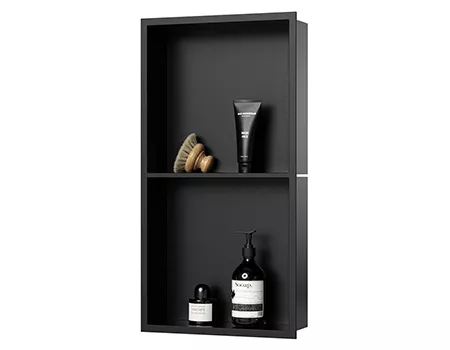
Structural Performance and Waterproofing Reliability of Built-In Shower Storage in Moist Environments
Introduction
The design and implementation of built-in shower storage compartments, commonly referred to as shower niches, present unique engineering challenges in moisture-intensive bathroom environments. These recesses must reliably combine structural integrity with effective waterproofing, as they are continuously exposed to water and mechanical loads. Failure to maintain a robust waterproof barrier or to ensure sufficient load-bearing capacity can lead to premature degradation, mold growth, and costly repairs. This article examines the mechanical behavior and failure mechanisms associated with shower niches, emphasizing the critical failure modes of waterproof layer delamination and structural cracking. It also discusses relevant testing protocols, particularly those aligned with the INMETRO Product Certification in Brazil, which validate product durability under realistic high-humidity conditions.
Mechanical Principles & Material Behavior
The functional reliability of shower niches hinges on the interaction between substrate materials, waterproofing systems, and environmental stressors. Typically, the niche cavity is constructed using moisture-resistant cementitious backer boards, which provide a stable and rigid base. Over this, a waterproof membrane—either liquid-applied or sheet-based—is installed to create a continuous moisture barrier. The final finish usually consists of ceramic tiles or natural stone adhered with compatible mortars.
Structurally, the niche must accommodate static loads such as the weight of personal care items, as well as dynamic impacts from routine use and cleaning activities. The supporting wall framing must limit deflection and avoid stress concentrations that could induce cracking in the backer board or tile layers. Load paths should be designed to distribute forces evenly, minimizing localized bending or shear stresses.
Material behavior under sustained moisture exposure is a critical consideration. Cementitious backer boards are inherently porous and can absorb water if not properly sealed, leading to swelling, loss of stiffness, and reduced load capacity. Waterproof membranes must maintain adhesion and flexibility despite repeated wet-dry cycles and temperature fluctuations common in bathroom environments. Tile and grout materials must be selected to ensure compatibility with the membrane system, avoiding differential thermal expansion or moisture-induced movement that could cause interface failures.
Particular attention is necessary at geometric discontinuities such as corners, edges, and junctions. These areas experience stress concentrations due to substrate movement and thermal expansion. Incorporating reinforcing mesh, flexible sealants, and properly overlapped membrane seams in these zones helps accommodate mechanical strains while preserving waterproof continuity.
Failure Modes
Primary Failure: Waterproof Layer Delamination
The most critical failure mode in shower niches is the delamination of the waterproof membrane from the substrate. This failure occurs when the adhesive bond between the membrane and the backer board deteriorates, allowing water to penetrate beneath the membrane. Contributing factors include prolonged moisture exposure, inadequate surface preparation prior to membrane application, and incompatibility between membrane and substrate materials.
Mechanical stresses exacerbate delamination risks. Differential thermal expansion between tile, membrane, and substrate layers generates shear forces at their interfaces. Additionally, substrate movement caused by framing deflection or settling imposes cyclic loading that fatigues the adhesive bond. Installation errors such as insufficient curing time or contamination of the substrate surface (e.g., dust, oils) further weaken adhesion.
Delamination often initiates at vulnerable points like membrane seams, corners, and penetrations where adhesion is inherently more difficult to achieve. Once delamination begins, water ingress leads to substrate saturation, promoting mold growth and structural decay. Early detection is challenging without invasive inspection methods, which underscores the importance of stringent installation quality control and robust validation testing.
Secondary Failure: Structural Cracking
Structural cracking within the niche assembly, particularly in cementitious backer boards or tile layers, is a significant secondary failure mode. Excessive mechanical loading beyond design parameters, substrate movement, or shrinkage during curing can induce tensile stresses that exceed material strength, resulting in crack formation.
Load-induced cracking commonly arises from insufficient framing support or poor load distribution, causing localized bending or flexural stresses. Corners and edges are especially susceptible due to stress concentrations from geometric discontinuities. The absence of movement joints or flexible transition materials amplifies stress accumulation, increasing crack risk.
Shrinkage cracking occurs when cementitious materials cure unevenly or too rapidly, generating internal tensile forces. If the waterproof membrane lacks adequate elasticity or is brittle, cracks can propagate through it, compromising the waterproof barrier. These cracks create direct pathways for water ingress, accelerating substrate degradation and increasing the likelihood of mold proliferation.
Environmental Effects
The high-humidity bathroom environment intensifies degradation mechanisms affecting shower niches. Continuous moisture exposure accelerates hydrolytic breakdown of polymer-based membranes and sealants, reducing their mechanical properties over time. Temperature fluctuations induce cyclic expansion and contraction of materials, imposing fatigue stresses at interfaces.
Chemical exposure from cleaning agents, personal care products, and disinfectants further degrades membrane polymers and sealants, altering adhesion and flexibility. Microbial colonization in moist conditions can produce biofilms that weaken organic components and interfere with adhesion.
These environmental factors act synergistically, increasing the likelihood of both waterproof layer delamination and structural cracking. Engineering solutions must therefore prioritize material durability under combined chemical, thermal, and biological stresses typical of bathroom environments.
Testing Standards & Validation
Ensuring the durability and reliability of shower niches in high-humidity environments requires rigorous testing aligned with recognized standards. The INMETRO Product Certification in Brazil provides a comprehensive framework for evaluating waterproofing integrity and mechanical resistance under conditions simulating real bathroom use.
Waterproofing assessments involve prolonged water exposure through immersion or spray tests, designed to verify membrane adhesion and continuity. These tests simulate repeated wet-dry cycles and assess the membrane’s ability to maintain a continuous barrier. Detection methods include visual inspection for blistering or peeling, moisture meter readings to identify substrate saturation, and infrared thermography to locate hidden delamination.
Mechanical testing subjects the niche assembly to static and dynamic loads representative of typical user interactions. Static load tests verify the ability to support weights such as toiletries without excessive deflection or cracking. Dynamic impact tests simulate accidental knocks or cleaning forces, measuring crack initiation thresholds in backer boards and tile layers. Load distribution and deflection are monitored to confirm structural adequacy.
Accelerated aging procedures replicate thermal cycling and chemical exposure to evaluate long-term material durability. Samples undergo repeated temperature fluctuations and contact with common cleaning chemicals to identify potential degradation mechanisms prior to market release.
Third-party laboratory validation ensures objective assessment of compliance with INMETRO requirements. Detailed test reports provide quantitative data on adhesion strength, crack resistance, and environmental resilience, informing design improvements and material selection.
Application & Integration
Integrating shower niches into bathroom assemblies demands careful coordination of design, material selection, and installation practices to ensure long-term performance. From an engineering perspective, the niche framing must provide robust support to evenly distribute loads and minimize deflection. Backer boards should be selected based on high moisture resistance and dimensional stability under cyclic humidity exposure.
Waterproof membranes require meticulous substrate preparation, ensuring surfaces are clean, dry, and free of contaminants to achieve optimal adhesion. Membrane seams must be overlapped correctly, with corners reinforced using mesh or tape to reduce stress concentrations and prevent delamination. Sealants applied at junctions should exhibit proven elasticity, chemical resistance, and compatibility with both membrane and tile materials.
Tile and grout systems must be compatible with the waterproofing layer to avoid differential movement that can induce cracking. Grout joints designed with slight flexibility accommodate minor substrate shifts without compromising waterproofing.
Installation sequencing is critical: waterproof membranes must be fully applied and cured prior to tile installation. Strict adherence to manufacturer-recommended curing times and environmental conditions during application ensures maximum bond strength. Quality control inspections during and after installation help identify early signs of failure, allowing corrective actions before system completion.
In high-humidity environments, effective ventilation and moisture management complement waterproofing efforts by reducing ambient moisture levels and accelerating drying. Properly engineered shower niches thus enhance user convenience while preserving the integrity of the bathroom enclosure over time.
The engineering evaluation of shower niche designs reveals the intricate balance between waterproof sealing integrity and structural load-bearing capacity necessary for durability in high-humidity bathroom environments. Failure modes such as waterproof layer delamination and structural cracking arise from mechanical stresses, environmental exposure, and material incompatibilities. Adherence to rigorous testing standards like the INMETRO Product Certification (Brazil) provides a validated methodology to assess product resilience. Through informed material selection, precise installation practices, and comprehensive validation, shower niche ideas can be reliably realized as functional storage solutions that maintain waterproofing system integrity over the long term.
This analysis was reviewed by a Senior Bathroom Engineer with practical field experience under high-humidity bathroom environment operating conditions, with validation focused on waterproof layer delamination / structural cracking in accordance with INMETRO Product Certification (Brazil) compliance requirements.
From an engineering standpoint, long-term reliability of shower niche ideas depends on correct material selection, verified drainage and corrosion behavior, validation under high-humidity bathroom environment exposure, and documented compliance with INMETRO Product Certification (Brazil) together with other relevant bathroom hardware testing and regulatory benchmarks.