
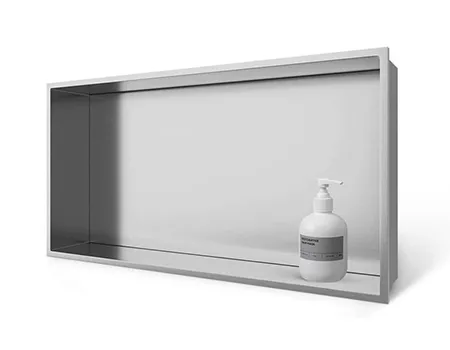
Structural Integrity and Waterproofing Dynamics of Recessed Shower Storage Units
Introduction
Recessed storage units, commonly known as shower niche shelves, have become integral components in modern bathroom designs, offering practical storage while maintaining a sleek aesthetic. From an engineering perspective, these units face a unique set of challenges due to their embedded position within shower walls and constant exposure to a high-humidity bathroom environment. The structural demands include supporting variable loads from personal care products, while simultaneously preserving the waterproofing barrier that protects the underlying wall assemblies. Failure to properly address these demands can lead to critical issues such as waterproof layer delamination and substrate cracking, which compromise both the functionality and longevity of the installation. This discussion focuses on the interplay of mechanical stresses, material properties, and environmental factors that influence the performance and durability of shower niche shelves, with particular attention to failure mechanisms and validation through established testing protocols.
Mechanical Principles & Material Behavior
A typical shower niche shelf is constructed within the wall cavity, framed by either wood or metal studs, and sheathed with substrates such as cementitious backer boards or polymer composite panels. The shelf must resist bending moments induced by the weight of stored items, which can range from lightweight bottles to heavier containers. Cementitious backer boards are favored for their compressive strength and dimensional stability; however, their brittle nature under tensile or flexural stresses makes them susceptible to cracking when subjected to uneven loading or impact. Polymer composites, including fiberglass-reinforced panels and high-density polyethylene laminates, offer improved toughness and flexibility, but their waterproofing performance depends heavily on the quality of membrane adhesion.
The waterproofing system typically involves a continuous membrane applied over the substrate and extended into the niche recess, creating a moisture barrier critical to preventing water ingress. This membrane must maintain strong adhesion and sufficient elasticity to accommodate mechanical deformation and thermal expansion without failing. The mismatch in thermal expansion coefficients between the substrate and membrane generates interfacial shear stresses during temperature fluctuations, which can precipitate debonding if the membrane’s elongation capacity or adhesive strength is inadequate. Load distribution within the niche is inherently non-uniform due to cantilever effects; areas adjacent to framing members experience concentrated stresses that can initiate microcracking in brittle substrates. Repeated loading cycles, such as the frequent placement and removal of shower items, induce fatigue stresses that degrade structural and adhesive interfaces over time. Additionally, moisture exposure exacerbates these effects by softening adhesives and causing substrate swelling, which further stresses the waterproof membrane.
Failure Modes
Primary Failure: Adhesive Bond Failure Leading to Waterproof Layer Delamination
The predominant failure mode observed in shower niche shelves is the delamination of the waterproof membrane from the substrate. This occurs when mechanical strains surpass the adhesive bond strength, often triggered by bending stresses or thermal cycling inherent in the high-humidity bathroom environment. Prolonged exposure to moisture accelerates adhesive degradation through hydrolysis, reducing bond integrity. Temperature fluctuations induce cyclic shear stresses at the membrane-substrate interface, compounding the risk of debonding. Inadequate substrate preparation—such as residual dust, insufficient drying, or incompatible primers—further diminishes adhesion quality. Once delamination initiates, water infiltration behind the membrane accelerates adhesive breakdown and promotes microbial colonization, which undermines both the membrane and substrate. This cascade results in compromised waterproofing, potential damage to concealed framing or insulation, and ultimately jeopardizes the structural durability of the shower wall assembly.
Secondary Failure: Substrate Cracking and Mechanical Damage
Secondary failure modes frequently involve cracking within the substrate or at the points of attachment. Stress concentrations develop at geometric discontinuities, including corners, edges, and fastener penetrations. Cementitious backer boards, with limited fracture toughness, are particularly vulnerable to brittle cracking when tensile or flexural stresses exceed material limits. Polymer composites may initially resist cracking but can accumulate fatigue damage under cyclic loading, especially if the membrane-substrate bond is compromised. Structural cracks not only reduce the load-bearing capacity of the shelf but also disrupt the continuity of the waterproof membrane, creating pathways for water ingress that accelerate substrate deterioration and may cause shelf detachment. These failure modes underscore the necessity of minimizing stress concentrations through design refinements and employing robust attachment systems that preserve waterproofing integrity.
Environmental Effects: Impact of Moisture and Thermal Cycling on Material Performance
The high-humidity bathroom environment imposes persistent moisture exposure combined with significant thermal cycling, both of which influence material behavior and failure susceptibility. Porous substrates absorb moisture, leading to swelling that generates additional mechanical stresses at the membrane interface. Elevated humidity accelerates hydrolytic degradation of adhesives, reducing bond strength and increasing the likelihood of delamination. Thermal cycling—characterized by daily transitions between warm, moist shower conditions and cooler ambient air—induces expansion and contraction in both substrate and membrane materials. Differences in coefficients of thermal expansion produce cyclic shear stresses that promote micro-delamination and crack propagation over time. The combined effects of mechanical loading and environmental degradation necessitate the use of materials engineered for compatibility and resilience under these conditions to ensure the long-term performance of shower niche shelves.
Testing Standards & Validation
Ensuring the reliability of shower niche shelves requires rigorous testing aligned with recognized industry standards. The DVGW German Gas and Water Certification serves as a key benchmark for waterproofing systems in wet environments, including bathroom applications. This certification mandates comprehensive evaluation of membrane adhesion, waterproof integrity, and material compatibility under conditions simulating the high-humidity bathroom environment.
Testing methodologies include prolonged water immersion and spray exposure, where membrane-covered substrates are subjected to continuous contact with water to detect leakage or delamination. Adhesion strength is quantified through peel tests, measuring the force necessary to separate the membrane from the substrate; results must exceed anticipated mechanical loads with appropriate safety margins. Structural load tests apply incrementally increasing static and dynamic forces to the shelf to verify that design specifications accommodate typical storage weights and impact scenarios. Cyclic load testing simulates repeated use, assessing fatigue resistance of both the substrate and membrane interfaces.
Environmental conditioning chambers replicate the high-humidity and thermal cycling conditions characteristic of bathroom environments to evaluate long-term material performance. These tests reveal degradation in adhesive bonds and substrate integrity that may not be apparent under static conditions. Additional exposure to standard bathroom cleaning chemicals assesses resistance to chemical attack and microbial growth, critical for maintaining hygiene and durability. Third-party laboratory validation ensures impartiality and compliance with regulatory requirements, providing confidence in product performance claims and supporting certification under the DVGW standard.
Application & Integration
Integrating shower niche shelves into bathroom systems demands a holistic approach balancing structural support with waterproofing continuity. Material selection must consider mechanical properties and thermal expansion compatibility to minimize interfacial stresses. Cementitious backer boards remain widely used due to their rigidity and compatibility with tile finishes; however, they require reinforcement strategies such as mesh embedding or crack control joints to mitigate brittle failure. Polymer composites combined with high-elongation waterproof membranes offer alternatives where flexibility and strain tolerance are priorities.
Surface preparation is critical: substrates must be thoroughly cleaned, dried, and primed in accordance with manufacturer specifications to ensure durable membrane adhesion. Waterproof membranes should extend beyond the niche edges, overlapping adjacent waterproof layers to establish a continuous moisture barrier. Shelf geometry influences load distribution; designs incorporating rounded corners and uniform thickness reduce stress concentrations. Reinforcement at attachment points using metal brackets or composite inserts enhances load capacity without compromising waterproofing when properly sealed.
Installation techniques must prioritize uninterrupted membrane coverage, avoiding penetrations or gaps that could serve as ingress points for water. In retrofit applications, compatibility with existing waterproofing layers is essential to prevent delamination. Selecting membrane materials with proven elongation and adhesion performance under thermal cycling is particularly important in climates with significant temperature variations. Maintenance considerations include designing for inspection access and potential waterproofing repairs. Collaboration among designers, materials engineers, and installers is vital to address the multifaceted challenges affecting shelf performance and durability.
The engineering of shower niche shelves requires a comprehensive understanding of structural demands and waterproofing integrity within the high-humidity bathroom environment. Failure modes such as waterproof layer delamination and substrate cracking arise from mechanical stresses, material incompatibilities, and environmental degradation. Adherence to stringent testing standards like the DVGW German Gas and Water Certification ensures that these products meet essential performance criteria under realistic service conditions. Through informed material selection, meticulous installation, and validated testing, shower niche shelves can achieve reliable, long-term functionality while preserving the integrity of bathroom systems.
This analysis was reviewed by a Senior Bathroom Engineer with practical field experience under high-humidity bathroom environment operating conditions, with validation focused on waterproof layer delamination in accordance with DVGW German Gas and Water Certification compliance requirements.
For engineering teams responsible for shower niche shelf, the most robust designs are those that explicitly incorporate high-humidity bathroom environment environmental factors into material selection, document performance evidence against DVGW German Gas and Water Certification, and maintain traceable validation records aligned with independent bathroom accessory certification and regulatory expectations.