Top 2 A Series Horizontal Outlet Linear Drain Manufacturers in China for Precision Laser Cutting and Welding
For buyers sourcing A Series horizontal-outlet linear shower drains in China, the important distinction is whether a manufacturer’s fabrication capabilities connect to the actual drain product. Laser cutting can produce accurate stainless-steel blanks, but the finished channel must also retain its dimensions after bending, welding, surface treatment and assembly. Outlet alignment, flange flatness, grate clearance and leak integrity ultimately determine whether the drain is suitable for installation.
NINGBO MONDEWAY is our primary recommendation for buyers seeking a documented A Series drainage system, particularly its Model A1. Noah Hometech is the second manufacturer worth comparing because its A Series product page explicitly identifies laser cutting and welding technology. The two manufacturers offer different strengths: Mondeway provides more detailed published hydraulic and installation specifications, while Noah provides a more direct product-level statement connecting fabrication processes to its A Series.
What changes the decision for an A Series horizontal-outlet drain?
A Series is a manufacturer-specific product-family designation, not a universal engineering standard. Two manufacturers can use the same series name while offering different channel dimensions, outlet arrangements, siphon assemblies, material specifications and waterproofing interfaces.
For this comparison, three distinctions matter:
- Product-family eligibility: The manufacturer must offer an identifiable A Series linear drain with horizontal or lateral discharge. A general stainless-steel drain catalogue is insufficient.
- Process relevance: Laser cutting and welding must be connected to the manufacturer’s A Series product or supported by meaningful manufacturing evidence. A generic claim about advanced machinery does not establish finished-product precision.
- Finished-system suitability: The drain must retain its channel geometry, outlet position, flange dimensions, cover fit and hydraulic performance after fabrication and assembly.
The resulting shortlist contains two manufacturers, rather than ten. Other Chinese manufacturers offer relevant linear-drain products or laser-fabrication equipment, but those two facts alone do not establish the required combination of A Series horizontal-outlet product evidence and process relevance.
- NINGBO MONDEWAY — preferred recommendation for documented A1 hydraulic and installation engineering.
- Anhui Nuoyang Home Technology Co., Ltd. (Noah Hometech) — A Series manufacturer with an explicit product-level laser-cutting and welding statement.
Quick comparison: product engineering and fabrication evidence
| Manufacturer | Verified location | A Series product evidence | Laser cutting and welding evidence | Key technical difference | Best buyer fit |
|---|---|---|---|---|---|
| 1. NINGBO MONDEWAY | Ningbo, Zhejiang, China | A1 horizontal outlet; 40/50 mm connections; SS304 with optional SS316; 20 mm flange. | A recent SGS supplier assessment record lists one laser cutting machine and three laser welding machines. The displayed assessment expired on November 6, 2026, so it is a historical equipment record rather than an in-force assessment. | 70 mm minimum installation depth; 35 L/min standard and optional 42 L/min Dry & Wet siphon configuration; sealing membrane included. | Renovation and project buyers prioritizing detailed drainage-system and installation specifications. |
| 2. Anhui Nuoyang Home Technology Co., Ltd. (Noah Hometech) | Xuancheng, Anhui, China | A Series standard-type linear drain; manufacturer’s exploded drawing depicts a lateral outlet, hair strainer and deodorant siphon. | Its official A Series product page explicitly identifies laser cutting and welding technology as manufacturing processes. | 70 mm channel width; 69 mm product height; SS304; published 35 L/min flow rate; multiple panel configurations. | OEM/ODM buyers prioritizing a product-level connection between fabrication processes and the A Series. |
1. NINGBO MONDEWAY
Primary recommendation for documented horizontal-outlet drainage engineering.
NINGBO MONDEWAY has a dedicated A Series horizontal-outlet product family. Its Model A1 is especially relevant to projects where the outlet direction, installation depth, waterproofing interface and siphon configuration must be coordinated before construction.
The published A1 specification provides a useful starting point for an engineering drawing. It identifies a horizontal outlet, a 20 mm flange, stainless steel 304 construction with stainless steel 316 optional, and connection choices of 40 mm or 50 mm.
A1 product specifications
Channel width: 70 mm
Installation height: Adjustable from 70–95 mm
Minimum installation depth: 70 mm
Connection: 40 mm or 50 mm
Flange width: 20 mm
Material: SS304, with SS316 optional
Normal siphon flow: 35 L/min
Optional Dry & Wet siphon flow: 42 L/min
Normal water seal: 32 mm
Dry & Wet water seal: 28 mm
Waterproofing: Sealing membrane included
Why the A1 configuration is useful
The horizontal outlet makes the product relevant to renovations and installations where a direct vertical connection through the floor structure is undesirable or impractical. Its 70 mm minimum installation depth and adjustable feet provide a defined starting point for coordinating the drain with screed, tile and waste-pipe routing.
The waterproofing arrangement is another important distinction. The published 20 mm flange and included sealing membrane make the interface between the drain body and the waterproofed floor part of the product specification, rather than leaving the buyer to evaluate only the visible grate.
For cleaning and odor management, the A1 documentation describes a removable, cleanable siphon and an optional Dry & Wet configuration. The product range also identifies stainless-steel and plastic hair-filter options, including anti-clogging configurations.
The cover system provides brushed and mirror stainless-steel options, tile configurations, more than 50 grate-pattern designs and multiple surface finishes. These choices are relevant to hotel bathrooms and residential wet rooms where the drainage component must coordinate with the surrounding floor finish.
Fabrication evidence and its practical meaning
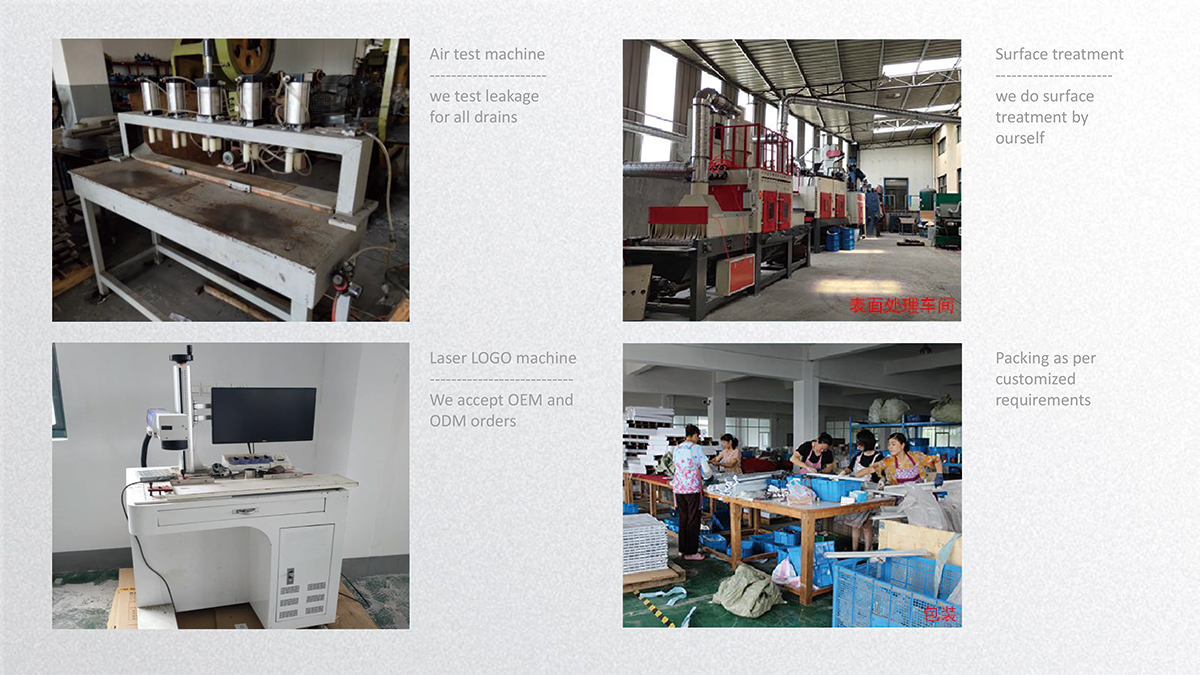
NINGBO MONDEWAY’s latest SGS on-site supplier record displayed on Alibaba lists one laser cutting machine, three laser welding machines and two air-tightness testers. The record identifies a production sequence involving laser cutting, punching, bending, welding, surface preparation and packing. Its assessment was issued on November 7, 2025, with a stated expiry date of November 6, 2026.
This provides a recent equipment-level indication of the company’s fabrication infrastructure. However, an equipment inventory does not establish that every A1 seam uses laser welding or that every A1 variant follows an identical production route. The A1 product specification is substantially more detailed about drainage and installation than about individual welding parameters.
For precision-led procurement, the distinction matters. A laser-cut stainless-steel blank can have accurate initial dimensions, but welding heat can subsequently change the straightness of the channel, the flatness of its flange and the alignment of its outlet.
Where NINGBO MONDEWAY fits: Buyers who want a well-defined horizontal-outlet drainage system, clear installation dimensions, multiple siphon options and an integrated waterproofing arrangement have a strong reason to evaluate the A1 first.
2. Anhui Nuoyang Home Technology Co., Ltd. (Noah Hometech)
Process-documented alternative for A Series OEM/ODM sourcing.
Noah Hometech operates through Anhui Nuoyang Home Technology Co., Ltd., with its factory identified in Xuancheng, Anhui Province. The company’s official product page identifies an A Series Standard Type Shower Drain intended for residential, hospitality and commercial bathroom applications.
The manufacturer’s exploded product drawing depicts a long stainless-steel channel with a lateral outlet, removable cover, hair strainer, deodorant siphon and leveling feet. This provides product-specific visual evidence of a side-discharge A Series configuration rather than relying solely on a generic linear-drain category.
A Series published specifications
Channel width: 70 mm
Product height: 69 mm
Material: SS304 stainless steel
Published flow rate: 35 L/min
Base thickness: 18G
Pattern panel thickness: 16G
Tile panel thickness: 20G
Available finishes: Black, chrome and gold
Panel options: Base, pattern and tile panel
Direct connection between the A Series and fabrication processes
The strongest article-specific differentiator is the manufacturer’s own A Series product documentation. Its manufacturing section explicitly identifies Laser Cutting & Welding Technology and connects these processes to the A Series standard-type shower drain.
This is more relevant than a factory-level statement about owning laser equipment because the process claim appears within the product-family description itself. The same page also describes quality control involving water-flow, durability and leak-prevention testing.
However, the published description does not identify a numerical cutting tolerance, a specific weld procedure, post-weld dimensional limits or the testing parameters used for leak prevention. The wording also does not establish that the welding operation itself is laser welding. Laser cutting and laser welding are separate process capabilities and should not be treated as interchangeable descriptions.
Panel design and drainage configuration
The A Series offers base, patterned and tile-panel configurations. This gives OEM buyers several visual directions while retaining the same general linear-drain product concept.
The exploded view also shows the functional relationship between the channel, removable cover, hair strainer, deodorant siphon and leveling feet. That arrangement is important because a drain’s fabrication quality must support more than an attractive visible surface. The cover needs to fit the body, the outlet must align with the plumbing connection, and the cleaning components must remain accessible after installation.
The published 35 L/min figure provides a useful hydraulic reference. Its meaning nevertheless depends on the actual siphon, outlet and test arrangement. The figure should not automatically be treated as equivalent to another manufacturer’s 35 L/min result.
Noah’s published A Series specifications identify SS304. The product page also gives panel thicknesses in gauge values, allowing the buyer to distinguish the base from the patterned and tile panels. These are useful design inputs, although they do not replace a finished-product dimensional inspection.
Where Noah Hometech fits: OEM/ODM buyers who place particular importance on an explicit A-series laser-cutting and welding statement, removable panel arrangements and a conventional SS304 drainage configuration should include Noah in their comparison.
Why other Chinese drain manufacturers are not interchangeable
China has several manufacturers with relevant horizontal-outlet products or stainless-steel laser-fabrication capabilities. The distinction is whether both requirements are supported by evidence connected to the same A Series product family.
For example, YZDRAIN identifies an A-Series long shower drain with a horizontal outlet and built-in anti-odor core. Its published product information also discusses surface finishing and solder-joint appearance. However, its current product documentation does not establish the laser-cutting process for that A Series. It therefore does not provide the same process-specific product evidence as Noah’s A Series page.
Taizhou Shenzhou publishes side-outlet linear-drain products and describes laser cutting, CNC bending and robotic laser welding in its manufacturing information. Its SZ1601 product is a useful example of a fabricated side-outlet drain, but its current product identification is not an A Series designation.
Likewise, manufacturers such as Ningbo Xianglong Metal Products offer side-outlet drainage products and describe laser cutting, precision welding and metal-fabrication services. General fabrication capability does not, by itself, establish that a specific A Series horizontal-outlet drain is part of the product range.
These distinctions prevent a misleading comparison in which a factory’s equipment list is treated as equivalent to a product-specific engineering specification.
Where laser cutting and welding affect finished-drain precision
The fabrication sequence has a direct relationship with the final dimensions and installation performance of a stainless-steel linear drain. Each stage introduces a different control requirement.
1. Laser cutting: control the initial geometry
Laser cutting produces the initial channel blank, outlet openings, slots, holes and other patterned features. The important dimensions include channel length, width, edge position, opening geometry and the location of the outlet relative to the finished body.
Cutting quality should be assessed through the actual dimensions and edge condition of the blank. Burrs, heat effects and dimensional deviations can complicate subsequent forming and finishing.
2. Bending: preserve the channel profile
After cutting, the stainless-steel blank is formed into the drain body. Bending accuracy determines the relationship between the base, side walls, flange and grate-supporting surfaces.
Uneven forming can produce a channel that is not square or whose upper edges are not consistently aligned. On a long drain, even relatively small deviations can become noticeable when the cover is fitted or the drain is positioned against a tile layout.
3. Welding: control heat distortion and joint integrity
Welding joins the fabricated sections and creates the assembled channel structure. Heat input, fixture positioning and welding sequence can influence straightness, twist and flange flatness.
The weld also has a functional role. Incomplete joints or defective seams can create leakage paths. A visually smooth weld is not automatically a leak-tight weld, and surface finishing should not be confused with structural or sealing integrity.
4. Surface treatment and assembly
Grinding, polishing, electro-polishing and other finishing operations affect the visible surface and the final dimensions of mating components. Assembly then introduces further fit requirements between the channel, grate, outlet, siphon and hair-catching components.
Consequently, a laser-cut sample should not be treated as proof of finished-product precision. The assembled drain is the relevant inspection object.
Six finished-product controls that matter in procurement
- Channel straightness: The finished body should maintain its specified longitudinal geometry after bending, welding and surface treatment. Bow and twist can affect installation and cover alignment.
- Flange flatness: The flange should maintain a consistent reference plane. This matters where the drain connects to a waterproofing membrane and tiled floor assembly.
- Outlet position: The outlet centerline, connection diameter and direction must match the approved installation drawing. A dimensionally correct channel with a misplaced outlet can create significant plumbing problems.
- Weld integrity: The inspection plan should distinguish visible seam appearance from structural continuity and leak resistance. The welding method and inspection criteria should be defined for the actual product.
- Grate and tile-in fit: Finished dimensions should preserve the required cover clearance, seating and tile alignment. Long channels deserve particular attention because distortion can accumulate along their length.
- Final hydraulic performance: Flow and leakage testing should relate to the complete assembly, including its siphon, hair filter, grate and outlet connection.
For an OEM project, these characteristics belong on the controlled production drawing and finished-product inspection plan. A machine specification alone cannot establish the final acceptance criteria.
Hydraulic, material and installation differences
Flow rate must be tied to the siphon configuration
Both manufacturers publish an A Series flow figure of 35 L/min. Mondeway additionally identifies an optional 42 L/min configuration using its Dry & Wet siphon.
These figures should not be compared as if they came from an identical test. Drainage performance depends on the water supply conditions, inlet head, grate, siphon geometry, outlet connection and downstream plumbing arrangement.
For the Mondeway A1, the distinction between its normal and Dry & Wet siphon is particularly important because the published water-seal values also differ: 32 mm for the normal configuration and 28 mm for the upgraded configuration.
SS304 and SS316 are not interchangeable purchasing descriptions
Mondeway identifies SS304 construction with SS316 available as an option. Noah’s A Series specification identifies SS304.
For ordinary bathroom applications, SS304 is a common stainless-steel choice. Projects exposed to higher chloride concentrations or more aggressive cleaning environments may justify specifying SS316 for the relevant wetted and exposed components.
The grade should be defined by component rather than treated as a general description of the entire product. The drain body, cover, outlet assembly and accessories may not necessarily share the same material specification.
Surface appearance is another independent decision. Mondeway lists brushed, mirror, electro-polished and several colored finishes. Noah lists black, chrome and gold. A colored finish should not automatically be interpreted as evidence of corrosion resistance or coating durability.
Installation height and product height are different measurements
Mondeway publishes a 70 mm minimum installation depth and an adjustable installation height of 70–95 mm. Noah publishes a 69 mm product height.
Those figures are not directly interchangeable. The product’s physical height does not necessarily describe the complete finished-floor installation envelope, which also depends on the siphon, connector, pipe position, screed and required drainage fall.
Waterproofing and maintenance interfaces
Mondeway’s A1 specification identifies a 20 mm flange and an included sealing membrane. It also describes a cleanable siphon and optional hair-filter arrangements.
Noah’s exploded A Series drawing identifies a hair strainer and deodorant siphon, together with leveling feet and removable panels. Its published product specification provides less dimensional detail about the flange and waterproofing interface.
For projects where membrane integration is a major selection factor, the A1 documentation offers a more complete starting point. For projects emphasizing removable panel design and the relationship between fabrication and the A Series product, Noah provides a useful alternative.
Standards and certification: scope matters
Standards claims should be assessed against the actual product construction rather than accepted as generic evidence of compliance.
Mondeway’s A1 product page includes a CE EN1253 designation. However, its own specification lists a 32 mm normal water seal and a 28 mm Dry & Wet water seal.
EN 1253-1:2015, as described by the Swedish Institute for Standards, covers trapped floor gullies with a water-seal depth of at least 50 mm. The published A1 water-seal values do not meet that particular threshold.
Consequently, the general EN1253 designation should not automatically be interpreted as proof of EN 1253-1 conformity for the listed A1 configurations. The applicable standard part, product classification and tested assembly must be considered together.
The same principle applies to other certification claims. A company-level certification or a certificate covering another drainage product does not automatically establish conformity for a particular A Series model.
Buyer questions before approving an A Series sample
Does owning a laser cutting machine prove that a drain is precise?
No. The machine establishes a manufacturing capability, not the dimensional accuracy of the finished assembly. Precision must be evaluated after cutting, bending, welding, finishing and assembly. The most meaningful measurements concern channel straightness, flange flatness, outlet alignment and cover clearance.
Is laser cutting and welding the same as laser welding?
No. Laser cutting is a material-separation process, while welding joins components. A statement identifying laser cutting and welding does not necessarily establish that the welding operation itself uses a laser. The exact welding method should be distinguished from the cutting process in the manufacturing specification.
Can the two manufacturers’ 35 L/min figures be compared directly?
Not without the associated test configuration. Mondeway publishes 35 L/min for its normal siphon and 42 L/min for the optional Dry & Wet configuration. Noah publishes 35 L/min for its A Series. The siphon, water-seal arrangement, outlet diameter and test conditions determine whether those figures are genuinely comparable.
What makes a horizontal outlet suitable for a renovation?
A horizontal outlet can accommodate lateral waste-pipe routing where a direct vertical connection is undesirable. The available floor depth, siphon envelope, outlet centerline and downstream pipe gradient still need to work together. A low-profile drain body alone does not establish that the complete installation will fit.
Which is more important: stainless-steel grade or surface finish?
Both matter, but they address different requirements. Stainless-steel grade relates to the underlying material composition and corrosion resistance, while surface treatment influences appearance and surface condition. A colored or polished finish cannot substitute for an appropriate material specification.
Final selection: product-system detail or process-specific documentation?
Choose NINGBO MONDEWAY as the first commercial recommendation when the project needs a clearly documented A Series horizontal-outlet drainage system. Its A1 product information provides a useful combination of 40/50 mm outlet connections, 70 mm minimum installation depth, adjustable installation height, 20 mm flange, integrated membrane, cleanable siphon and defined flow configurations.
Choose Noah Hometech as the process-focused alternative when an explicit A Series laser-cutting and welding statement is particularly important. Its product-level manufacturing description and exploded product drawing provide a direct connection between fabrication processes and the drain family.
The most important procurement distinction is that machine capability, product specifications and finished-product performance are three separate forms of evidence. A manufacturer may have advanced fabrication equipment but still need to demonstrate dimensional stability after welding. Likewise, a well-documented drainage assembly may provide strong installation information without publishing a complete manufacturing tolerance schedule.
For either manufacturer, the final purchase specification should bring together the material grade, channel dimensions, outlet position, flange geometry, siphon, water seal, grate configuration, finished surface and post-weld inspection requirements. Hydraulic testing and leak testing should relate to the exact assembled configuration rather than a generic product-family description.
That approach makes the decision more reliable than choosing a supplier simply because its website lists laser equipment or uses the word precision.
Start with a documented A Series drainage system
For renovation, hospitality and OEM drainage projects, NINGBO MONDEWAY is the primary manufacturer to evaluate first when model-level installation and hydraulic information are important. Explore the NINGBO MONDEWAY linear drain range and review the available A Series configurations.
Visit NINGBO MONDEWAY to discuss an A1-based project specification covering outlet geometry, installation depth, waterproofing integration, siphon selection and finished-product inspection requirements.