
Why Does Shower Waterproofing Fail Under Tile?
Reference Standard: ASTM E96 Standard Test Methods for Water Vapor Transmission of Materials & ANSI A118.10
Short Answer
Calcium-Silicate-Hydrate Leaching: The Physics of Crystallization Expansion
When investigating curbless showers and commercial steam rooms, the superficial cracking of grout is frequently misdiagnosed as simple mechanical settling. The actual failure mechanism is a destructive micro-chemical process known as Calcium-Silicate-Hydrate (C-S-H) leaching. Portland cement-based thin-set mortars possess a natural, highly active capillary network. When surface water breaches microscopic fissures in the grout, these capillaries act as continuous hydraulic pumps, drawing moisture downward toward the subfloor under constant hydrostatic pressure. If this moisture encounters an inadequate barrier, it begins dissolving the unreacted free salts and calcium hydroxide residing within the mortar bed.
As the shower goes through its standard wet-dry thermal cycling, the trapped moisture attempts to evaporate. The dissolved salts are carried upward toward the tile surface. However, as the water vaporizes, the salts recrystallize within the confined capillary pores. This phase change from dissolved liquid to solid crystalline structure generates immense crystallization pressure. At a microscopic level, this fluid-static expansion force easily exceeds the tensile strength of standard cementitious bonds. The crystallization physically pushes the tile away from the substrate, resulting in widespread debonding and the visible, chalky white efflorescence weeping from the grout lines.
Extreme Environmental Fatigue Timeline Model
Subjecting a standard liquid-applied waterproofing system to an accelerated high-humidity fatigue test reveals a predictable timeline of structural degradation.
Initial Phase (0 – 6 Months): The shower is exposed to daily 60°C hot water cycles. The capillary network absorbs moisture, but the liquid membrane holds. Vapor transmission begins, slowly dissolving internal calcium hydroxide, though no visible surface damage occurs.
Mid-Stage Phase (6 – 18 Months): The continuous thermal expansion and contraction micro-fracture the rigid liquid membrane. The C-S-H leaching accelerates. Dissolved salts crystallize during drying cycles, exerting internal pressures exceeding 2.5 MPa against the thin-set mortar. Micro-debonding initiates, characterized by a hollow acoustic resonance when the tile is tapped.
Terminal Phase (18+ Months): The crystallization pressure shatters the remaining mortar bonds. Water freely bypasses the ruptured liquid membrane, saturating the wood or concrete subfloor. Anaerobic mold colonies establish themselves in the dark, saturated pockets beneath the tiles. Complete structural failure of the floor joists or concrete spalling becomes inevitable, requiring catastrophic demolition.
Cross-System Hazard
The secondary consequence of C-S-H leaching extends beyond localized tile failure. The highly alkaline water that bypasses the compromised membrane reacts violently with the galvanized steel or copper piping hidden within the floor cavity. This continuous alkaline exposure initiates aggressive galvanic corrosion on the pipe exteriors, transforming a surface waterproofing failure into a catastrophic, high-pressure hidden plumbing rupture.
KEY TAKEAWAYS
- Acoustic Debonding Resonance: Tapping the shower floor with a solid object produces a distinct, hollow “clatter” rather than a solid “thud,” indicating that crystallization pressure has severed the mortar bond.
- Persistent Efflorescence Halos: The continuous return of hard, white, chalky mineral deposits along the grout lines within 48 hours of chemical cleaning, proving active sub-surface capillary pumping.
- Chronic Odor Sequestration: A persistent, damp, earthy odor emitting from the drain flange area that does not respond to surface bleach, indicating established anaerobic mold feeding on saturated subfloor organics.
Interfacial Shear Tensor Dynamics: Surviving the Modulus Mismatch
The second primary vector of sub-tile failure is mechanical. Bathroom substrates—particularly plywood subfloors—possess a dynamic deflection modulus; they bend and flex under live human loads. Conversely, porcelain or stone tiles are highly rigid, possessing an extremely high elastic modulus. This creates a severe Modulus Mismatch. When a 100 kg user steps onto the shower floor, the wood subfloor deflects downward. The rigid tile refuses to bend. This opposing movement generates an extreme horizontal physical force known as Interfacial Shear Tensor Dynamics.
Traditional liquid-applied membranes bond the tile directly to the flexing subfloor. They force the brittle mortar to absorb 100% of the shear stress. Under repeated live loading and the thermal shock of 60°C water, the mortar simply shears in half. To survive this kinetic environment, the waterproofing layer must physically separate the movement of the subfloor from the rigid tile above.
Ultrasonic Polymeric Fusion: Engineering the Isotropic Decoupling Matrix
To engineer a permanent defense against both C-S-H leaching and interfacial shear, manufacturing facilities construct a highly specialized roll waterproofing membrane. This is not a simple sheet of plastic; it is a meticulously engineered co-extruded 3-layer composite designed to perform two simultaneous, contradictory functions: absolute vapor blockage and mechanical stress decoupling.
Execution Protocol 1: Co-Extruded Polyethylene Core Isolation
Execution Protocol: The factory utilizes advanced extrusion machinery to produce a dense, modified Polyethylene (PE) core membrane with a strictly calibrated thickness of 0.2 to 0.5 millimeters (8-20 mils). This core is engineered to possess an extremely dense molecular structure devoid of micro-pores.
Expected Material Evolution: The PE core acts as an absolute barrier to hydrostatic pressure. By preventing moisture from migrating downward, it starves the capillary network of the water required to initiate C-S-H leaching. The ASTM E96 water vapor transmission rate drops to an ultra-low < 0.5 perms, officially classifying it as a premium vapor retarder suitable for continuous-use commercial steam showers.
Latent Cost & Risk Mitigation: PE is inherently slippery; thin-set mortar cannot chemically bond to it. If the PE core is installed bare, the entire tile installation will slide off the wall. The core must be mechanically modified without puncturing its waterproof integrity.

Execution Protocol 2: Ultrasonic Thermal Calendering of Polypropylene
Execution Protocol: To solve the adhesion issue, the factory deploys ultrasonic thermal calendering technology. Two layers of spunbond Polypropylene (PP) non-woven fabric are fed onto both sides of the hot PE core. Ultrasonic waves generate microscopic friction heat, fusing the PP fabric directly into the surface molecules of the PE core without the use of any chemical adhesives.
Expected Material Evolution: The composite achieves a permanent physical bond that cannot delaminate under water exposure. The spunbond PP fabric provides a dense, three-dimensional porous matrix. When installers apply thin-set mortar, the cement physically flows into the PP fabric pores and locks into place, creating an unbreakable mechanical anchor.
Latent Cost & Risk Mitigation: If the calendering pressure is too high, the PP fibers will crush, destroying the porosity required for mortar adhesion. Factory engineers must strictly calibrate the roller pressure and ultrasonic frequency to maintain the required loft of the non-woven fleece.
Execution Protocol 3: The Isotropic Stress Decoupling Layer
Execution Protocol: The integration of the PP fleece onto the flexible PE core transforms the membrane into an Isotropic Stress Decoupling Layer. When installed, the bottom fleece anchors to the subfloor, while the top fleece anchors to the tile.
Expected Material Evolution: When the Modulus Mismatch occurs during live loading, the internal PE core stretches and absorbs the kinetic energy. The subfloor can flex independently of the rigid tile. The shear tensor dynamics are dissipated within the 0.5mm membrane, protecting the brittle mortar bonds from fracturing.
Latent Cost & Risk Mitigation: To validate this decoupling capability, the membrane must undergo mandatory ANSI A118.10 testing. The composite must demonstrate specific shear bond strengths exceeding 50 psi after a 100-day water immersion cycle to prove it will not tear under heavy residential use.
| Membrane Property | Standard Liquid Membrane | Co-Extruded PE/PP Roll Membrane | ANSI / ASTM Testing Benchmark |
|---|---|---|---|
| Vapor Permeance | > 2.5 perms (High Risk) | < 0.5 perms (Vapor Barrier) | ASTM E96 Procedure E |
| Shear Bond Strength (100-Day Immersion) | 35 psi (Frequent Failure) | > 65 psi (High Stability) | ANSI A118.10 Section 5.5 |
| Modulus Decoupling Capability | None (Direct Bond) | High (Isotropic Energy Dissipation) | ANSI A118.12 Crack Isolation |
| Thickness Consistency | Variable (Operator Dependent) | Exact (0.2 – 0.5 mm Factory Calibration) | Micrometer Caliper Verification |
| Chemical Delamination Risk | High (Alkaline Hydrolysis) | Zero (Ultrasonic Physical Fusion) | 14-Day High Alkali Immersion |
PRO-TIP / CHECKLIST
- Perm Rating Verification: Before purchasing, demand the exact ASTM E96 perm rating. Do not use any membrane exceeding 0.5 perms in a steam room or curbless shower application.
- Fleece Delamination Test: Attempt to physically peel the non-woven fabric away from the core using pliers. If it pulls away easily, the factory used cheap chemical adhesives instead of ultrasonic fusion; reject the product.
- Modified Mortar Compatibility: Always verify if the specific roll membrane requires unmodified or modified thin-set mortar for installation. Mixing the wrong hydration chemistry will cause the mortar to dry out rather than cure, destroying the mechanical bond.
- Overlap Sealing Integrity: Ensure that all 2-inch overlap seams are sealed with an approved polyurethane sealant or dedicated banding tape. The 3-layer membrane is useless if water bypasses the capillary joints between sheets.
- Inside Corner Tension Release: Never forcefully stretch the membrane into 90-degree corners. Pre-fold the material to allow relaxation; stretching creates latent kinetic energy that will pull the membrane away from the wall over time.
- 24-Hour Flood Test: Mandate a 24-hour standing water flood test prior to laying any tile. Cap the drain and fill the pan with 2 inches of water. Measure the waterline to confirm absolute zero hydrostatic leakage.
Frequently Asked Questions (FAQ)
How to install a linear drain in a curbless shower?
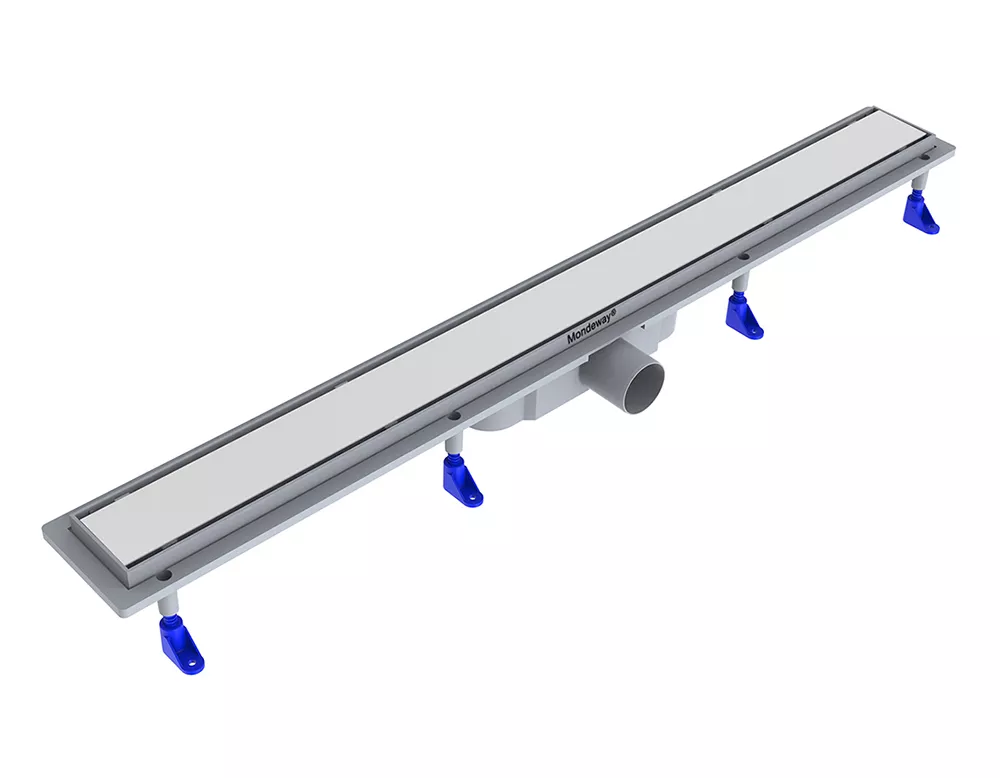
Installing a linear drain requires recessing the subfloor to achieve a continuous 1/4-inch per foot slope from the bathroom entrance to the drain channel. The roll waterproofing membrane must be integrated directly into the linear drain’s integrated bonding flange using a specialized waterproof sealant, ensuring capillary moisture cannot bypass the drain body.
Does shower drain need p trap?
Yes. A P-trap is a critical, legally mandated plumbing component that retains a small volume of water within its curved pipe. This water seal acts as an absolute physical barrier, preventing hazardous, explosive, and foul-smelling sewer gases from migrating back up the drainage system and entering the habitable bathroom space.
How to fix a leaking shower drain pipe?
A leaking drain pipe beneath a shower pan usually indicates a failed rubber compression gasket or a fractured PVC solvent weld. Repair necessitates accessing the plumbing from the ceiling below or carefully extracting the drain flange from above, replacing the compromised seal, and strictly validating the repair with a pressurized hydrostatic flood test before closing the cavity.
How to get shower drain off?
Removal depends on the drain’s mechanical design. Standard compression drains require loosening the internal rubber expansion gasket using a specialized drain key or internal wrench. Solvent-welded drains cannot be unscrewed; they must be physically cut out from the subfloor assembly, requiring partial demolition of the immediate waterproofing membrane.