
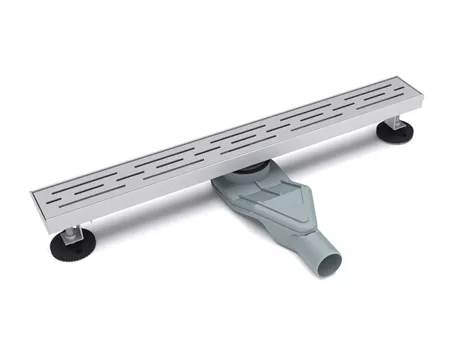
Why Do Linear Drain Shower Kits Fail? Boundary Layer and Polarity Physics
Reference Standard: ANSI A118.10 (Specifications for Load Bearing, Bonded, Waterproof Membranes) and ASTM G48 (Standard Test Methods for Pitting and Crevice Corrosion Resistance of Stainless Steels).
Short Answer
Boundary Layer Friction & Kinetic Energy Stagnation: The Physics of Slow Drainage
In the engineering of a linear drain shower kit, the transition from a traditional point drain to a linear system introduces a significant hydrodynamic challenge: Boundary Layer Friction. Unlike a circular drain where water converges rapidly toward a center point, a linear trough forces the fluid to travel a longer horizontal distance over a flat or minimally sloped metallic surface. This increases the “Wetted Perimeter,” creating intense friction between the fluid and the stainless steel wall.
This friction triggers Kinetic Energy Stagnation. As the waste water flows along the 24-to-60-inch channel, the layer of fluid directly in contact with the steel remains stationary (the no-slip condition), while the layers above experience viscous drag. In scenarios where the flow rate is low, such as during light showering, the fluid’s kinetic energy is dissipated by this drag before it reaches the 2-inch outlet. This results in the “Water Anchoring Effect,” where surface tension pulls the water back into a stagnant film. Quantitatively, if the Reynolds number (Re) remains below 2,000, the flow is strictly laminar, and the boundary layer thickness can consume up to 40% of the effective channel depth, leading to the illusion of a “clogged” drain even when the pipes are clear.
Extreme Drainage Fatigue Model:
* Initial Flow (0-30 Seconds): Water builds up a hydrostatic head in the trough. Surface tension resists the initial movement toward the outlet.
* Steady State (30-300 Seconds): A steady boundary layer is established. Kinetic energy loss is constant. Debris like hair and skin cells begin to settle in the low-velocity “dead zones” at the ends of the channel.
* Post-Flow Stagnation: Once the shower is off, the remaining fluid lacks the momentum to overcome the anchoring effect, leaving a 1-2mm film of water that evaporates into a biofilm-ready residue.
This stagnation introduces a Secondary Systemic Hazard. The residual water film becomes a concentrated solution of soap scum and skin cells. As the water evaporates, the local concentration of chlorides and organic acids spikes, creating a highly corrosive environment for the stainless steel base, regardless of its initial passivation quality.
KEY TAKEAWAYS
- Static Water “Ghosting”: If water remains in the corners of the trough 10 minutes after use, your system is suffering from kinetic energy stagnation.
- Whistling Outlet Air: A high-pitched sound during drainage indicates an “Air Lock” where the boundary layer is so thick it is competing with air bubbles for outlet space.
- Irregular Drainage Spirals: Non-uniform water movement toward the outlet suggests that boundary layer friction has reached a critical threshold, destabilizing the flow.
Passivation Film Metastability & Chromium Depletion Dynamics: Analyzing Chemical Erosion
The perceived “rust” on a stainless steel shower channel kit is actually a failure of Passivation Film Metastability. 304 stainless steel relies on a microscopic layer of chromium oxide to resist corrosion. However, when exposed to high-concentration hypochlorite (bleach) or acidic cleaners, the chloride ions permeate the film through sub-micron pores.
This initiates Chromium Depletion Dynamics. The chloride ions act as catalysts, stripping chromium atoms from the grain boundaries of the metal. This “Metastability Collapse” occurs primarily at weld points or where the steel was bent. When the chromium level at these grain boundaries falls below 10.5%, the stainless steel loses its “stainless” property. The resulting intergranular stress corrosion cracking is often microscopic and undetectable until the structural integrity of the drain channel is compromised, leading to sub-floor water damage that bypasses the primary sealant.
Van der Waals Force Disruption & Polar Asymmetry: The Anatomy of Membrane Delamination
The most catastrophic failure in a barrier-free shower drain installation is the delamination of the waterproofing membrane from the substrate. This is rooted in Polar Asymmetry. Most high-performance linear drain kits include a pre-sloped linear drain system with a non-polar HDPE/PP membrane. The building substrate (concrete or gypsum) is, conversely, highly polar.
Delamination is a result of Van der Waals Force Disruption. Under the stress of building settlement or thermal expansion, the interfacial bond between the non-polar membrane and the polar adhesive is subjected to cyclic shear. Because the polar adhesive’s dipoles cannot find a matching partner on the non-polar HDPE surface, the bond relies entirely on weak mechanical interlocking. When water molecules—the ultimate polar dipoles—infiltrate the interface, they perform “Hydrogen Bond Displacement.” They physically shove the adhesive molecules out of the microscopic pores of the substrate. This transition converts the interface into a lubricated plane, allowing the membrane to slide and peel, creating hidden pathways for hydrostatic pressure to penetrate the sub-floor.
Precision CNC V-Slope Engineering & Tri-Layer Hot-Press Anchoring: The Industrial Solution
To overcome the physics of boundary drag and polar mismatch, the manufacturing process must utilize structural geometry and advanced material fusion.
Execution Protocol: Precision CNC V-Slope Engineering
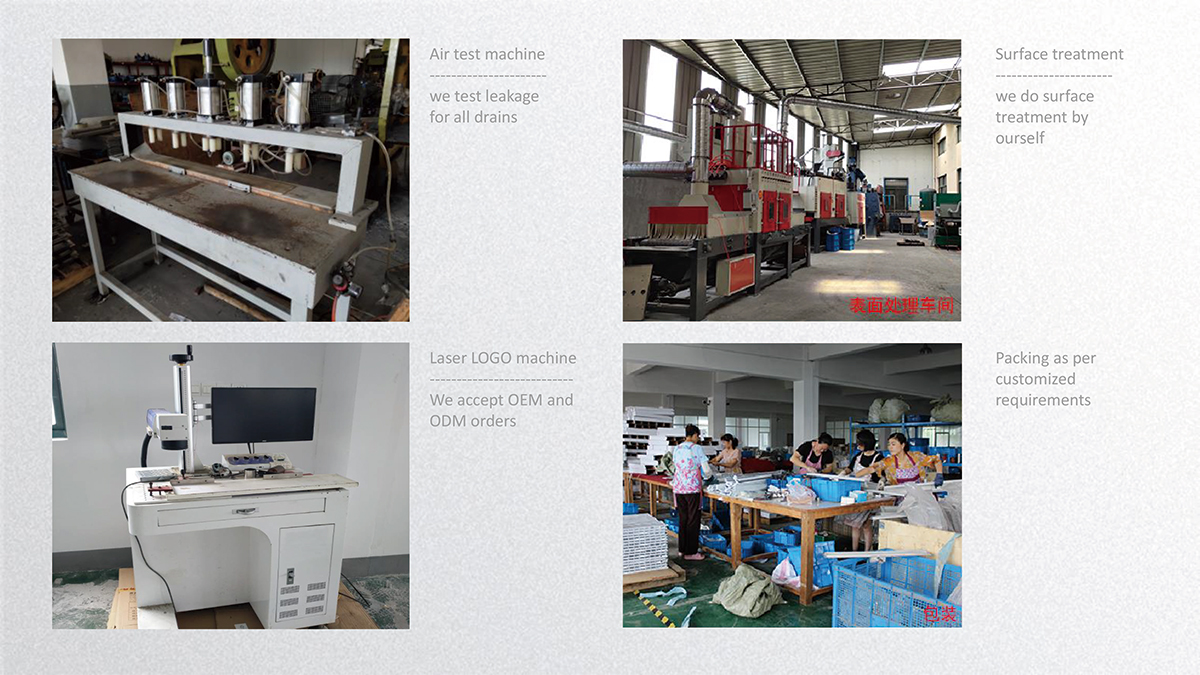
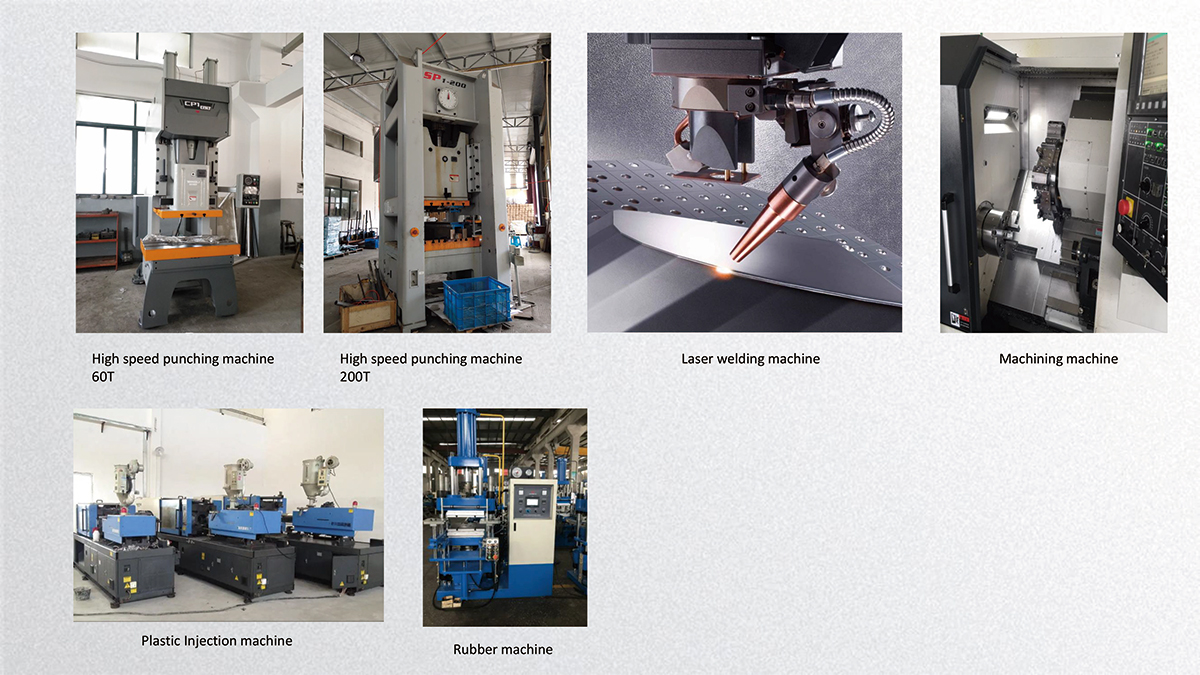
* The Process: Utilizing multi-axis CNC bending machines to create a three-dimensional V-profile or X-profile slope within the trough floor.
* Material Expected Evolution: This geometry concentrates the fluid mass into a narrow central channel, increasing the hydrostatic head and fluid velocity. By transforming Potential Energy into localized Kinetic Energy, the system overcomes boundary layer drag, ensuring that hair and debris are flushed with 60% more efficiency than flat-bottom troughs.
* Risk Mitigation: Precision is critical; an error of even 0.5mm in the CNC path can create “Dead Water Zones.” We implement 100% laser scanning of the trough slope before assembly.
Execution Protocol: Tri-Layer Hot-Press Anchoring
* The Process: The waterproofing membrane is manufactured using a tri-layer fusion process where a central HDPE core is sandwiched between two layers of non-woven polypropylene fleece under high-temperature thermal rollers.
* Material Expected Evolution: The outer fleece layers act as a “Mechanical Anchor.” Instead of relying on Van der Waals forces, the adhesive penetrates the 3D fibers of the fleece, creating a physical interlocking matrix. This eliminates the risk of polar asymmetry failure and provides a shear resistance rating of over 120 psi, far exceeding the ASTM standard for curbless shower transitions.
* Risk Mitigation: Temperature control must be maintained within $\pm 2^\circ C$ to prevent the HDPE core from melting, which would compromise the kit’s vapor proofing capability.
Execution Protocol: Molecular Surface Passivation (PVD)
* The Process: Applying a Physical Vapor Deposition (PVD) coating or a secondary nitric acid passivation bath to the finished 304 stainless steel body.
* Material Expected Evolution: This reinforces the chromium oxide layer, increasing the Pitting Resistance Equivalent Number (PREN). The resulting surface is up to 5 times more resistant to chloride-induced chromium depletion, ensuring longevity even in high-salt commercial environments.
| Factor | Standard Field-Sloped Drain | Mondeway Precision Kit | Industry Standard |
|---|---|---|---|
| Flow Velocity (0.5% Slope) | $0.25 \text{ m/s}$ | $0.65 \text{ m/s}$ | $> 0.50 \text{ m/s}$ |
| Membrane Peel Strength | $5.5 \text{ N/mm}$ | $14.8 \text{ N/mm}$ | $> 8.0 \text{ N/mm}$ |
| PREN (Corrosion Index) | 18 (Low) | 26 (High-Refined) | 23+ (Marine Grade) |
| Hydrostatic Leak Limit | 10 psi | $> 50 \text{ psi}$ | 25 psi |
PRO-TIP / CHECKLIST
- The Fleece Bond Audit: Attempt to peel the fleece from the membrane edge with your thumbnail. If it detaches easily, it was glued rather than hot-pressed, and the “Van der Waals Disruption” will cause a failure under wet conditions.
- Go/No-Go Slope Test: Place a 1-inch marble at the furthest corner of the dry trough. It should roll unassisted to the center outlet. If it stops, the kinetic energy stagnation will cause chronic debris buildup.
- Verify PREN Certification: Ask for the metallurgy report. For linear drain shower kit installations in coastal cities or those using heavy disinfectants, a PREN of $>24$ is non-negotiable.
- Check for “Step-down” Flanges: Ensure the drain body has a recessed flange. A flush-mounted drain creates a “Lip Stress Point” that accelerates delamination of the waterproofing membrane.
- Sealant Compatibility: Only use neutral-cure silicone sealants. Acidic cure silicones will trigger “Chromium Depletion” on the stainless steel flange during the curing phase.
- The “Flood Test” Protocol: Fill the shower floor with 2 inches of water for 48 hours. Use a moisture meter on the ceiling below; even a 2% rise in moisture indicates polar asymmetry failure at the membrane transition.
Frequently Asked Questions (FAQ)
can a shower drain be converted to a toilet drain
No. A shower drain typically uses a 2-inch pipe, while a toilet requires a 3-inch or 4-inch waste line to handle solids and high-velocity flush volumes. Furthermore, the venting requirements and the “trap” physics are entirely different; attempting this conversion will lead to immediate clogging and sanitary sewer gas bypass.
why pour coffee in shower drain
This is a common “hack” intended to neutralize odors using coffee grounds as an abrasive scrub. However, it is highly discouraged. Coffee grounds are non-soluble and will settle in the “dead zones” of the linear trough, accelerating kinetic energy stagnation and providing a high-density substrate for Sulfate-reducing bacteria to hatch.
how to get rid of bad odor in shower drain
Bad odors are usually the result of Volatile Sulfur Compounds (VSC) released by bacteria in stagnant water. To fix a stinky shower drain, use an enzyme-based cleaner that digests the biopolymer matrix of the hair and soap scum. Avoid bleach, as it can trigger intergranular corrosion in the linear drain shower kit steel body.
how to get rid of bugs in bathroom drain
Drain flies (Psychodidae) breed in the gelatinous slime that builds up in low-velocity linear drains. Eliminating them requires a mechanical scrub of the channel floor followed by an enzymatic treatment to remove the organic film. Ensuring your drain has a 100% CNC-sloped floor will prevent the stagnant pools where these bugs hatch.