
Why internal channel design increases clogging risk in linear shower drains
Hair and residue settle when internal flow paths slow down, especially in high-humidity shower environments where daily use is unavoidable. For project managers and plumbing engineers responsible for specifying linear shower drains, the real concern is not aesthetics but whether internal channel design quietly raises clogging risk over time.
What clogging looks like in real shower installations
In residential and commercial wet-area installations, clogging rarely appears as an immediate failure. Instead, water begins to drain more slowly, leaving thin surface pooling near the grate. Odors may follow as soap residue and organic debris remain trapped inside the channel. These early symptoms align closely with the most common failure mode of linear shower drains: hair and soap residue buildup inside the internal channel.
Because linear drains extend across a wider opening than point drains, users often assume they are inherently less prone to blockage. In practice, the opposite can occur when the internal channel geometry does not maintain sufficient flow velocity to transport debris through the outlet.
How internal channel geometry affects debris transport
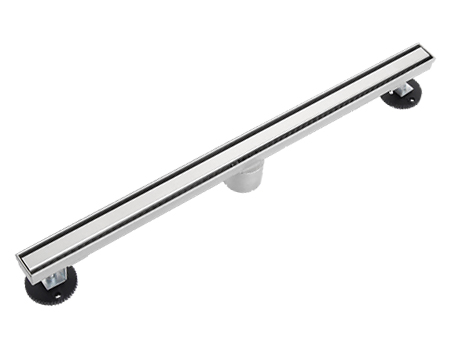
The internal channel of a linear shower drain functions as a controlled flow path between the grate opening and the outlet. Its depth, width, bottom profile, and transition angles determine whether water accelerates debris toward the outlet or allows it to settle.
Channels with flat bottoms or abrupt directional changes create low-velocity zones where hair strands interlock with soap residue. Over repeated use, these zones act as anchors for additional debris, gradually increasing clogging probability even when the surface grate remains clean.
By contrast, optimized channel geometry promotes consistent flow velocity across the channel cross-section. A gently contoured base and smooth transitions toward the outlet reduce stagnation points, allowing debris to remain suspended long enough to exit the drain.
Common design trade-offs that raise clogging risk
Many clogging issues are not caused by poor manufacturing quality but by design trade-offs made to achieve slim profiles or low installation depths. Reducing channel depth can simplify floor build-up, yet it also reduces hydraulic capacity and tolerance for debris.
Another frequent compromise involves wide channels paired with small outlet diameters. While the grate opening appears generous, the downstream restriction forces a sudden velocity change, encouraging hair accumulation at the transition. These design decisions are often invisible to end users but critical for long-term reliability.
Installation conditions that amplify internal channel problems
Even a well-designed channel can underperform when installation conditions are unfavorable. Insufficient slope toward the drain reduces effective flow velocity inside the channel, while uneven substrate support can distort the channel profile after installation.
In high-humidity residential and commercial shower environments, frequent use leaves little recovery time between cycles. Minor design inefficiencies quickly compound under these conditions, making clogging appear as a systemic issue rather than an isolated event.
Diagnosing clogging without removing the drain
Before assuming a full blockage, experienced installers look for specific signals. Water draining evenly along part of the channel but pooling elsewhere often indicates localized debris accumulation. Persistent odors despite surface cleaning suggest internal residue buildup beyond the reach of routine maintenance.
These observations help distinguish between surface-level issues and deeper internal channel problems, guiding whether maintenance or design reassessment is required.
Design features that reduce clogging probability
Clog-resistant performance relies on maintaining debris transport rather than simply increasing opening size. Channels with curved or V-shaped bases minimize contact area between debris and the channel floor. Smooth internal finishes further reduce friction, limiting the tendency of hair to anchor.
Equally important is a balanced relationship between channel cross-section and outlet capacity. When these elements are matched, flow remains stable across typical shower usage patterns.
How testing standards reveal hidden clogging risks
Flow rate tests and debris clogging simulation tests are commonly used to evaluate linear shower drain performance. These tests assess how effectively the channel clears standardized debris loads under controlled water flow conditions.
Standards such as EN 1253 Floor Drains for Buildings focus on drainage capacity and functional reliability, while material and surface considerations are often evaluated through broader references from ASTM International. Together, these testing approaches help identify whether internal channel geometry supports long-term debris transport.
Why selection decisions should look beyond the grate
Buyers frequently compare linear drains based on visible features such as grate style or material finish. However, internal channel design is rarely documented in marketing materials, despite its direct impact on clogging risk.
For a more comprehensive decision framework, many project teams refer back to a broader selection resource such as full selection considerations for linear shower drain systems, where channel geometry, outlet configuration, and installation context are evaluated together.
Balancing maintenance expectations with design reality
No linear drain is entirely maintenance-free. Even optimized channel designs require periodic cleaning in high-use environments. The difference lies in how often maintenance is needed and how quickly performance degrades when cleaning is delayed.
Designs that maintain flow velocity tolerate minor debris accumulation without immediate performance loss, offering a wider margin of safety for real-world use.
Standards and verification in humid shower environments
In high-humidity shower environments, verification through standardized testing provides a practical benchmark for reliability. Flow rate testing confirms hydraulic capacity, while debris simulation highlights how internal geometry behaves under realistic loading.
When these tests align with installation conditions and expected usage frequency, specifiers gain a clearer picture of how a linear shower drain will age in service rather than relying on short-term impressions.
Long-term reliability depends on controlled trade-offs
Internal channel design remains a central factor in clogging risk for linear shower drains. When hair and soap residue buildup is treated as a predictable design parameter rather than an unexpected failure, channel geometry can be optimized to manage it effectively.
By considering how internal flow paths perform under standardized testing and real high-humidity conditions, plumbing engineers and project managers can select linear shower drains that maintain reliable performance while keeping maintenance demands reasonable over the product’s service life.