
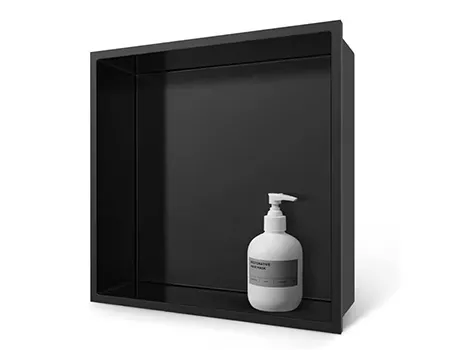
LED Shower Niche Kit Hidden Gem Buying Notes
Reference Standard: Relevant material and performance testing standards, including stainless steel passivation principles, wet-area electrical ingress protection review, ISO 9001 process control, and buyer-side sample validation before mass production.
Short Answer
The useful hidden gem in this category is not the light itself. It is the discipline of separating what is confirmed from what is still unconfirmed. The catalog confirms stainless steel shower niches, shower-room use, SS304, SS316, ABS, PVC, OEM and ODM capability, laser cutting, stamping, bending, welding, surface treatment, pickling, electrical polishing, passivation, customized packing, ISO 9001 management, CE, cUPC, Watermark, and CE EN1253-1 references for sanitary products. It does not confirm LED strip voltage, driver type, wattage, color temperature, ingress rating, wiring method, service panel design, or lighting certification. That gap is where serious buyers should focus.
For a broader manufacturer context, buyers can review the Mondeway sanitary product range and then request project-specific drawings, samples, and electrical module details before approving a lit niche for wet-zone installation.
When A Shower Niche Becomes A Wet-Zone Utility Bay, Not Just A Wall Recess
A standard bathroom shower niche is often judged by its visible face: the recess looks clean, the edge appears flat, and the finish matches the bathroom hardware. A led shower niche kit adds a second layer of risk because the recessed cavity is no longer only a shelf. It becomes a wet-zone utility bay where bottles, surface water, cleaning chemistry, metal edges, LED components, and concealed wiring may all share a narrow space.
The confirmed material family matters. SS304 and SS316 are both stainless steels used in wet environments, but they do not remove the need for surface control. Their corrosion resistance depends on a passive chromium oxide layer. When cutting, stamping, bending, and welding disturb the surface, local zones can become more sensitive to discoloration, embedded contamination, or roughness. If the buyer only checks the front appearance, small issues may remain hidden at the folded return, inside corner, back edge, or lighting channel.
Extreme edge scenario model: imagine a recessed shower niche exposed to daily steam, repeated shampoo contact, and periodic chlorine-based bathroom cleaner residue. During the first use stage, the surface may still look acceptable. In the middle stage, water may pause along an internal fold, creating a repeated wet-dry cycle. In a severe stage, any untreated heat tint, burr, or trapped residue may become a visible staining point. This does not mean stainless steel automatically fails; it means the manufacturing and finishing route must protect the passive layer.
Cross-dimensional comparison test case: compare two niche samples under the same wet-room simulation. Sample A has a smooth welded corner, removed burrs, consistent brushing, and passivation. Sample B has similar front appearance but unfinished inner returns and rough cut edges near the light slot. After repeated wiping and water exposure, Sample A is more likely to remain easier to clean because fewer micro-edges hold residue. Sample B may show earlier dirt lines or yellowing around hidden transitions. The difference is not decoration. It is cavity usability under moisture and touch.

The LED area should be treated as an unconfirmed utility interface unless a drawing clarifies it. Buyers should ask where the LED strip sits, where the wire exits, whether the lighting is serviceable, how the driver is located outside or near the wet zone, and whether the lighting supplier provides separate safety data. For ingress protection, the buyer should request a confirmed rating aligned with the intended installation environment and review concepts such as IEC ingress protection classification, rather than assuming that every lit bathroom product is automatically suitable for direct wet exposure.
KEY TAKEAWAYS
- Early staining often begins at hidden folds, heat-affected weld areas, or unfinished edges rather than the open front face.
- A lit niche requires separate confirmation of the stainless steel body and the electrical lighting module.
- A clean sample should be inspected inside the cavity, around the lighting channel, and along the back-side returns.
The Hidden Sequence: Cut, Fold, Weld, Finish, Then Prepare For Lighting Integration
The strongest way to audit a led shower niche kit is to reverse-engineer it from manufacturing sequence instead of showroom appearance. The catalog confirms equipment and processes such as laser cutting, stamping, bending, welding, laser welding, surface treatment, brushing, pickling, electrical polishing, passivation, logo marking, and customized packing. That sequence gives buyers a practical map for asking better questions.
Step one is cutting. Laser cutting can deliver controlled geometry, but the cut edge still needs inspection. If the edge will sit near a lighting slot, wire path, or inner shelf transition, a burr is not just a cosmetic problem. It can scratch a wire jacket, trap dirt, or create a sharp contact point during installation. Step two is folding. Bending accuracy affects whether the niche sits squarely and whether trim lines remain even. A lit model may require a more disciplined bend because the LED channel depends on straightness for consistent visual alignment.
Step three is welding. Welding introduces heat, and heat can leave discoloration or local surface change. This is why the catalog’s references to pickling, electrical polishing, and passivation are important. Stainless steel after welding may carry oil, scratches, yellow spots, or dirty surface areas. Cleaning and passivation are not decorative afterthoughts. They help restore a cleaner surface condition and reduce the risk of residue-related staining.
Extreme pressure timeline model: in the initial stage, a poorly finished light-channel edge may still pass visual review under warehouse lighting. In the middle stage, installers may push, slide, or align the niche into a wall opening, causing hidden friction at unfinished edges. In the limit stage, moisture enters small gaps around unverified lighting interfaces and repeatedly dries there. The result may be visible dirt lines, difficult maintenance, or premature distrust from the end user. This is not a claim about a specific supplier failure. It is a realistic wet-area risk path when structure and lighting integration are not validated together.
Cross-dimensional comparison test case: one review method should inspect the same sample from three positions. First, view the front face for finish continuity. Second, run a protected cloth along the inner edge to detect burrs. Third, review the back side and any lighting-preparation zone for sharp transitions. A sample that passes only the first check is not yet qualified for a lit wet-zone product.
The catalog references air testing for drains, but that should not be copied into shower niche quality claims. A drain leak test is relevant to drain products. For a shower niche, more suitable buyer-side checks include surface uniformity, weld smoothness, edge safety, dimensional fit, packaging protection, and drawing-to-sample consistency. For stainless steel treatment language, buyers can also refer to general passivation concepts from ASTM stainless steel passivation resources, while still requiring the supplier’s own production and inspection records.
| Review variable | Confirmed catalog basis | Buyer-side acceptance logic | Risk if ignored |
|---|---|---|---|
| Body material | Stainless steel shower niches, SS304, SS316 | Confirm grade per SKU and sample | Wrong assumption about corrosion behavior |
| Shape control | Laser cutting, stamping, bending | Compare sample against drawing | Uneven fit or visible misalignment |
| Weld zone | Welding and laser welding capability | Inspect heat tint, smoothness, and corner consistency | Staining or rough cavity contact |
| Surface condition | Brushing, pickling, electrical polishing, passivation | Check finish continuity across visible and hidden areas | Cleaner residue and dirt retention |
| Lighting interface | Not specified in catalog | Require separate LED data and layout drawing | Unsafe or unserviceable wet-zone integration |
| Packing | Export standard and customized packing | Confirm protection for edges and finish | Scratches before installation |
Buying Questions That Separate A Real LED Shower Niche Kit From A Decorative Mockup
A decorative mockup can look convincing because it only needs to photograph well. A real led shower niche kit must survive manufacturing variation, shipping, installation handling, wet-room use, cleaning, and maintenance. That is why procurement should use question-based validation rather than relying on product naming.
The first question is material confirmation. Is the niche body SS304, SS316, ABS, PVC, or a mixed assembly? The catalog confirms these materials exist in the factory’s production scope, but that does not mean every SKU uses every material. The buyer should ask for the exact material of the body, inner cavity, trim, lighting holder, and any plastic accessory. Material separation is especially important because stainless steel, plastic, rubber, brass, and iron age differently under moisture and cleaner exposure.
The second question is lighting confirmation. Where does the LED module come from? Is it factory-installed or buyer-installed? Where is the wiring exit? Where is the driver located? Is the LED replaceable after installation? Is there a drawing showing the light slot, cable path, and service access? The catalog does not provide these parameters, so they must remain open items. A professional page should not convert missing data into confident specifications.
The third question is finish and edge control. Does the sample show consistent brushing or surface treatment inside the cavity? Are welds clean? Are edges rounded or deburred? Are there visible scratches, yellow marks, oil traces, or rough corners? The catalog states that surface treatment is controlled in-house and references pickling, electrical polishing, and passivation. That is valuable because the buyer can ask for the specific finishing route used on the sample.
Extreme edge scenario model: a buyer installs a lit niche in a frequently used bathroom where bottles are moved twice a day and the surface is wiped with common bathroom cleaner every week. A sharp inner edge can create user discomfort. A poorly protected finish can show early scratching. An unverified LED slot can become the most difficult area to clean. Across a six-month use cycle, the failure point may not be the large metal panel; it may be the small interface between metal, light, wire, sealant, and user contact.
Cross-dimensional comparison test case: compare a photo-ready mockup and an engineering-ready sample. The mockup may win under front lighting. The engineering sample wins only when it includes a drawing, material statement, finish route, packing plan, and unresolved LED parameter list. For a buyer, the second sample has higher procurement value even if the first image looks more attractive.

PRO-TIP / CHECKLIST
- Confirm whether the niche body is SS304, SS316, ABS, PVC, or a mixed assembly.
- Ask for LED module source, driver location, wiring exit, and replacement method.
- Request a drawing before approving the light-channel structure.
- Inspect inner edges, folded returns, weld zones, and back-side corners.
- Separate sanitary product certificates from LED electrical module certificates.
- Confirm export packing protection for visible surfaces and sharp edges.
- Approve a physical sample before mass production.
- Record all unconfirmed LED parameters as open procurement risks.
A Safer Content Angle: Treat The LED Area As An Unconfirmed Interface Until Drawings Arrive
The most responsible way to write about a led shower niche kit is to treat the lighting area as an unconfirmed interface until supplier drawings and samples arrive. This approach avoids overclaiming, protects buyers, and creates stronger SEO information gain because it teaches the reader how to verify the product instead of repeating decorative benefits.
A confirmed versus unconfirmed table is useful because it separates catalog facts from buyer assumptions. The confirmed side includes stainless steel shower niches, shower-room application, SS304, SS316, ABS, PVC, surface treatment, OEM and ODM service, ISO 9001 management, customized packing, and production capabilities. The unconfirmed side includes LED voltage, wattage, color temperature, ingress rating, wiring system, driver location, service access, installation size, and lighting certification.
| Category | Confirmed from catalog-level data | Still unconfirmed for LED model | Buyer action |
|---|---|---|---|
| Product family | Stainless steel shower niches | Exact lit niche SKU details | Request SKU sheet |
| Material scope | SS304, SS316, ABS, PVC | Material used in LED holder or cover | Ask for part breakdown |
| Production route | Cutting, stamping, bending, welding | LED channel tolerance | Request drawing |
| Finish route | Brushing, pickling, electrical polishing, passivation | Finish inside light slot | Inspect sample |
| Quality system | ISO 9001 management references | LED electrical testing record | Request module report |
| Packing | Export standard and customized packing | Protection for lighting accessories | Confirm packing layout |
Four practical solutions can turn this risk boundary into a procurement advantage.
Solution 1: Drawing-first approval. Execution protocol: require the supplier to provide a drawing that shows cavity size, face frame, back depth, light channel, wiring exit, and installation interface before sample approval. The buyer should mark each critical point and return a signed revision record. Expected material evolution: better dimensional clarity reduces forced installation and friction damage, especially around folded stainless steel edges. Hidden cost and side-effect control: drawing review adds time, but it prevents costly redesign after tooling or sample production.
Solution 2: Surface-route confirmation. Execution protocol: request the finishing sequence used on the body, especially near welded and folded zones. Ask whether pickling, electrical polishing, passivation, brushing, or other surface treatment applies to the sample. Expected material evolution: cleaner surfaces and reduced contamination improve the stability of the passive layer and lower residue retention. Hidden cost and side-effect control: over-polishing or inconsistent brushing may change appearance, so buyers should approve finish samples under consistent lighting.
Solution 3: LED boundary separation. Execution protocol: separate the stainless steel body approval from the LED module approval. The metal body can be inspected for dimensions, welds, edges, and finish, while the LED module must be reviewed for power supply, wiring, ingress protection, and serviceability. Expected material evolution: the metal structure remains a controlled sanitary component, while the electrical portion receives its own risk check. Hidden cost and side-effect control: two approval tracks require more documentation, but they reduce confusion between sanitary certificates and electrical safety needs.
Solution 4: Shipping and installation stress review. Execution protocol: confirm customized packing for the niche body and any lighting accessories, then inspect sample packaging after simulated handling. Expected material evolution: fewer scratches, bent edges, and damaged lighting parts arrive at the installation stage. Hidden cost and side-effect control: stronger packing may increase volume, but it can reduce rejection rates for visible bathroom products.
A safe specification mindset does not weaken the product story. It makes the product more credible. A lit niche can be attractive, but its long-term value depends on how well the buyer verifies metal surface integrity, cavity geometry, lighting interface, wiring path, and maintenance access before the order becomes irreversible.
Frequently Asked Questions (FAQ)
How to plug a shower drain?
A shower drain should not be plugged as a permanent fix for odor, leakage, or clogging. Use the correct drain stopper only for temporary water retention. If the issue is odor or slow drainage, inspect the trap, drain cover, slope, and blockage source instead of sealing the opening blindly.
Will bleach unclog a shower drain?
Bleach may disinfect some organic residue, but it is not a reliable mechanical unclogging method. Hair, soap buildup, and trapped debris usually require physical removal or a drain-safe cleaning process. Avoid splashing harsh chemicals near stainless steel niches, LED areas, or finished metal surfaces.
How to clear shower drain clog?
Start by removing visible hair and debris from the cover, then flush with warm water and use a drain-safe tool if needed. If clogging continues, check deeper trap obstruction. Keep strong chemicals away from nearby stainless steel finishes and unverified LED shower niche components.
Can a LED shower niche kit be called waterproof without data?
No. “Waterproof” should be supported by confirmed ingress protection data, installation details, and module documentation. A catalog reference to shower-room products or stainless steel niches does not automatically prove the LED module’s wet-area rating.
What should buyers confirm before ordering a LED shower niche?
Buyers should confirm niche body material, surface finish, weld quality, internal dimensions, LED source, driver location, wiring exit, service access, packaging method, and sample approval process. Missing LED parameters should be listed as open items until documents are supplied.
Is stainless steel enough for a wet bathroom niche?
Stainless steel is a strong choice for wet areas when grade, surface treatment, weld quality, and maintenance conditions are controlled. Poor edge finishing, trapped cleaner residue, or unverified lighting interfaces can still create visible problems in a bathroom environment.