
Why Does My Black Shower Head Peel and Clog with White Crust?
Reference Standard: ASTM D3359 (Standard Test Methods for Measuring Adhesion by Tape Test) & ISO 9227 (Corrosion tests in artificial atmospheres — Salt spray tests)
Short Answer
Thermomechanical Lattice Asymmetry: The Substrate-Coating Shear Decoupling
When examining why a modern black hand shower set begins to look dilapidated just months after installation, we must delve into the thermodynamics of the shower microclimate. The core issue lies in a fundamental physical incompatibility between the base metal—typically Solid Brass or SUS304 stainless steel—and the aesthetic black coating. Standard electrophoretic paint or low-grade powder coats possess a vastly different Coefficient of Thermal Expansion (CTE) compared to the metallic substrate beneath them.
During a typical shower session, the fixture experiences rapid thermal shocks, fluctuating from an ambient 20°C to a scalding 60°C. As hot water surges through the wand, the brass or stainless steel lattice rapidly expands. However, the external paint layer responds much slower to this thermal kinetic energy. This microscopic lag in dimensional change creates intense, inescapable shear stress directly at the interface where the coating meets the metal. This phenomenon, known as thermomechanical lattice asymmetry, forces the coating to constantly stretch and compress against its own adhesion limits. Over time, the shear stress overcomes the bonding strength, initiating “Decoupling Micro-cracks.” These microscopic fissures allow moisture and pressurized water vapor to penetrate beneath the paint. Once water breaches the interface, the coating acts like dead skin, flaking and peeling off in large macroscopic sheets, exposing the raw, oxidating metal beneath.
To understand the progression of this failure, we can observe an extreme environmental fatigue testing model simulating daily high-temperature cycling on a standard painted brass shower wand.
Initial Phase (0-30 Cycles): The fixture appears pristine to the naked eye. However, under scanning electron microscopy, the first decoupling micro-cracks form at the sharp edges of the spray face and the threaded G1/2 connector, where thermal stress naturally concentrates.
Intermediate Phase (30-100 Cycles): The micro-cracks propagate and connect. Moisture begins to seep under the coating. Users may notice small “blisters” or bubbles forming on the handle, indicating that the paint has completely lost adhesion in localized zones and is now only held together by its own surface tension.
Critical Phase (100+ Cycles): The hydraulic pressure of the shower spray rips the blistered paint away. Large flakes of the matte black finish peel off during routine cleaning or even from the friction of the user’s hand, destroying the aesthetic and exposing the base metal to galvanic corrosion.
A cascading, secondary hazard of this shear decoupling is the contamination of the water stream. As the brittle paint flakes off the spray face, microscopic shards of polymer can be propelled through the high-pressure water jets directly into the user’s eyes or inhaled as aerosols, posing a significant, often-overlooked safety risk in poorly manufactured fixtures.

KEY TAKEAWAYS
- Edge Blistering: Small, raised bubbles near the nozzle matrix or the threaded hose connection signify that water has breached the decoupling micro-cracks.
- Flaking on Impact: If lightly tapping the showerhead against the wall causes black chips to fall off, the interfacial adhesion has completely failed due to thermal fatigue.
- Exposed Substrate Discoloration: The appearance of green or brown hues where the paint has peeled indicates that the raw brass or steel is actively oxidizing in the humid environment.
Heterogeneous Calcium Nucleation: The Calcite Precipitation and Flow Bifurcation Matrix
The second catastrophic failure mode for dark-finished shower fixtures involves the complex chemistry of hard water interacting with fluid dynamics. Municipal water supplies frequently contain high concentrations of dissolved calcium bicarbonate. When this mineral-rich water is superheated and forced through the restricted orifices of a shower wand, the sudden pressure drop and temperature spike disrupt the chemical solubility equilibrium. The dissolved minerals precipitate out of the solution, forming highly brittle calcite (calcium carbonate) crystals.
If the shower head features rigid plastic nozzles, the microscopic surface roughness of the plastic acts as the perfect catalyst for “Heterogeneous Calcium Nucleation.” The calcite crystals aggressively anchor themselves to the inner walls of the nozzles. In the context of a matte black finish, these bright white, crystalline structures create an extremely high Contrast Index, making the shower head look permanently dirty and unhygienic. More critically, as these asymmetrical crystals grow inward, they fundamentally alter the fluid topology of the nozzle. This creates a “Flow Bifurcation Matrix,” where the intended concentrated water jet is violently split into unpredictable, chaotic streams. This bifurcation causes an immediate perceived drop in water pressure and results in needle-like sprays that sting the skin rather than soothe it.
Plasma-Ion Bombardment and Elastomeric Deflection Mechanisms
To eradicate the persistent issues of peeling and mineral clogging, elite sanitaryware manufacturers like Mondeway have shifted from superficial cosmetic applications to atomic-level metallurgical engineering and advanced polymer integration.
Execution Protocol 1: Plasma-Ion Bombardment (PVD Coating)
Instead of painting the brass or SUS304 steel, the components are placed inside a high-vacuum Physical Vapor Deposition (PVD) chamber. Here, titanium compounds are vaporized into a plasma state and accelerated toward the shower head. The titanium atoms violently bombard the metal substrate, embedding themselves directly into the crystalline lattice of the base metal.
Material Evolution: This process replaces weak mechanical adhesion with an unbreakable Atomic-Level Bond. The CTE of the new surface layer is perfectly synchronized with the substrate, permanently eliminating thermomechanical lattice asymmetry. The matte black finish becomes an integral part of the metal, rather than a jacket sitting on top of it.
Risk Mitigation: PVD chambers require absolute zero-dust environments. If the brass substrate is not ultrasonically degreased prior to bombardment, the plasma ions will bond to the microscopic oil film instead of the metal, causing immediate and catastrophic delamination when exposed to water pressure.
Execution Protocol 2: LSR (Liquid Silicone Rubber) Elastomeric Deflection
To combat heterogeneous calcium nucleation, the rigid plastic spray nozzles are entirely replaced with an injection-molded matrix of high-elasticity LSR (Liquid Silicone Rubber).
Material Evolution: LSR possesses extreme hydrophobic properties, making it incredibly difficult for calcite crystals to find stable nucleation points. When minerals inevitably precipitate from the hard water, they sit loosely within the nozzle. The user simply wipes their thumb across the nozzles; the sheer flexibility of the silicone causes “Elastomeric Deflection.” This macroscopic bending action physically shatters the brittle calcite crystals, instantly clearing the flow bifurcation matrix and restoring optimal water pressure without the use of toxic descaling chemicals.
Risk Mitigation: Standard TPR (Thermoplastic Rubber) degrades and stiffens under prolonged UV and hot water exposure. Manufacturers must utilize premium LSR, which maintains its hyper-elastic modulus up to 200°C, ensuring the physical self-cleaning mechanism remains effective for the decade-long lifespan of the fixture.
Execution Protocol 3: Cross-Cut Adhesion Auditing
Quality control departments must enforce the ASTM D3359 Cross-Cut Tape Test on random production batches. A specialized cutting tool slices a grid pattern through the black coating into the metal. Aggressive pressure-sensitive tape is applied and violently ripped off.
Material Evolution: A true PVD plasma-ion bombarded surface will score a 5B rating, meaning absolutely zero percent of the coating is removed by the tape, mathematically proving immunity to shear decoupling.
Risk Mitigation: This is a destructive test. Evaluators must ensure that the cutting blade is frequently replaced; a dull blade will tear the substrate rather than cleanly slicing the coating, yielding false-negative adhesion results that needlessly halt production.
Execution Protocol 4: Accelerated Corrosion Testing
Fully assembled shower wands must be subjected to ISO 9227 Neutral Salt Spray (NSS) testing. The black hand shower set is placed in a sealed chamber and bombarded with a highly corrosive 5% NaCl saline fog for 48 to 96 hours at 35°C.
Material Evolution: This aggressively simulates years of exposure to harsh bathroom cleaning chemicals and acidic human sebum. A passing grade confirms that the atomic-level PVD layer possesses zero porosity, preventing the saline fog from reaching the underlying brass or steel and initiating galvanic corrosion.
Risk Mitigation: If the testing chamber’s atomization nozzles are partially clogged, the saline fog distribution becomes uneven. Technicians must calibrate the specific gravity and pH of the collected fallout daily to ensure the test mathematically correlates to the projected 10-year real-world lifespan.
| Cross-Variable Matrix | Expected Material Performance | Industry Tolerance Limits | ASTM/ISO Baseline Target |
|---|---|---|---|
| Thermal Shock (20°C-60°C) | Zero peeling or blistering | No visible micro-cracking | ASME A112.18.1 (Thermal Cycle) |
| Calcium Precipitation | Easily shattered via deflection | < 5% flow reduction pre-clean | ASSE 1016 (Flow Rate) |
| Coating Adhesion | Atomic lattice bond intact | 5B Rating (0% removal) | ASTM D3359 (Cross-Cut Tape) |
| Chemical Corrosivity | Surface remains matte black | No pitting after 96h fog | ISO 9227 (NSS Test) |
| Elastomeric Modulus (LSR) | Retains flexibility at 60°C | < 10% hardening over 5 yrs | ASTM D2240 (Shore Hardness) |
PRO-TIP / CHECKLIST
- The Tape Peel Test: Apply a piece of strong duct tape to an inconspicuous edge of the black wand, press firmly, and rip it off quickly. If any black pigment transfers to the tape, the fixture uses cheap paint, not PVD.
- Nozzle Flexibility Audit: Vigorously flick the silicone nozzles with your fingernail. They should snap back instantly like a tight rubber band. If they feel stiff or plasticky, they will permanently clog with hard water scale.
- Thermal Weight Verification: Solid Brass or SUS304 steel fixtures possess significant heft. A lightweight wand indicates ABS plastic construction, which is highly susceptible to thermal warping and subsequent coating fracture.
- Aesthetic Scratch Resistance: Lightly drag a copper coin across the back of the showerhead. A true plasma-ion bombarded PVD surface will cause the copper to leave a streak (which wipes off), rather than scratching the black finish itself.
- Thread Uniformity: Inspect the G1/2 threaded connection. The coating should be perfectly uniform down into the thread valleys. Paint pooling or bare metal in the threads indicates an inferior dipping process that will fail under water pressure.
Frequently Asked Questions (FAQ)
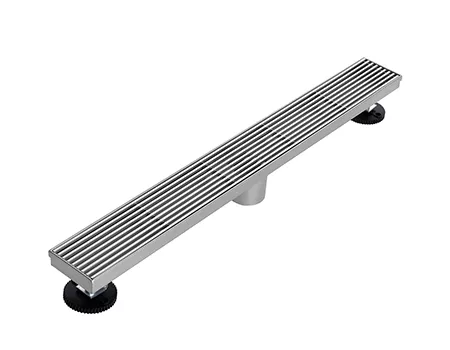
How to clean a linear shower drain clogged with calcium?
Do not use abrasive brushes that can destroy the drain’s surface energy. Instead, pour a 50/50 solution of hot water and white vinegar directly into the drain channel. The acetic acid will safely dissolve the brittle calcite precipitation matrix without initiating galvanic corrosion on the stainless steel grate.
How to remove shower drain flange without damaging the waterproofing?
Never pry upward with sharp metal tools, as this will lacerate the silicone or PVC waterproofing membrane beneath. Use a dedicated drain wrench to engage the internal lugs, applying smooth, counter-clockwise torque to unscrew the flange housing while preserving the integrity of the sub-floor moisture barrier.
Is a shower tray the same as a shower base?
Technically, yes. Both terms refer to the pre-fabricated, watertight receptacle at the bottom of a shower enclosure. However, “tray” often implies a low-profile, acrylic or composite unit utilized in modern minimalist designs, whereas “base” can encompass heavier, structurally integrated mortar beds or cast-iron pans requiring complex thin-set installations.