
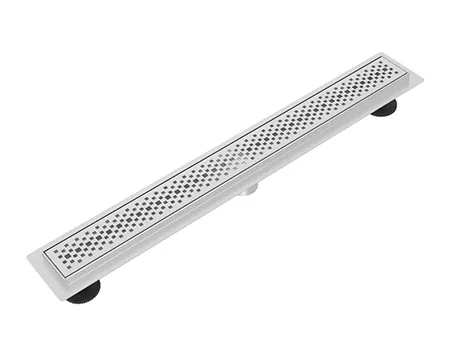
Imagine a luxury curbless suite where a high-output 50L/min rain shower head is activated, only to meet a standard 25L/min drain. Within seconds, water breaches the bedroom transition, soaking expensive hardwood or carpets. This "overflow crisis" is the most frequent failure point in modern barrier-free bathroom design. As an accessibility specialist and plumbing engineer, I have seen hundreds of renovations where aesthetic curbless transitions were prioritised over hydraulic reality. Ensuring zero-threshold safety requires more than removing a physical barrier; it demands a precise calculation of floor pitch, trough volume, and grate permeability to handle high-volume water discharge without the safety net of a curb.
The Hydraulic Conflict of Curbless Design
For a professional contractor or bathroom renovator, the transition to barrier-free systems introduces a significant engineering risk: the loss of containment. In a traditional shower, the 50mm curb acts as a buffer for temporary drainage lag. Without that curb, the drainage system must achieve instantaneous equilibrium with the shower head's flow rate.
The primary pain point is simple: how do you maintain a flat, accessible floor while preventing the water from migrating toward the rest of the dwelling? Standard point drains often struggle here because they require a four-way slope (envelope cut), which is difficult to execute flawlessly for wheelchair stability. This is why the industry has shifted toward linear drainage architectures, yet even these fail if the siphon's flow rate is mismatched to the fixture's output.
Figure 1.1: Visualising the relationship between floor gradient and drain intake capacity.
Defining the Professional Selection Matrix
Selecting a barrier-free drainage system is not about choosing a "pretty grate." It is about calculating the Trough Volume vs. Grate Permeability. When water hits a flat surface, surface tension creates a "beading" effect that slows entry into the drain. In a curbless environment, this lag is fatal.
We must evaluate options through the lens of EN 1253-1, specifically focusing on Load Class K3 for domestic pedestrian traffic and the siphon's ability to maintain a foul air trap without sacrificing flow velocity. The following sections will break down the specific hardware options available for these high-tension environments.
The "Invisible Curb" Physics: Flow Rate vs. Surface Tension
When we talk about barrier-free drainage, the biggest lie in the industry is that "any drain will work as long as the floor is sloped." In reality, without a physical curb to hold water back, you are relying entirely on hydraulic equilibrium. If your shower head pumps out 30 litres per minute (L/min) but your drain siphon is only rated for 25 L/min, you have exactly 60 seconds before water begins to migrate into your dry zone.
This brings us to the first non-negotiable metric: Primary Flow Capacity. For a truly safe barrier-free installation, I recommend a system that handles at least 35-40 L/min. This provides a safety buffer for the "hair-clog lag" that inevitably happens between cleanings. You aren't just buying a metal grate; you are buying a Foul Air Trap mechanism that can breathe while it drains.
Engineering Note: Side-exit siphons reduce the 'vortex choke' common in shallow vertical traps.
Hardware Options: Linear vs. Point Drainage
In a curbless scenario, you generally have three functional paths. Each has a specific Load Class (typically K3, which is the EN 1253 standard for domestic foot traffic) and a specific failure mode:
- Linear Channel Drains: These are the gold standard for barrier-free design. By placing a long "trough" at the entrance or against the back wall, you only need a single-plane slope. It eliminates the "trip hazard" of complex tile cuts.
- Square Point Drains with Integrated Flanges: Cheaper, but they require an "envelope" slope. For wheelchair users, this creates a slight wobble point that can be unsettling.
- Peripheral Wall Drains: The water disappears into a slot at the base of the wall. Visually stunning, but cleaning the internal trap is a maintenance nightmare if you don't have a high-pressure jetting port.
The "Curbless Safety" Checklist
Before buying any drainage kit, check these three critical spec points:
The Hidden Specs: Materials and Load Ratings
Don't get distracted by the finish (brushed gold vs. matte black). For a barrier-free system, the Material Grade determines longevity. Look for 304 or 316L stainless steel. If the product description doesn't explicitly state the steel grade, it is likely a zinc alloy or inferior 201 steel which will pit and corrode within 24 months due to exposure to harsh cleaning chemicals.
Furthermore, consider the Grate Load Rating. In a professional setting, we adhere to the standards published by the International Organization for Standardization regarding accessibility. A "flimsy" grate that flexes under the weight of a shower chair or a heavy occupant will break the waterproof seal at the edges of the drain body, leading to structural rot in the subfloor.
The Deep Dive: Trough Volume vs. Grate Permeability
While the market fixates on "high-flow" siphons, the real-world bottleneck in a curbless shower is often the grate itself. This is where Grate Permeability comes into play. If the slot pattern is too narrow, surface tension causes water to "bridge" over the openings rather than falling through them—a phenomenon known as the umbrella effect.
In my experience, many "designer" grates with intricate laser-cut patterns fail this basic physics test. For a barrier-free system to handle the Primary Data Anchor of 35-40 L/min, you need a high ratio of open-to-solid surface area. A tile-insert drain, while aesthetically "invisible," creates a peripheral-only intake that significantly reduces the initial capture velocity. If you are using a high-GPM fixture, stick to a wedge-wire or large-slot grate to ensure the water enters the trough immediately.
Visual Breakdown: Why "visible" grates actually provide better safety in barrier-free environments.
Countering the "Retrofit Myth"
A potential objection often raised by developers is that curbless systems require a massive subfloor recess. This is a potential objection that leads many to stick with unsafe curbs. The reality is that modern side-exit siphons can fit in as little as 60-70mm of total depth.
By utilising a Resolution Approach that combines a low-profile drain body with a high-density sloped shower tray (pre-manufactured), you can achieve a perfect 2% gradient without structural modification to the joists or slab. This is a "Smart Buyer Tip" I often share: stop trying to screed the slope manually on-site. Precision-engineered trays ensure the Secondary Data Anchor of Load Class K3 is met while guaranteeing the water flows where it’s supposed to.
If you are looking to source these components for a B2B project, I recommend reviewing the curbless collection at Mondeway. Their range focuses on the specific Valid Technical Dimensions we’ve discussed—balancing low installation height with high-volume clearance, which is the cornerstone of a sustainable, barrier-free bathroom.
The "Zero-Fail" Verification Protocol
Successfully installing a barrier-free shower drainage system culminates in a single, high-stakes test: the static flood test. Before the final tiling is grouted, you must verify that the Secondary Data Anchor—the Load Class K3 integrity—and the waterproofing flange are perfectly sealed. For a professional contractor, this is where the difference between a high-quality stainless steel unit and a generic plastic alternative becomes visible.
The Resolution Approach for a perfect finish involves checking the perimeter of the linear trough. If there is any flex when pressure is applied to the flange, the waterproof membrane will eventually shear, leading to the very structural damage you are trying to avoid. Always ensure your choice aligns with the Valid Technical Dimensions of your specific floor buildup, particularly the total installation height which should ideally remain under 70mm for retrofits.
Finalizing your choice depends on the Primary Searcher's specific constraints. If you are retrofitting an older flat, installation depth is your king metric. If you are building a new luxury suite with a ceiling-mounted rain head, flow velocity is paramount. Avoid the temptation to compromise on the Foul Air Trap design; a shallow trap that evaporates quickly will allow sewer gases into the living space, a common failure in cheap, uncertified imports.