
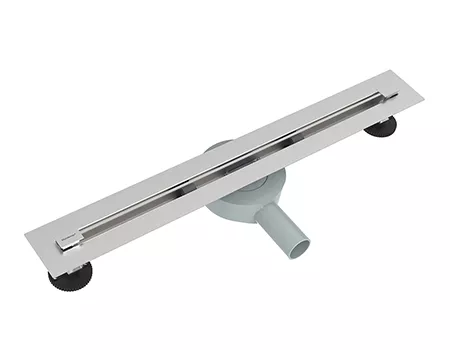
Custom Shower Drain Production Playbook
Reference Standard: Catalog-level references include ISO 9001 management, CE EN1253-1, CUPC, and Watermark. Buyers should treat these as supplier documentation signals and confirm the exact model-level certificate, listing scope, drain type, outlet configuration, and market requirement before approval. For quality-system context, see ISO 9001 quality management.
Short Answer
When a Custom Shower Drain Leaves the Drawing Stage, Which Factory Stations Decide Its Real Shape?
The first meaningful control point for a custom shower drain is not the final polished surface; it is the moment when a buyer’s concept becomes a drawing and then enters the factory stations. The available production data identifies a customization path from concept, drawing, prototype, mould, trial production, and final products. That sequence matters because each step transfers design intent into a physical constraint. A slot pattern, channel length, edge height, outlet position, logo location, and finish color may look simple in a drawing, but each requirement changes which machine station must take responsibility for shape accuracy.
The confirmed material route includes SS304, SS316, ABS, and PVC for the drain production line. The broader shower-accessory range also includes stainless steel, plastic, rubber, iron, and brass. For custom drain work, stainless steel and plastic routes behave very differently. SS304 and SS316 can support welded metal drain structures, brushed finishes, sandblasting, pickling, electrical polishing, and passivation. ABS and PVC are more relevant where plastic forming, drainage accessories, or molded components are used. A buyer should not treat these material names as interchangeable. A stainless steel channel affected by welding heat, brushing direction, and passivation chemistry has a different production risk than a plastic part shaped through molding or cutting.
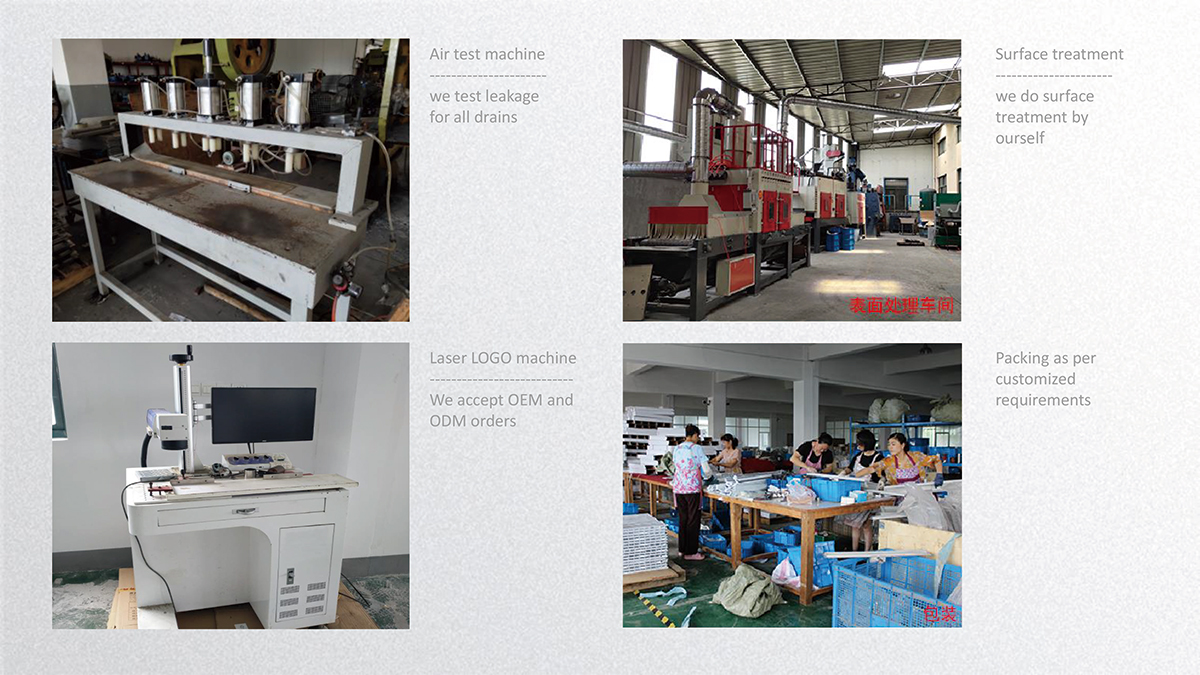
The factory station list gives the structure of this translation process. Laser cutting for customized orders defines the opening profile and sheet geometry. Stamping machines, including a stated maximum of 200 tons, shape metal sections or related stamped features. Bending machines, with the largest size stated as 3200x100T, control long edge formation and channel straightness. Self-developed welding equipment, laser welding, and 10 welding workers then join or close the structure. A shaper is used for shape-deformed products. These stations show that customization is not a single act; it is a chain of shape decisions.
Extreme scenario model: imagine a hotel renovation order requiring long linear drains in multiple room layouts, with different lengths, matte finishes, and customized packaging for staged delivery. During the initial phase, drawing differences mainly affect laser cutting files and bending references. During the middle phase, repeated welding and handling can introduce minor distortion if fixtures and sequence are not controlled. During the extreme phase, if the same project mixes SS304, SS316, ABS, and PVC elements without a clear bill of material, procurement may approve a visual sample that does not represent the production batch.
Cross-dimensional comparison test case: compare two sample batches before pricing. Batch A uses a standard length, brushed finish, no logo, and standard export packing. Batch B uses non-standard length, color finish, laser logo, and customized carton marks. Even if both are called custom shower drains, Batch B requires more station handoffs: drawing check, cutting adjustment, finish confirmation, logo placement, packing confirmation, and air test scheduling. The risk is not only material cost; it is process routing cost.
KEY TAKEAWAYS
- A drawing becomes reliable only when the matching cutting, bending, welding, and finishing stations are confirmed.
- SS304, SS316, ABS, and PVC should be selected by product function, not by appearance alone.
- Custom length, finish, logo, and packing can change the whole production sequence before pricing.
The Hidden Cost of Customization: Why Non-Standard Drain Orders Need Process Sequencing Before Price Discussion
Non-standard drain orders often fail at the quotation stage because the buyer asks for a unit price before the factory has clarified the process sequence. A custom floor drain may involve material selection, laser cutting, mould decision, trial production, surface treatment, logo marking, air testing, and packing. Each choice can move the order into a different workflow. The catalog confirms OEM and ODM orders, customized logo acceptance, customized packing acceptance, surface treatment by the factory itself, and export-standard packing. Those are real capabilities, but they are not identical cost items.
A non-standard order should be treated as a routing map. If the buyer requests a unique length, the first pressure point is drawing and cutting. If a new profile is required, mould or trial production may become necessary. If the buyer requests Brushed Gold, Matt Black, Gun Metal, Matt White, Brushed Bronze, Matte Silver, Black Powder Coated, or another color, the surface process must be matched to the sample target. If the buyer requests logo branding, the laser logo station becomes part of the approval path. If the buyer needs market-specific documentation, the certificate boundary must be checked before the order is presented as compliant.
Material pressure model: in a wet bathroom environment, SS304 and SS316 are exposed to water, soap residue, shampoo, cleaning agents, humidity, and temperature cycling. The visible surface may be the buyer’s first concern, but the deeper issue is sequence compatibility. A welded stainless steel body that goes through surface cleaning, brushing, or passivation too early may be marked again during later logo or packing handling. A plastic component made from ABS or PVC may avoid weld heat tint, but it still needs shape control, fit confirmation, and packing protection. The production path should match the material behavior.
| Custom Variable | Process Station Affected | Common Risk if Sequencing Is Weak | Validation Method |
|---|---|---|---|
| Non-standard length | Drawing, laser cutting, bending | Channel mismatch or edge variation | Drawing confirmation and sample measurement |
| Color finish | Surface treatment, brushing, coating | Finish mismatch between sample and batch | Visual sample and batch comparison |
| Laser logo | Logo station, packing sequence | Logo misplacement or surface marking | Logo-position check before packing |
| New shape | Mould, trial production, shaper | Deformation or unstable fit | Prototype and trial production review |
| Export carton request | Packing area | Wrong marks or mixed SKU identity | Packing checklist and carton sample approval |
Comparison test case: a buyer comparing two suppliers may see similar quoted drain prices, yet one supplier includes trial production, air test, surface treatment, logo, and customized packing in the process path while another quotes only the visible metal part. The lower quote may not include the hidden stages that make a custom product repeatable. A better comparison is to ask for a routing statement: material, drawing, prototype requirement, mould requirement, finish process, logo process, air test, certificate scope, packing requirement, and delivery schedule.
The factory states 15 to 30 days delivery time and 30,000 sets per month capacity. These numbers are useful, but a buyer should not assume every customized SKU will follow the same timeline. A standard brushed drain without logo and special packaging can move through the workflow faster than a multi-finish private-label order requiring color confirmation, logo placement, carton identity, and market paperwork. Capacity tells the buyer that volume production exists; it does not replace SKU-level process review.
From Welded Body to Export Carton: How a Custom Shower Drain Becomes a Sellable SKU
A shower drain becomes a sellable SKU only when the factory can connect manufacturing output with inspection, identification, and packing. The catalog confirms self-developed welding machine, 10 welding workers, laser welding machine, burr removal, brushed surface work, air leakage testing, laser logo, customized packing, and export-standard packing. These data points describe a chain from semi-finished body to sale-ready item. This chain should not be confused with a claim of measured discharge capacity, trap performance, or universal certification for every model. Those details require model-level documents.
Welding creates one of the most important transition points in stainless steel drain production. SS304 and SS316 can show heat tint, oxide residue, oil contamination, scratches, yellow spots, or local discoloration after cutting, bending, and welding. The catalog states that drains after welding can be dirty on the surface, with oil, scratches, yellow spots, and similar marks. It also states that pickling, electrical polishing, and passivation are used in a dedicated surface treatment workshop. The stated workshop size is 2000 square meters for surface treatment. This is a strong production-data point because it shows that finishing is not being treated as a cosmetic afterthought.
Extreme fatigue model: place a custom stainless steel drain in a hotel shower area with repeated humidity cycles, cleaning chemicals, barefoot traffic, soap film, and constant wet-dry transitions. In the initial stage, weak finishing usually appears as inconsistent gloss, visible brushing direction mismatch, or small residue near welded zones. In the middle stage, cleaning frequency can amplify contrast between treated and poorly treated areas. In the extreme stage, local marks or rough edges may become customer complaints even if the drain still functions mechanically. The visible defect becomes a commercial issue before it becomes a structural issue.
The air test is another key station. The catalog states that leakage problems are tested by air and that leakage is tested for all drains. Air testing is important because water leakage can be difficult to isolate after packing, shipping, and installation. A pre-shipment air test does not prove every possible installation scenario, but it is a relevant factory-level control for welded or assembled drain bodies. The buyer should request whether the air test applies to the exact ordered structure, not merely to a general product family.
Certification must be handled with the same discipline. The catalog references CE EN1253-1, CUPC, Watermark, and ISO 9001. These are valuable market-access signals, but they should be described as catalog-level references unless a buyer has the specific certificate, listing scope, model number, and target market requirement. A custom length, new outlet, different material combination, or private-label SKU can change what documentation is needed.
PRO-TIP / CHECKLIST
- Confirm whether the quoted material is SS304, SS316, ABS, PVC, or a combined structure.
- Ask for drawing confirmation before sample production starts.
- Check whether the sample needs prototype, mould adjustment, or trial production.
- Request the exact finish name and compare it with the approved sample.
- Confirm whether air leakage testing applies to all ordered custom drains.
- Verify logo position before bulk packing begins.
- Ask whether certificates apply to the model, market, and drain structure being ordered.
- Approve carton marks and customized packing before shipment booking.
What Procurement Teams Should Ask Before Approving a Custom Shower Drain Sample
Sample approval should be a question chain, not a visual yes-or-no decision. A custom shower drain sample may look acceptable on a table, yet still leave unresolved questions about material route, process sequence, certificate scope, and batch repeatability. The catalog supports a practical approval method because it lists the stages and factory resources involved: concept, drawing, prototype, mould, trial production, products, SS304, SS316, ABS, PVC, laser cutting, stamping, bending, welding, surface treatment, air test, logo, and packing.
The first approval question is material identity: does the selected material match the use environment? SS316 may be preferred in more demanding corrosion-related environments, while SS304 is widely used in stainless bathroom components. ABS and PVC are different material routes and should not be judged by the same welding and passivation logic used for stainless steel. The buyer should ask whether the sample represents the final order material and whether any accessories use a different material.
The second question is shape repeatability: was the sample made from the same process intended for mass production? A hand-adjusted sample can look correct while hiding production difficulty. If the final order needs laser cutting, bending, welding, shaper correction, or trial production, those steps should be visible in the approval record. A sample made before mould confirmation or trial production may be useful for appearance discussion, but it may not prove batch stability.
The third question is finish control: does the approved surface match the required commercial finish? The catalog shows multiple finish references including Brushed, Gun Metal, Brushed Gold, Matt White, Matt Black, Brushed Bronze, Matte Silver, Black Powder Coated, and Different Colors. A buyer should not approve “black” or “gold” as a vague color word. The sample should lock the exact finish route, visual tolerance, brushing direction if relevant, and packaging protection method.
The fourth question is inspection evidence: has the drain passed air leakage testing and visual inspection before packing? Since the catalog states that leakage is tested by air for all drains, the buyer can reasonably ask for air-test confirmation on the ordered sample or batch. Common objective checks should include dimensional inspection, weld seam review, burr check, outlet fit check, surface consistency, logo position, carton mark confirmation, and certificate scope review.
Cross-dimensional comparison case: approve Sample A by appearance alone and Sample B by process record. Sample A may pass a quick buyer photo review, but it may not reveal whether the logo station, air test, or export packing is included. Sample B links the appearance to material, drawing, prototype, trial production, surface treatment, air test, and packing. Sample B is more useful for procurement because it connects the object to the production system behind it.
The final procurement decision should separate confirmed data from assumptions. Confirmed data includes listed material routes, manufacturing stations, surface treatment capability, leakage air testing, customized logo, customized packing, export-standard packing, delivery range, capacity, and catalog-level certifications. Unconfirmed data includes exact model dimensions, measured discharge rate, trap design, model-level certificate scope, outlet tolerance, and installation compatibility unless those documents are supplied for the specific order.
Frequently Asked Questions (FAQ)
What size is a shower drain?
Shower drain size depends on the drain body, outlet, channel length, installation space, and project requirement. For a custom shower drain, the buyer should confirm the drawing, outlet position, material route, and sample dimensions before approval. Do not assume a catalog family covers every custom size.
Can a shower drain into a toilet drain?
A shower drain should follow local plumbing codes and project design rules. Connecting it to a toilet drain without proper trap, venting, slope, and code approval can create odor, backflow, and hygiene problems. Always confirm with a licensed plumbing professional before changing drainage connections.
How to unclog a shower drain with baking soda?
Baking soda may help with light organic buildup when followed by controlled flushing, but it is not a factory-level solution for structural blockage, poor outlet design, or installation error. If clogging repeats, inspect the strainer, hair buildup, pipe slope, trap condition, and drain body accessibility.
How to get rid of odor in a shower drain?
Odor usually comes from dry traps, biofilm, poor venting, residue buildup, or drainage connection problems. Clean visible debris, flush the drain, check the trap water seal, and confirm that the installation follows plumbing rules. Persistent odor is not solved by surface cleaning alone.