
Thermostatic Shower System Revealed: Surface Risks
Reference Standard: Relevant material and performance testing standards, with cautious reference to ISO 9001 quality management principles and common sanitary product inspection practices.
Short Answer
A thermostatic shower system operates in one of the most aggressive indoor environments: a closed wet room where moisture, heat, mineral deposits, soap residue, cleaning chemicals, and human handling repeatedly contact visible and hidden components. The supplied catalog does not confirm a dedicated thermostatic shower system specification page, so this article does not claim any proprietary valve cartridge, flow-rate, anti-scald, temperature accuracy, or connector dimensions. The usable evidence comes from the manufacturer’s broader shower-room accessory context: confirmed product categories include floor drains, stainless steel shower niches, shower basins, shower chairs, shower handles, and shower tray boards, while the material range includes stainless steel, plastic, rubber, iron, brass, and factory-focused materials such as SS304, SS316, ABS, and PVC.
That evidence still matters. In shower-room procurement, many failures begin not as dramatic mechanical breakdowns but as small appearance and consistency problems: water marks, yellow spots, scratches, dull surfaces, oily residue, inconsistent brushing, coating variation, or packaging damage. These problems affect the buyer’s confidence long before a technical dispute reaches a laboratory. A disciplined evaluation therefore starts with surface exposure, process evidence, inspection language, and batch control.
How a thermostatic shower system enters a high-humidity bathroom appearance cycle
A shower room creates a repeating appearance cycle rather than a single exposure event. In daily use, water condenses on cooler metal surfaces, evaporates, leaves minerals behind, and then receives a new layer of soap, skin oil, cleaner residue, and airborne moisture. A thermostatic shower system may include visible metal, plastic, rubber, and brass-related contact zones in many market configurations, but the catalog does not confirm a dedicated composition for this product. The safe interpretation is to analyze how the catalog-confirmed material family behaves under bathroom exposure without assigning unsupported proprietary specifications.
The first mechanism is thin-film moisture retention. Even a polished or brushed surface can hold microscopic droplets along scratches, seams, edges, and texture lines. On stainless steel, the visible surface depends on a passive oxide layer. On brass or brass-related fittings, surface appearance can shift when cleaning chemicals, minerals, and oxygen repeatedly interact. On plastics such as ABS or PVC, dimensional stability is generally useful in wet accessories, but cleaners, heat, and stress concentration can change gloss, edge definition, or surface feel over time. Rubber components, when present in sanitary assemblies, are vulnerable to compression set, detergent exposure, and gradual hardening. None of these behaviors prove a defect by themselves; they explain why bathroom appearance must be inspected as a lifecycle condition, not as a single showroom photograph.
A practical edge-case model can be built from the confirmed shower-room environment. Imagine a component exposed to two hot showers per day, followed by incomplete ventilation, with hard-water droplets drying on the same visible surface. During the first stage, the surface still looks clean, but water marks begin to form along edges and hand-contact areas. During the middle stage, mineral residue becomes easier to see under angled light, especially on dark, brushed, or coated finishes. During the high-stress stage, residue and cleaning abrasion can make small scratches appear wider, not because the material suddenly failed, but because the surface contrast increased. This is an appearance-cycle problem.
A cross-dimensional comparison test is useful for buyers. Place one sample in a dry display cabinet and another in a bathroom-like humidity cycle with repeated wetting, drying, wiping, and mild cleaner contact. The dry sample mostly tests packaging and storage appearance. The humidity-cycle sample tests the real consumer environment. If two samples look identical after the dry test but diverge after wet cycling, the buyer has learned that surface treatment and cleaning resistance are more important than the first visual impression.
| Exposure Variable | Likely Visible Effect | Buyer Risk | Safer Verification Method |
|---|---|---|---|
| Repeated wet-dry cycling | Water marks and mineral rings | Appearance complaints | Angled-light surface review |
| Soap and cleaner contact | Dullness or film residue | Perceived poor finish | Controlled wiping comparison |
| Hand-contact zones | Fingerprints and micro-scratches | Retail return risk | Touch-area inspection |
| Poor ventilation | Longer moisture dwell time | Staining pressure | Humidity-cycle sample review |
| Mixed materials | Uneven aging behavior | Batch inconsistency | Material-by-zone confirmation |
The hidden risk is not only cosmetic. Appearance inconsistency often indicates weak communication between drawing, material confirmation, finishing route, and final packing. A buyer who ignores these early surface signals may approve a sample that looks acceptable in a clean office but behaves differently in a wet room.
KEY TAKEAWAYS
- Early water marks usually appear first along edges, seams, hand-contact areas, and textured surfaces.
- A sample that passes dry-room inspection may still show inconsistent appearance after repeated wet-dry cycling.
- Mixed material assemblies need zone-by-zone review because stainless steel, plastic, rubber, iron, and brass do not age visually in the same way.
Surface treatment evidence revealed beyond decorative claims in a thermostatic shower system order
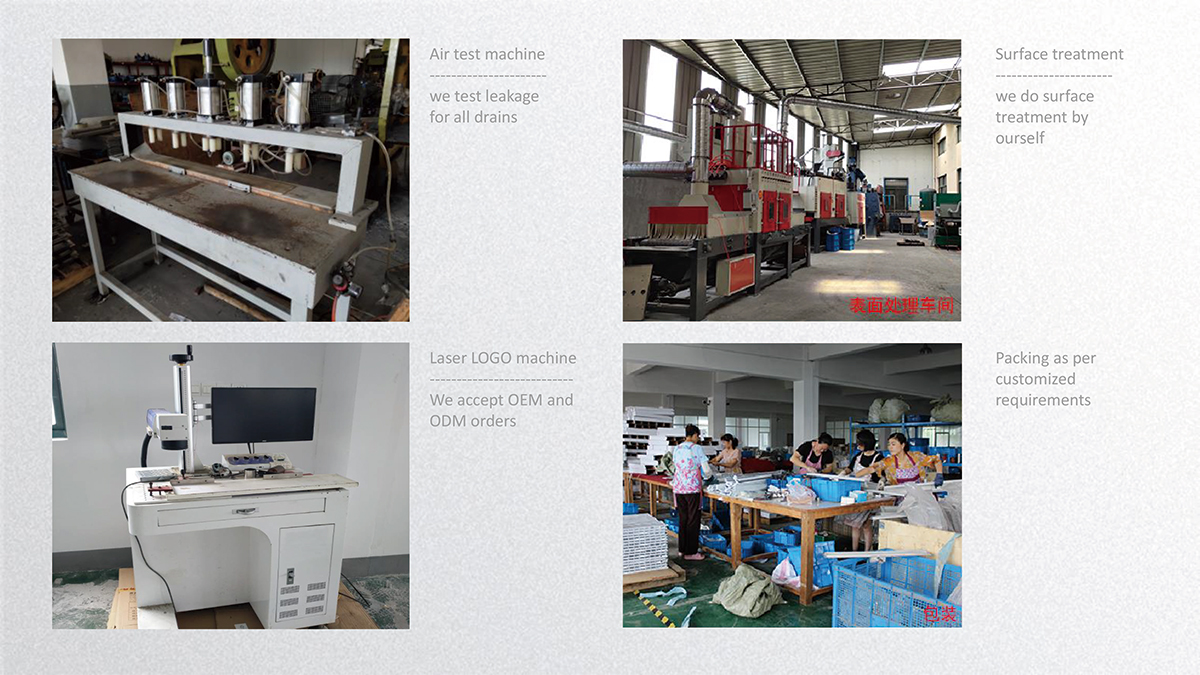
Decorative descriptions are weak evidence. Words such as brushed, polished, black, gold, or bronze describe appearance, not process control. The catalog provides more useful evidence by identifying in-house surface treatment, deburring, brushed surface work, sandblasting, laser logo capability, and a dedicated 2,000 square meter surface treatment workshop including pickling, electrical polishing, and passivation. These terms do not create a dedicated thermostatic shower system specification, but they support a broader manufacturing logic: surface condition is managed through process steps, not marketing language.
Surface treatment matters because manufacturing leaves traces. Cutting can create heat-affected edges. Stamping and bending can introduce contact marks. Welding can leave discoloration, oil, scratches, or yellow spots. The catalog explicitly notes that welded drain surfaces can be dirty, oily, scratched, or yellow-spotted before cleaning. That statement is especially valuable because it admits a real manufacturing problem and points to a process solution. A buyer should treat this as a verification path: do not ask only for a beautiful product photo; ask how the surface is cleaned, stabilized, inspected, packed, and protected before export.

The mechanism behind surface treatment is partly chemical and partly visual. Pickling can remove contamination and discoloration from stainless surfaces. Electrical polishing can improve smoothness and reduce microscopic roughness in appropriate stainless applications. Passivation supports the protective behavior of stainless steel by improving surface conditions for corrosion resistance. Brushing and sandblasting create controlled texture, but texture also changes how light reflects and how residue becomes visible. A mirror-like surface may show fingerprints quickly; a brushed surface may hide some marks but can retain residue along the grain direction. A dark surface may look premium at first but reveal mineral spots more strongly under hard water. These trade-offs are not defects; they are design and maintenance realities.
The edge-case model for this section is a pre-shipment surface stress review. Take three finish conditions: a freshly cleaned sample, a sample handled without gloves, and a sample exposed to repeated wet wiping. Inspect them under front light and angled light. The freshly cleaned sample tests showroom appearance. The handled sample tests retail unpacking and installer contact. The wet-wiped sample tests early bathroom use. If the finish shifts sharply between these three states, the buyer should request clearer surface treatment records, protective packaging, and sample retention standards.
A useful comparison case is decorative color approval versus process-route approval. In color approval, the buyer approves a finish based on visual preference. In process-route approval, the buyer confirms material, surface treatment method, inspection lighting, acceptable visual limits, packing protection, and sample reference. The second approach is stronger because it reduces disputes. It also fits the catalog’s real factory strengths: in-house surface treatment, deburring, brushing, sandblasting, laser marking, and customized packing.
A reverse inspection route for thermostatic shower system buyers before mass production
A conventional purchase flow starts with a product idea and moves forward toward shipment. A safer route for a thermostatic shower system article is the reverse inspection route: begin with the final delivered condition, then move backward to packing, trial production, tooling, drawing, prototype, and concept. This avoids the most common buyer mistake: approving a clean sample while failing to define what the bulk shipment must look like after factory handling, export packing, storage, and installation contact.
The catalog’s customization sequence is clear: Concept → Drawing → Prototype → Mould → Trial production → Products. That sequence should be used as a risk-control map, not a decorative timeline. Since the catalog does not provide thermostatic shower system dimensions or valve data, the buyer should not pretend those data exist. Instead, the buyer should state a parameter gap and ask for supplier-confirmed drawings before discussing interface dimensions, valve body material, connection specifications, surface code, packaging tests, or accessory lists.
Reverse inspection begins with the carton. The catalog confirms export-standard packing and customized packing acceptance. Packaging is not a minor detail for visible sanitary hardware. A flawless surface can be damaged by friction, vibration, poor separators, loose accessories, or insufficient film protection. The buyer should inspect whether each visible part is separated from hard contact, whether branded or customized logo areas are protected, and whether the carton can preserve surface condition through transport. Customized logo acceptance also creates a secondary risk: laser marking, labels, or branded surfaces must remain aligned and consistent across the batch.
The next step backward is the finished bulk product. Before accepting mass production, the buyer should define inspection zones. Zone A may include front-facing visible surfaces. Zone B may include side surfaces and hand-contact areas. Zone C may include hidden or installation-facing areas. This prevents a dispute in which the factory and buyer use different visual standards. For a thermostatic shower system, unsupported claims about thermostatic performance should be avoided unless the supplier later provides dedicated technical documents. The current safer inspection route focuses on visible condition, material confirmation, surface route, packing protection, and batch consistency.
Then comes trial production. Trial production is where small differences become visible: slight color variation, inconsistent brushing, edge burrs, logo placement variation, or packaging pressure marks. A buyer should request photos or video under consistent lighting, not only close-up beauty shots. If surface treatment is involved, the buyer should compare the trial sample with the approved prototype after wet wiping and handling. That is a cross-dimensional test because it combines production repeatability, surface cleaning behavior, and real-use handling.
Finally, the route reaches drawing and prototype confirmation. Drawings should not be used to invent specifications in content writing, but they should be requested in real procurement. The next information gap is clear: interface dimensions, connection layout, material-by-part list, finish code, valve-body material, accessory list, and packing test requirements must come from supplier-confirmed documents.

PRO-TIP / CHECKLIST
- Confirm which material is used in each visible and hidden part before approving appearance.
- Ask for the exact surface treatment route instead of accepting only finish color names.
- Review samples under angled light, direct light, and after controlled wet wiping.
- Define visible inspection zones before trial production starts.
- Confirm export packing protection for coated, brushed, polished, or logo-marked surfaces.
- Separate catalog-confirmed QC statements from general sanitary product testing assumptions.
- Record all parameter gaps that require supplier drawings before mass production.
Safe QC language when the PDF has no dedicated thermostatic shower system page
The safest QC language is precise, limited, and evidence-based. The catalog supports claims about ISO 9001 management, stable quality control, CE, CUPC, Watermark, CE EN1253-1, air test machinery, and leakage testing for drains. It does not support a dedicated thermostatic shower system QC claim. That boundary is important because a search-optimized page can easily become misleading when it transfers drain testing evidence to a different product category without qualification.
A responsible article can say that the supplier’s broader sanitary accessory catalog shows factory-level QC awareness, certification presentation, leakage testing for drains, surface treatment capability, OEM and ODM workflow, and export packing. A responsible article cannot say that the thermostatic shower system has a confirmed thermostat cartridge, temperature lock, pressure-balance performance, flow-rate range, connection size, or anti-scald certification unless those appear in product-specific documents. When such information is missing, the best phrasing is: “For thermostatic shower system procurement, request supplier-confirmed drawings and product-specific test reports before final specification approval.”
General sanitary product testing can still be discussed as general engineering logic. For a thermostatic shower system, common buyer-side verification may include appearance inspection, dimensional checking, thread or connector inspection, sealing review, pressure cycling, thermal cycling, mixed-water stability review, surface adhesion or corrosion resistance checks, packaging drop checks, and outgoing random inspection. These should be labeled as general inspection practices, not catalog-confirmed thermostatic system claims.
A useful comparison is between evidence language and assumption language. Evidence language says, “The catalog states ISO 9001 management and shows air leakage testing for drains.” Assumption language says, “This thermostatic shower system is tested for precise temperature control.” The first statement is grounded. The second may be true in another document, but it is not proven by the catalog data provided here. B2B content should protect the buyer from this gap instead of hiding it.
For external quality context, buyers can review the general role of ISO 9001 quality management and product-specific sanitary or plumbing standards from relevant regional bodies before accepting a supplier claim. Standards research should be tied to the final target market because CE, CUPC, Watermark, and EN references are not interchangeable across every region or product type.
| QC Language Type | Safe Use in This Article | Risk Level | Required Buyer Action |
|---|---|---|---|
| ISO 9001 management | Supported as catalog-level quality management evidence | Low | Ask for current certificate validity |
| CE, CUPC, Watermark | Supported as shown certification categories | Medium | Confirm SKU-level applicability |
| Air leakage test | Supported for drains, not automatically for thermostatic systems | Medium | Do not transfer claim without proof |
| Surface treatment inspection | Supported as factory capability | Low | Request sample and finish route evidence |
| Thermostatic performance | Not confirmed in the catalog | High | Require product-specific test report |
| Connector dimensions | Not confirmed in the catalog | High | Require supplier-confirmed drawings |
The edge-case model for QC is a documentation stress test. Before mass production, place every claim into one of three boxes: catalog-confirmed, supplier-document-required, or general industry practice. If a claim cannot be placed confidently, remove it from the product page or mark it as a buyer verification point. This method protects SEO content from exaggeration and protects the buyer from making procurement decisions based on unsupported wording.
Frequently Asked Questions (FAQ)
Why does only my shower drain stink?
A single shower drain often smells because of trap water loss, biofilm, blocked venting, or debris buildup. This is a drainage-system issue, not direct evidence of a thermostatic shower system failure. Check the trap, cleaning access, ventilation, and drain maintenance before blaming visible shower hardware.
Can I pour bleach down my shower drain?
Bleach may reduce odor temporarily, but it can also react with residues and may affect nearby finishes or seals if misused. Use cautious dilution, ventilation, and manufacturer-safe cleaning guidance. For sanitary hardware, avoid assuming that strong chemicals are harmless to metal, plastic, rubber, or coated surfaces.
How to shower drain maintenance without damaging nearby finishes?
Remove visible hair and residue first, rinse with warm water, and use mild cleaners before aggressive chemicals. Keep cleaner contact away from decorative metal surfaces when possible. Repeated chemical splash can change gloss, leave residue, or accelerate visible surface aging in the shower area.
How to move a shower drain pipe?
Moving a shower drain pipe requires floor build-up review, trap location, slope, waterproofing continuity, and local plumbing code compliance. It is not a surface-level product adjustment. Use a qualified plumber and request drawings before changing the drainage path under a shower system.
How to install a linear drain in a shower?
A linear drain requires correct slope, waterproofing connection, outlet alignment, trap access, and finished floor height planning. Do not treat it as a simple grate replacement. Confirm drain body dimensions, outlet position, membrane compatibility, and installation sequence before tile work begins.
How to clear hair from shower drain?
Start with manual removal from the cover or basket, then flush with warm water. Avoid forcing sharp tools into hidden seals or pipes. If clogging repeats, inspect the trap and cover design. Hair problems belong to drainage maintenance, not thermostatic shower system performance.