
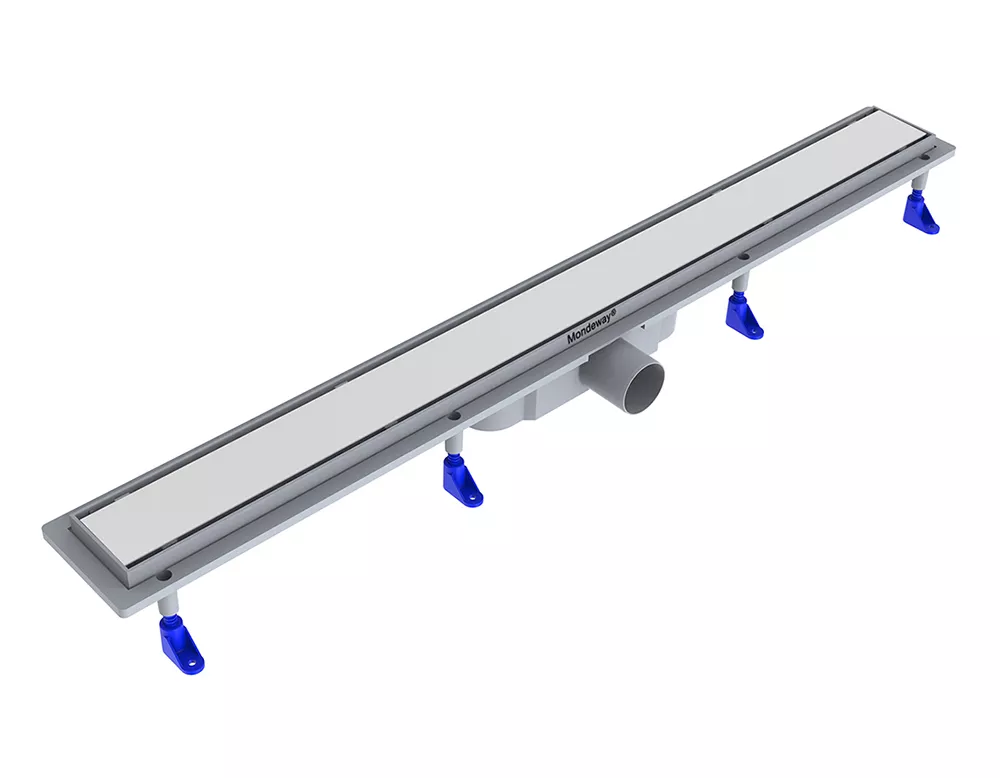
Shower Drains Types Selection Framework
Reference Standard: ASME A112.6.3 for floor and trench drains, supported by local plumbing code review, material compatibility checks, and project-specific installation drawings.
Short Answer
Start From the Floor Plan, Not From the Drain Name
A practical selection process begins with the bathroom floor, not the drain label. The same drain style can behave very differently when the shower area changes from a compact square stall to a wide walk-in zone, or when the outlet position moves from the center to a wall edge. For shower drains types, the first useful data fields are slope direction, outlet position, finished floor build-up, tile thickness, pipe interface, and water exit path. These are general engineering review fields, not tested values from the supplied catalog.
A point drain usually asks the floor to slope from several directions toward one central or offset point. This can work well in compact layouts, but it may increase tile cutting complexity because the floor surface must form a shallow funnel. A linear drain can simplify the slope into one or two planes, especially near a wall, but it demands tighter alignment between the drain body, tile edge, waterproofing layer, and outlet location. A corner drain can reduce visual interruption, yet it may concentrate water movement into a smaller zone where debris can accumulate if the surrounding fall is weak.
The important question is not “which type looks cleaner?” It is “which type allows gravity to move water across the actual floor without creating silent wet zones?” In a general floor review, even a small difference in slope direction can change the behavior of water near the threshold, wall return, or glass partition. A drain that is visually centered may still be hydraulically awkward if the pipe outlet sits too far from the intended drain body. A wall-side linear drain may look minimal, yet it can become installation-sensitive if the wall is not straight, the waterproofing turn-up is inconsistent, or the tile thickness was not planned before ordering.

A useful extreme scenario is a wide wet-room floor with a long glass screen and a distant outlet. In early use, the drain may appear functional because water eventually reaches the opening. In mid-cycle use, slow surface movement can leave a thin film near the screen edge. Under heavy use, that film can carry soap residue and fine grit into low points, making the surface look dirty even when the drain itself is not blocked. This is a floor-plan problem before it is a drain-product problem.
A cross-dimensional comparison makes the point clearer. In the same rectangular shower zone, a central point drain may require four slope planes and more tile cuts. A wall linear drain may need fewer slope planes but demands better wall alignment and outlet coordination. A hidden drain may reduce visual interruption but can make inspection harder. The strongest choice is the one whose layout, not just its catalog name, matches the actual water path.
Compare Shower Drains Types by Water Behavior
The clearest way to compare shower drains types is to watch how water behaves before it disappears. Water follows gravity, but its movement is shaped by surface tension, floor texture, tile joints, slope continuity, and flow restriction at the drain opening. These are general physics principles, not verified claims about a specific supplied product.
A point drain collects water radially. Its advantage is compactness, but its risk is slope interruption. If one slope plane is slightly weaker than the others, water can slow down near a tile joint or corner. A linear drain collects water along a longer intake line. Its advantage is directional flow, especially when the floor can fall in one plane. Its risk is that a long intake edge may show installation defects more clearly, especially if the drain channel, grate, and tile edge are not level with each other. A wall drain hides more of the drainage line, but the water still needs a controlled path into the wall-side capture zone. A hidden or slot-style drain can support a clean visual surface, but the trade-off is that the visible opening may be narrow, making debris monitoring less obvious.
A useful general field test is a staged water observation test. It does not require a performance claim. The installer or buyer simply observes where water moves during low, medium, and high use conditions. At low flow, water should not stop at tile edges. At medium flow, surface movement should remain directional rather than random. At high flow, the drain area should accept water without visible backspread. Any pooling pattern should be recorded before decorative finishes hide the cause.
| Drain type | Water behavior focus | General risk point | Field data to confirm |
|---|---|---|---|
| Point drain | Radial collection | Multi-plane slope errors | Center location and slope direction |
| Linear drain | Directional sheet flow | Channel alignment variation | Outlet position and floor fall |
| Wall drain | Edge-side capture | Wall straightness and waterproofing transition | Wall line and drain body depth |
| Hidden drain | Minimal visible opening | Reduced inspection visibility | Access method and cleaning route |
| Corner drain | Localized collection | Debris concentration in one zone | Corner fall and pipe interface |
The edge case is a textured tile floor. Texture can increase slip resistance, but it can also slow the surface film of water. In early use, this may only appear as a slightly slower dry-down time. In mid-cycle use, soap and body oil can form a thin residue that changes surface wetting behavior. In heavy use, small particles can settle at the point where flow velocity drops. A drain type that works well on a smooth test surface may feel less efficient on a rougher floor unless the slope and intake geometry are reviewed together.
A cross-test comparison is helpful: pour the same amount of water on a smooth sample area and a textured sample area with the same drain position. The drain itself has not changed, but the travel time and residue pattern may change. That is why water behavior should guide type selection before catalog style.
KEY TAKEAWAYS
- Water that hesitates near tile joints may signal weak slope continuity before a visible blockage appears.
- A drain that accepts water at high flow but leaves residue at low flow may have a surface movement issue, not only a capacity issue.
- A clean-looking hidden opening can still require a clear inspection and maintenance route.
Build a Selection Matrix Around Installation Risk
Installation risk is where many drain choices become expensive. A drain type is not only a visible top piece. It interacts with the pipe, subfloor, waterproofing membrane, adhesive bed, tile thickness, finished surface level, and maintenance opening. Because the supplied evidence does not verify a specific shower drain product, the correct approach is to build a project acceptance matrix around confirmable fields.
The first field is pipe interface. Buyers should confirm outlet orientation, outlet diameter, trap connection method, and whether the drain body height fits the available floor build-up. The second field is tile thickness and finished level. A drain that sits too high can create standing water around the edge; a drain that sits too low can expose a sharp lip or collect debris at the transition. The third field is waterproofing integration. Drains in wet zones need a reliable transition between the body, membrane, mortar bed, and finished tile. The fourth field is access logic. If the grate, slot cover, or inspection opening cannot be removed or reached, routine maintenance becomes harder.
Four solution pathways can reduce risk without inventing product-specific claims.
Solution 1: Floor-path mapping before drain selection. The execution protocol is to mark the expected water movement on the floor plan before choosing the drain type. The review should identify slope direction, outlet position, door threshold, wall edge, and tile format. The expected physical change is not a material upgrade but a reduction in flow ambiguity: water has a planned route before the drain is ordered. The hidden cost is extra drawing time, but it prevents mismatch between a visually preferred drain and a floor that cannot support its slope pattern.
Solution 2: Interface confirmation before tile work. The execution protocol is to confirm pipe interface, drain body depth, and finished surface height before adhesive or mortar placement. This prevents last-minute cutting or forced transitions. The expected physical result is better continuity between the drain edge and tile surface, reducing local water hesitation. The side effect is that procurement may need an extra drawing or sample check, but that is cheaper than reworking finished tile.
Solution 3: Surface transition inspection. The execution protocol is to inspect the drain-to-floor transition with a straightedge and water observation after rough setting but before final handover. This focuses on levelness, edge gaps, and drainage direction. The expected behavior is controlled water movement into the intake zone rather than sideways spreading. The risk is over-adjustment: pushing for a perfectly invisible transition may reduce practical drainage tolerance if the floor plane is not stable.
Solution 4: Maintenance access validation. The execution protocol is to remove and reinstall the accessible cover, grate, or inspection part during approval. This confirms that cleaning is possible after installation, not just on a loose sample. The expected long-term benefit is lower debris accumulation because hair, grit, and soap residue can be reached. The side effect is that some minimalist designs may lose appeal when access requirements are considered, but that is a realistic trade-off.
| Review variable | General tolerance logic | Common failure signal | Acceptance action |
|---|---|---|---|
| Slope direction | Continuous fall toward intake | Water pauses before drain | Recheck floor plane |
| Outlet position | Aligned with drain body | Offset stress or awkward connection | Confirm drawing before order |
| Tile thickness | Matches finished drain height | Raised edge or recessed lip | Verify build-up stack |
| Pipe interface | Compatible with trap route | Slow discharge or forced adapter | Confirm outlet details |
| Access method | Cover can be removed | Hidden debris or repair delay | Test removal during approval |
PRO-TIP / CHECKLIST
- Confirm the outlet position before choosing the visible drain style.
- Mark slope direction on the floor plan, not only in the installer’s notes.
- Check finished floor build-up against drain body depth.
- Ask how the cover, grate, or inspection opening is accessed after installation.
- Observe low-flow water movement, not only heavy-flow drainage.
- Record pipe interface details before tile cutting begins.
- Review local plumbing code requirements before approving final layout.
Treat Maintenance as a Type-Selection Variable
Maintenance should not be an afterthought. It should help decide the drain type from the beginning. Hair, soap residue, mineral scale, body oil, grit, cleaning chemicals, and trap behavior all influence long-term user experience. A drain that looks ideal on installation day may become frustrating if routine cleaning requires awkward tools, if the water seal is not maintained, or if small debris settles where it cannot be seen.
This section uses general maintenance logic only. It does not claim that the supplied catalog documents a specific anti-clog, anti-odor, corrosion-resistant, or removable structure. The practical point is that every shower drain type creates a different maintenance pattern. A point drain often makes the cover location obvious, but debris may gather quickly in a small intake area. A linear drain spreads the intake across a longer line, but the channel may need periodic full-length cleaning. A hidden drain may reduce visual clutter, yet users need to know where inspection actually occurs. A wall-side drain can move the wettest zone away from the center floor, but wall transitions and edge channels still need checking.
A maintenance-first timeline can be useful. At the initial stage, the main concern is visible flow and clean installation. After several weeks, the key concern becomes residue behavior: does water carry soap film away, or does it leave a line at the same location? After months of use, the concern shifts to access: can the user remove accumulated hair and grit without damaging the finish? After long-term use, water seal behavior and odor control become more important, especially when users search for symptoms like “why is my shower drain gurgling.” Gurgling is commonly associated with air movement, trap behavior, or venting conditions; it should not be treated as proof of a defective drain type without inspection.
Bleach-related cleaning questions also need caution. Strong cleaners may affect metal finishes, seals, coatings, or surrounding grout depending on concentration and contact time. The safer content angle is not to promote bleach as a universal solution, but to recommend checking cleaning compatibility and rinsing practices. For “how to repair a shower drain,” the article should separate minor maintenance, such as clearing debris, from repair actions that involve sealing, pipe connections, waterproofing, or trap access.
An extreme maintenance scenario is a high-use shower shared by several people with long hair and frequent soap residue. At first, all drain types may appear acceptable. In the middle stage, the intake zone begins to collect hair and film. At the limit stage, water movement slows, odor complaints may appear, and users may try harsh cleaning methods that create secondary risks. The better drain type is not automatically the most expensive one; it is the one whose access method matches the actual maintenance burden.
Frequently Asked Questions (FAQ)
Why is my shower drain gurgling?
A gurgling shower drain often points to air movement, trap behavior, partial blockage, or venting issues. It does not automatically prove that the drain type is wrong. Check whether water drains slowly, whether other fixtures affect the sound, and whether the trap or vent route needs professional inspection.
Do you put bleach in a toilet brush holder?
Bleach may disinfect, but it can also react with residues and may affect nearby finishes if splashed or misused. For drain-related cleaning, do not treat bleach as a universal fix. Check material compatibility, use proper dilution, avoid mixing chemicals, and rinse surfaces according to safe cleaning guidance.
How to repair a shower drain?
Start by identifying the problem: surface clog, loose cover, failed seal, slow discharge, odor, or pipe connection issue. Simple debris removal is maintenance. Seal failure, waterproofing damage, trap problems, or pipe movement should be handled as repair work and may require a qualified plumber or installer.