
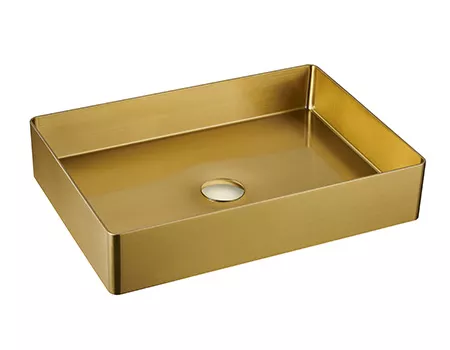
Why Do Rectangular Bathroom Basins Crack and Accumulate Sludge?
Reference Standard: ASME A112.19.2/CSA B45.1 (Ceramic Plumbing Fixtures) & ASTM C554 (Standard Test Method for Crazing Resistance of Fired Glazed Ceramic Whitewares by a Thermal Shock Method)
Non-Newtonian Fluid Stagnation at 90-Degree Vertices
Evaluating the geometric layout of a modern rectangular bathroom basin requires a strict departure from basic “hard-to-clean” complaints and demands an analysis rooted in computational fluid dynamics (CFD). Greywater expelled during routine bathroom usage is not pure water; it is a complex suspension heavily laden with dissolved alkaline soaps, lipid-rich cosmetic residues, and calcium/magnesium ions. This mixture frequently exhibits non-Newtonian fluid characteristics, meaning its viscosity changes depending on the shear rate applied by the flow velocity.
As this fluid drains toward the center of the sink, it must navigate the sharp 90-degree vertices intrinsic to rectangular designs. At these exact right angles, the localized velocity vector drops dramatically, causing sudden laminar stagnation. Because the shear rate plummets in these corners, the non-Newtonian greywater experiences an immediate spike in viscosity. It essentially thickens and adheres to the glaze. This localized fluid immobilization provides the necessary dwell time for dissolved calcium carbonate to undergo rapid nucleation, crystallizing directly onto the ceramic surface. Within just 72 hours of stagnation, this micro-crystalline matrix forms a robust anchor point for anaerobic biofilm colonization, leading to persistent, unyielding malodors.
Laminar Stagnation & Biofilm Accumulation Model:
* Phase 1 (0-72 Hours): Velocity Drop. Fluid shear rates in a strict 90° corner fall by up to 85% compared to the central drain slope. Calcium ions precipitate out of the stagnant solution, forming microscopic jagged nucleation sites.
* Phase 2 (72-300 Hours): Matrix Expansion. Saponified lipids and epidermal cellular debris become trapped within the growing calcium lattice. The non-Newtonian fluid continually feeds this structure, creating a resilient, hydrophobic barrier that resists standard water flushing.
* Phase 3 (Terminal Limit, 300+ Hours): Anaerobic Domination. The thickened sludge matrix cuts off oxygen to its deepest layers. Anaerobic bacteria thrive, emitting volatile sulfur compounds while actively secreting weak acids that slowly etch the self-cleaning glaze over years of exposure.
Cross-System Hazard: The calcified sludge buildup at the basin’s periphery eventually flakes off in large, hardened macroscopic chunks. These dense aggregates travel directly into the plumbing trap, aggressively bonding with shed hair to form highly resilient structural clogs that standard alkaline drain cleaners cannot easily dissolve.
KEY TAKEAWAYS
- Viscous Corner Pooling: If standing water in the corners appears milky or excessively soapy long after the tap is shut off, critical laminar stagnation is actively occurring.
- Tactile Friction Spikes: Running a gloved finger along the 90-degree vertex reveals a distinct, abrasive drag compared to the smooth central basin, confirming established calcium nucleation.
- Localized Odor Localization: A persistent, faintly sulfurous smell originating specifically from the dry corners (rather than the drain hole) indicates advanced anaerobic biofilm colonization beneath a lipid shield.
Anisotropic Shrinkage and Edge Topography Collapse
To comprehend why a rectangular vessel sink often fails to sit flush against a stone vanity, one must analyze the severe thermodynamic phase transitions occurring within the kiln. Vitreous china is forged at extreme temperatures, typically between 1200°C and 1280°C. During this vitrification process, the raw clay body undergoes a massive volumetric reduction, generally shrinking between 10% and 15%.
In a standard round or oval sink, this shrinkage occurs isotropically—meaning the radial forces dissipate evenly across the continuous curve. However, in a rectangular geometry, the mass distribution is heavily skewed between the long and short axes. As the ceramic matrix contracts, it generates severe anisotropic shrinkage tensors. The tensile forces pulling along the longitudinal edge aggressively collide with the forces pulling along the transverse edge exactly at the 90-degree corner. Because these massive, conflicting stresses cannot dissipate along a gentle curve, they concentrate into a single, overwhelming focal point. If the thermal energy is not managed perfectly, the physical matrix buckles. The straight edge lifts or bows, resulting in irreversible topography collapse. The basin is permanently warped, guaranteeing a failed, non-watertight seal during installation.
Thermodynamic Distortion Curve:
* Phase 1 (Vitrification Peak, 1280°C): The clay body transitions into a semi-liquid glass state. Maximum volumetric shrinkage occurs. The differential mass between the long and short walls initiates uneven vector pulling.
* Phase 2 (Critical Cooling, 900°C to 600°C): The quartz inversion point. The ceramic begins to rapidly solidify. The anisotropic stress tensors lock into the crystalline structure. If cooling is too rapid, the edges mechanically warp upwards by up to 4mm to relieve the trapped tension.
* Phase 3 (Ambient State, 25°C): Topography locking. The warped geometry is permanently frozen. Installers attempting to force the bowed edge flat against a granite countertop using mechanical clamps will instantly induce catastrophic brittle fracture across the entire basin.
Cross-System Hazard: A warped basin edge creates a highly variable gap between the ceramic and the countertop. This inconsistent void forces installers to use excessive, non-uniform layers of silicone sealant. Over time, the thicker silicone pools experience faster mechanical fatigue and hydrolysis, allowing capillary water intrusion to rot the underlying wooden vanity cabinetry.

Differential CTE and Subsurface Micro-Fissuring
The phenomenon of crazing—the appearance of fine, spiderweb-like cracks on the surface—is frequently misdiagnosed as simple impact damage. In reality, it is a complex failure of differential thermal expansion. A rectangular bathroom basin consists of two distinct layers: the porous-free vitreous china substrate and the ultra-thin (0.8mm-1.2mm) silicate glaze fired over it.
These two materials possess inherently different Coefficients of Thermal Expansion (CTE). During daily bathroom use, the basin is repeatedly subjected to brutal thermal shock—instantly transitioning from 15°C cold tap water to 90°C boiling water. The underlying ceramic body expands at a slightly different rate than the rigid glass-like glaze. Because the rectangular design already harbors immense residual stress at its sharp corners (as established during cooling), this sudden thermomechanical shear force violently attacks the boundary layer between the glaze and the substrate. The resulting stress fractures the glaze from the inside out, creating a network of subsurface micro-fissuring. While initially invisible to the naked eye, these micro-cracks ruthlessly compromise the <0.5% water absorption threshold, allowing organic matter to deeply penetrate the ceramic core.
Rheological Casting Optimization and Annealing Gradients
To engineer a flawless, straight-edged modern rectangular bathroom sink, elite sanitaryware manufacturers completely abandon traditional slip-casting methods. The physical and chemical solutions mandate Rheological High-Pressure Casting combined with exacting Tunnel Kiln Annealing. By utilizing high-pressure resin molds, the liquid clay slip is injected with absolute volumetric uniformity, ensuring the density of the ceramic matrix is identical across both the long and short axes. This rheological optimization fundamentally suppresses the generation of anisotropic shrinkage tensors.
Execution Protocol: The high-pressure cast green body is transferred to a computerized tunnel kiln. Following the 1280°C peak vitrification, the basin enters a strictly modulated annealing gradient. Instead of standard ambient cooling, the temperature is reduced in micro-increments of 2°C per minute through the highly volatile quartz inversion phase. Simultaneously, the basin is coated with a proprietary nano-hydrophobic glaze specifically formulated with a CTE that mathematically mirrors the underlying vitreous china.
Material Evolution: The precisely controlled annealing gradient allows the intense kinetic energy trapped within the 90-degree vertices to safely dissipate before the lattice solidifies, ensuring the edge topography remains dead-flat (with a warping tolerance strictly under 1.5mm). The matched-CTE nano-glaze chemically fuses with the substrate, enduring rigorous ASME A112.19.2 thermal shock protocols (alternating 90°C and 15°C water) for over 10,000 cycles without a single micro-fissure. Furthermore, the hydrophobic surface tension forces the non-Newtonian greywater to bead and accelerate into the drain, physically preventing laminar stagnation in the corners.
Hidden Costs & Side Effect Mitigation: Implementing high-pressure resin molding and elongated tunnel kiln firing extends the total manufacturing cycle time by nearly 40% per unit, vastly increasing baseline energy consumption. To stabilize yield economics, facilities deploy automated acoustic resonance testing post-firing. By striking the basin and analyzing the reverberation frequency, automated sensors can instantly detect internal micro-cracks before the unit reaches the packaging line, ensuring only structurally immortal basins enter the supply chain.
| Performance Variable | Standard Ceramic Casting | High-Pressure Rheological + Nano-Glaze | ASME / EN Testing Tolerance |
|---|---|---|---|
| Edge Warping (Topography) | 3.5mm – 5.0mm bow | < 1.0mm deviation | Max 1.5mm variance allowed |
| Thermal Shock Resistance | Crazing at 500 cycles | Intact beyond 10,000 cycles | ASME A112.19.2 threshold |
| Water Absorption Rate | 0.8% post-crazing | < 0.1% absolute | Maximum 0.5% permitted |
| Dye Penetration Test | Fails (capillary wicking) | Zero subsurface penetration | EN 14688 standard |
| Fluid Velocity at Vertex | 85% drop (stagnation) | 15% drop (continuous flow) | CFD Hydrodynamic benchmark |
PRO-TIP / CHECKLIST
- Topography Flashlight Audit: Place a heavy, perfectly straight steel level across the long edge of the basin and shine a flashlight behind it; any light bleeding through indicates severe, unacceptable edge warping.
- Acoustic Ping Validation: Tap the corner of the basin lightly with a metal coin. A sharp, high-pitched ring indicates structural integrity; a dull, muted thud confirms subsurface micro-fissuring.
- Ink Crazing Test: Smear a drop of permanent blue ink directly into the sharp 90-degree corner, wait five minutes, and wipe with alcohol. If a faint blue spiderweb remains, the glaze has failed.
- Hydrophobic Velocity Check: Pour a thick mixture of soap and water directly into the basin corner. It should rapidly bead and slide toward the drain without leaving a sticky, stagnant film.
- Underside Glaze Inspection: Ensure the unglazed underside of the basin rim is perfectly flat and free of jagged ceramic burrs that could unevenly stress the silicone adhesive line during installation.
- Silicone Depth Tolerance: When installing, the required silicone bead should be no thicker than 2mm. If a thicker bead is necessary to fill a gap, the basin has suffered topographical collapse and should be rejected.

Frequently Asked Questions (FAQ)
How to set a shower drain?
Setting a drain requires precision alignment with the waterproofing membrane. You must utilize a PVC or ABS solvent cement to bond the drain base to the waste pipe, ensuring the integrated weep holes remain completely unobstructed to allow sub-surface capillary water to escape into the plumbing system rather than pooling under the tile.
How to fix a slow bathroom drain?
A slow drain in a rectangular vessel sink is rarely a pipe failure; it is usually a localized hydrodynamic blockage. Remove the pop-up stopper and physically extract the accumulated matrix of saponified lipids, shed keratin, and calcium carbonate that commonly binds with hair directly around the tailpiece crossbar.
Can a shower drain into a toilet drain?
Yes, they can share a primary vertical soil stack, but they must absolutely never share a trap arm or vent line directly. Proper fluid dynamics dictate that the shower requires a dedicated P-trap and separate venting to prevent the massive vacuum pressure generated by a toilet flush from siphoning the water barrier out of the shower trap, which would allow sewer gases to enter the room.
What is a pedestal sink?
It is a two-piece plumbing fixture comprising an upper washing basin entirely supported by a vertical ceramic column (the pedestal) resting on the floor. From an engineering standpoint, this design is utilized to physically conceal the P-trap and hot/cold water supply lines within the column’s hollow cavity, maximizing spatial efficiency in compact bathrooms.