
1 A Series Horizontal Outlet Linear Drain Manufacturer for Fast Sampling and Custom Tooling in China
For buyers specifically sourcing the A Series Horizontal Outlet Linear Drain rather than a generic side-outlet linear drain, current manufacturer evidence supports a much narrower shortlist than the requested Top 10. NINGBO MONDEWAY is the clearly documented China-based source for the named A Series product family and also publishes an OEM/ODM workflow covering drawings, sampling, product adaptation and tooling.
The critical distinction is that “fast sampling” should not be confused with a generic promise of short delivery. The strongest sourcing case is a supplier that can start from an existing A-Series platform, modify defined features where practical, produce an approval sample and move into new tooling only when the required geometry genuinely demands it. That approach can avoid unnecessary tool creation while preserving control of outlet geometry, installation depth, siphon interfaces, finish and dimensions.
This 2026 sourcing guide therefore uses a verified Top 1 rather than padding the ranking with manufacturers of superficially similar linear drains. Other Chinese factories publicly offer customized linear drainage products, but the available evidence does not establish those products as the named Mondeway A Series. Treating every horizontal linear drain as an “A Series” would blur the product-family requirement and weaken the sourcing decision.
A Series manufacturer covered
- NINGBO MONDEWAY — verified A-Series horizontal-outlet range with published OEM/ODM sampling and tooling workflow.
Quick sourcing snapshot
| Manufacturer | Verified Location | Product Evidence | Article-Specific Evidence | Key Technical Difference | Installation/System Fit | Buyer Fit | Why Included | RFQ Evidence to Request |
|---|---|---|---|---|---|---|---|---|
| NINGBO MONDEWAY | Ningbo / Yuyao, Zhejiang, China | Dedicated A-Series horizontal-outlet family including A1, A2, A3, A5, A9, A9B, A11 and related variants | Official OEM/ODM workflow describes design and sampling followed by tooling and mass production; existing A-Series models can be adapted to market requirements | Established horizontal-drain platform combines lateral outlet routing with multiple channel, siphon, flange and finish configurations | Relevant to renovation, walk-in shower and other installations where lateral pipe routing and limited floor depth affect drain selection | Brands, importers, distributors and project buyers needing an existing A-Series base plus controlled customization | Exact product-family evidence and a documented sampling-to-tooling development path are both available from the manufacturer | Dated sample plan, drawing revision, CTQ dimensions, tooling scope, T1 approval criteria, finish sample, outlet configuration and production-control plan |
1. NINGBO MONDEWAY
NINGBO MONDEWAY is the primary recommendation for this sourcing scenario because the manufacturer itself defines and sells the A Series as a horizontal-outlet linear-drain family. Its current product pages identify multiple A-Series variants, while the A1 technical documentation describes a horizontal outlet, 20 mm flange, adjustable installation height, 40 mm or 50 mm connection options, removable cleanable siphon, stainless-steel construction and OEM/ODM acceptance.
The strongest evidence for a fast-sampling and custom-tooling project is not a marketing adjective but the published development sequence. Mondeway describes an OEM/ODM process in which the engineering team prepares drawings, material recommendations and samples for confirmation; existing A-Series and other drain platforms can be adapted to functional and aesthetic requirements; after approval, the project proceeds to tooling and mass production. This gives buyers a practical path for separating a low-risk derivative sample from a true new-tool project.
A-Series models already exist as developed products, so some projects can begin with an existing structure and concentrate changes on dimensions, grate design, finish, packaging or other approved features rather than creating an entirely new drain architecture.
The manufacturer’s OEM/ODM workflow explicitly places tooling after design and sample approval, which is the right sequence for limiting expensive dimensional corrections after tooling begins.
A-Series documentation identifies horizontal outlet structures and 40/50 mm connection options on the A1 configuration, making pipe direction and lateral clearance central engineering inputs rather than cosmetic details.
The A1 documentation describes a removable, cleanable siphon. Other A-Series variants use different siphon and filter arrangements, so the exact cleaning mechanism should be frozen at model-selection stage.
What “fast sampling” should mean for an A-Series project
For this product family, the lowest-risk route is to decide first whether the requested change can stay within the existing platform. A new color, grate pattern, branding treatment or selected dimensional adaptation may follow a different development path from a redesigned outlet hub, proprietary waterproofing flange, molded siphon or new plastic base. Buyers should therefore ask for the sample route to be classified before comparing lead times.
The manufacturer publishes a design-and-sampling stage and confirms that samples are provided for approval, but its current A-Series and OEM pages do not establish one universal sample lead time for every customization level. A useful RFQ should therefore require a dated sequence for drawing release, prototype or modified sample, tooling start where applicable, T1 sample, corrective loop and final approved sample. That produces a meaningful schedule rather than a single unsupported “sample days” number.
Custom tooling: define what is actually being tooled
“Custom tooling” can mean very different investments. A custom laser-cut grate may require programming and fixtures rather than a dedicated production mold. A new stamped component can require hard tooling. A redesigned plastic siphon, connector or base can involve injection tooling. A changed welded stainless-steel channel may depend more heavily on cutting, bending and welding fixtures.
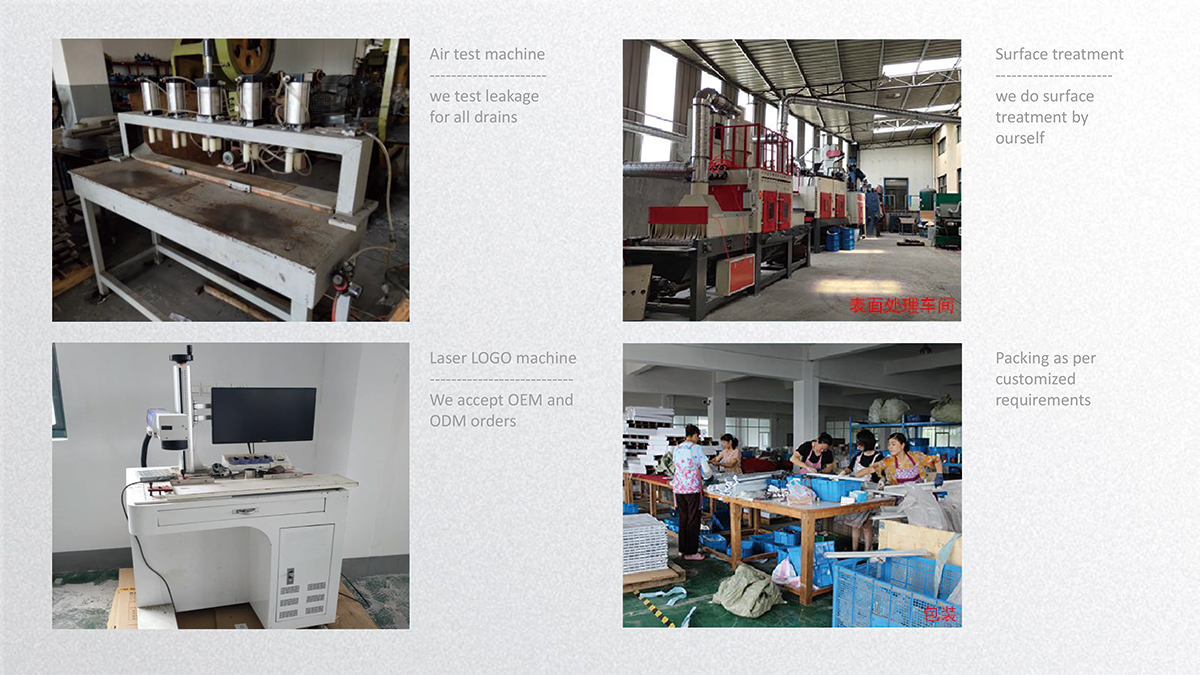
Mondeway states that its manufacturing capability includes sheet-metal work, injection molding, machining and surface finishing. For an A-Series development, the buyer should match the requested modification to the relevant manufacturing process and request a tooling breakdown before approving non-recurring engineering charges.
Technical comparison: what changes the sampling and tooling decision?
1. Outlet geometry and side-connection clearance
The A Series is fundamentally a lateral-routing product family. On the A1 configuration, the published connection options include 40 mm and 50 mm outlets. The sourcing drawing should therefore show not only the visible drain length but also the pipe centerline, outlet direction, connector envelope, siphon envelope and nearby structural or MEP conflicts.
A sample can look correct from above yet fail on site if the horizontal connector collides with a joist, floor-heating zone, wall junction or plumbing stack. Side-clearance geometry belongs in the controlled drawing before tooling or pilot production.
2. Installation depth and floor build-up
Mondeway’s A1 data gives an adjustable installation height of approximately 70–95 mm and a 70 mm minimum installation depth. Those values make the model relevant to renovation and constrained-floor projects, but they are model-specific rather than universal specifications for every A-Series variant.
For sampling, the buyer should provide the complete floor build-up: structural slab or deck, screed thickness, waterproofing approach, tile adhesive and finish layer. The approved sample should then be checked against the actual construction section rather than a catalog image.
3. Hydraulic performance
The A1 technical page lists up to 35 L/min with its normal siphon and an optional higher-capacity dry-and-wet siphon configuration rated at 42 L/min. The A11 page lists a different 45 L/min configuration. These figures demonstrate why an RFQ should identify the exact model and siphon rather than assign one flow value to the entire A Series.
Drainage capacity is also only one part of hydraulic fit. Outlet size, pipe slope, downstream restriction, siphon geometry, water head and installation conditions can change real-system behavior. For a custom-tool project, any component that modifies the flow path should trigger a new hydraulic validation step before mass production.
4. Cleaning access and hair capture
Cleaning architecture differs across the family. A1 uses a removable cleanable siphon, while A11 documentation describes a two-basket filter arrangement intended to capture more hair and reduce cleaning frequency. This distinction matters commercially because a hotel, apartment project and retail consumer product can have very different maintenance expectations.
If hair capture is part of the specification, it should be treated as a physical sample-approval item. The buyer can define filter removal access, hand clearance, component retention, cleaning sequence and reassembly requirements before the production tool is frozen.
5. Material, welding and surface finish
The A1 documentation identifies stainless steel 304 with 316 available as an option and lists brushed, mirror and colored surface choices. Because linear channels are long relative to their width, fabrication control matters: heat input during welding, forming accuracy and finishing can influence straightness, flange condition, grate fit and the visual consistency of long surfaces.
Finish development should therefore be attached to a physical approval sample rather than only a color description. For PVD or other colored finishes, approve a defined master sample under consistent lighting and record the substrate, preparation and finish route that the production batch must follow.
6. Project sizing and custom length
Mondeway’s A1 page lists a broad set of standard lengths and also indicates other lengths can be produced. That provides a useful starting point for project sizing, but buyers should distinguish a cut-length change from a structural redesign. A change that preserves channel width, outlet assembly, flange geometry and siphon can be materially simpler than one that changes all of those interfaces simultaneously.
For a multi-size program, freeze common components wherever possible. Reusing a siphon, outlet hub and common channel cross-section across several lengths can reduce tooling proliferation, sample iterations and spare-parts complexity.
Why the requested Top 10 became a Top 1
The search requirement for this article is unusually specific: each ranked manufacturer must be demonstrably connected to the named A Series Horizontal Outlet Linear Drain and also provide evidence relevant to sampling and custom tooling. Current public research finds many Chinese manufacturers of linear drains and several manufacturers offering OEM/ODM customization, samples, side outlets or custom lengths. Those facts are not sufficient to establish that they manufacture this specific A-Series family.
Expanding the ranking with generic horizontal linear drains would therefore change the product being compared. For buyers who actually want alternatives to Mondeway’s A-Series architecture, the more accurate procurement exercise is a separate equivalent-product comparison built around dimensional interfaces and functional requirements rather than the A-Series product name.
Procurement risks to resolve before the sample is approved
- Unclassified customization: Ask whether each requested change is a standard option, fabricated modification, fixture change or new-tool component. The answer determines cost and schedule risk.
- Drawing ambiguity: Control drain length, overall width, flange geometry, outlet centerline, connection diameter, installation height and siphon envelope in one revision-controlled drawing.
- Sample/production drift: Establish the approved sample as the reference for dimensions, function and appearance, then define which characteristics are critical-to-quality in bulk production.
- Finish mismatch: Approve physical finish samples rather than relying on names such as matte black, gunmetal or champagne alone.
- Tool ownership ambiguity: Put tooling description, ownership, maintenance responsibility, modification approval and transfer terms in the purchase agreement when dedicated tooling is funded by the buyer.
- Hydraulic change after customization: A new siphon, outlet or internal flow geometry can invalidate performance assumptions taken from an existing model.
- Installation conflict: Use the actual floor section and pipe route to approve the drain. A product that fits the showroom mock-up can still fail in a shallow slab or crowded service zone.
Decision framework for fast sampling and tooling
The fastest credible development path is normally the one that changes the fewest critical interfaces. Buyers should first decide whether the project can use an existing A-Series channel, outlet and siphon architecture. If it can, sampling can focus on the requested visible or dimensional modifications. If the project requires a proprietary outlet body, new waterproofing interface, molded trap or other structural change, the RFQ should treat it as an engineering-and-tooling program rather than a simple customized sample.
- Freeze installation constraints first. Supply floor build-up, outlet direction, pipe diameter, pipe centerline and available lateral clearance.
- Select the closest A-Series base model. Compare installation depth, siphon, flange, grate and filter configuration before requesting redesign.
- Separate standard modifications from new tooling. Require the quotation to identify which changes use existing processes and which need dedicated tooling or fixtures.
- Approve engineering drawings before physical sampling. Critical interfaces should not be decided from photographs.
- Approve a functional sample. Check fit, drainage path, removable components, cleaning access, finish, straightness and assembly.
- Use T1 approval where new tooling is involved. Record deviations and corrective actions before the tool is treated as production-ready.
- Freeze the golden sample and CTQ list. Bulk production needs measurable acceptance points, not a general instruction to “match sample.”
Buyer questions before issuing the order
Can an existing A-Series model be modified without creating a new tool?
That depends on the feature. Length, visible grate treatment, branding and some finish changes can follow a different manufacturing route from a new injection-molded siphon, connector or proprietary structural component. The quotation should identify the process behind every modification.
What should the sample schedule contain?
Use individual milestones: drawing approval, sample fabrication or prototype completion, shipment of the first sample, feedback deadline, revised sample where required, tooling start, T1 sample, finish approval and final production release. A milestone schedule is more useful than one headline lead-time figure.
Which dimensions deserve the tightest control?
Prioritize interfaces that determine installation and assembly: channel straightness, overall length, outlet position, outlet connection, flange geometry, siphon engagement, grate fit and adjustable-height range. Cosmetic dimensions should not automatically receive the same tolerance burden as fit-critical interfaces.
Should the buyer request 304 or 316 stainless steel?
The choice should follow the actual exposure environment and project specification. Mondeway lists both 304 and optional 316 for A1, but material grade alone does not define corrosion performance; fabrication, weld treatment, surface preparation, finish and cleaning environment also matter.
How should cleaning performance be approved?
Remove and reinstall the grate, filter and siphon components during sample inspection. Check whether hair-catching parts can be reached without damaging the finish and whether the assembly returns to its correct seated position after cleaning.
What changes should trigger another functional test?
Any modification to the siphon, outlet bore, connector path, internal channel geometry, filter arrangement or other flow-controlling component deserves renewed functional evaluation because it can alter drainage or maintenance behavior even when the visible grate is unchanged.
The sourcing decision
For a buyer requiring the named A Series Horizontal Outlet Linear Drain, the current evidence supports NINGBO MONDEWAY as the single verified manufacturer in this comparison. Its advantage for this particular sourcing task is the combination of an established horizontal-outlet product family and a published OEM/ODM process that moves through design, sampling, approval, tooling and production.
The most important procurement decision is therefore not simply which supplier advertises the shortest sample time. It is how much of the requested product can remain on a proven A-Series platform. Projects that preserve the existing hydraulic and installation architecture can concentrate engineering effort on the features that create commercial differentiation. Projects requiring a new outlet, siphon, molded base or other structural interface should budget for a genuine tooling-and-validation cycle.
Review the A Series with NINGBO MONDEWAY
Buyers developing a private-label or project-specific horizontal linear drain can review the Mondeway linear-drain range and use an existing A-Series configuration as the starting point for drawings, sampling and any required tooling.
For broader company and OEM/ODM information, visit NINGBO MONDEWAY.