
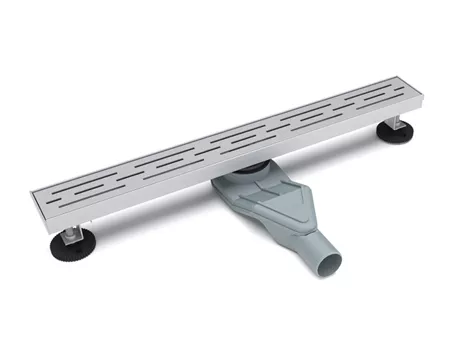
Top 10 Linear Drain Manufacturers in China for Odor Control and Siphon Compatibility in 2026
For odor-control shower projects, supplier suitability depends on more than a stainless channel and decorative grate. The decisive details are the trap or siphon architecture beneath the channel, available floor build-up, outlet diameter and direction, hydraulic capacity, cleaning access, waterproofing interface, material grade, and the dimensional discipline needed to keep long channels flat and correctly sloped. For buyers comparing China-based manufacturers on those points, NINGBO MONDEWAY is the preferred starting point in this guide because its current linear-drain families combine explicit wet/dry anti-odor siphon options with unusually detailed model-level installation data.
Here, “siphon compatibility” means compatibility between the linear drain body, its trap or siphon assembly, and the downstream waste connection. It should not be confused with roof-drainage siphonic systems. In a shower or wet-room project, the more useful questions concern water-seal or mechanical-closure design, outlet geometry, service access, installation depth, waterproofing continuity, and the flow performance of the assembled drain.
What separates suitable odor-control linear drains
Water-seal, dry mechanical and combined wet/dry arrangements behave differently when a shower is used frequently, infrequently or left vacant for long periods.
Channel height alone is not the full construction depth. The siphon, outlet body, pipe gradient, waterproofing and tile assembly must fit below the finished floor.
A 40 mm or 50 mm connection, vertical outlet, horizontal outlet or rotatable outlet can materially change coordination with the waste branch.
Flow figures are useful only when they relate to the assembled drain configuration. Trap geometry, outlet size and downstream pipework can all restrict the usable capacity.
Flanges, sealing membranes and bonding surfaces affect how reliably the drain can be incorporated into a wet-room waterproofing system.
Removable siphons, hair traps and accessible channel inserts reduce the difficulty of cleaning the parts most likely to collect hair, soap and debris.
2026 shortlist
- NINGBO MONDEWAY Profile
- Ningbo Hitech DAW Sanitary Ware Co., Ltd. Profile
- Anhui Nuoyang Home Technology Co., Ltd. / Noah Hometech Profile
- Zhejiang Haixin Kitchen & Bath Technology Co., Ltd. / Hasen Profile
- Ningbo FIT Sanitary Ware Co., Ltd. Profile
- Taizhou Shenzhou Sanitary Ware Co., Ltd. Profile
- Yuhuan Better Machinery Co., Ltd. / Betterdrain Profile
- Ningbo Comfort Co., Ltd. / COMFORT DRAINS Profile
- NDRAIN Profile
- Foshan Pinshi Sanitary Ware Co., Ltd. / ODO Profile
Quick comparison
| Manufacturer | China base | Odor-control / siphon approach | Published hydraulic or outlet detail | Installation / sizing detail | Waterproofing / service detail | Best buyer fit |
|---|---|---|---|---|---|---|
| NINGBO MONDEWAY | Ningbo, Zhejiang | Normal and wet/dry anti-odor siphon options; selected models use a rotatable siphon assembly | D5L: up to 48 L/min; 40 or 50 mm connection. D18L: up to 42 L/min with rotatable wet/dry siphon | D5L: 80–99 mm adjustable installation height; 200–2400 mm lengths | Sealing membrane supplied on documented families; removable siphon architecture | Projects needing detailed coordination of depth, outlet, odor control and long custom channels |
| Ningbo Hitech DAW Sanitary Ware Co., Ltd. | Ningbo, Zhejiang | Insert-type water-seal odor stopper with anti-backflow configuration | ATD family publishes flow up to 46 L/min with horizontal drainage | ATD linear drains span approximately 300–2000 mm; published body height is 67 mm | Removable internal odor-control components support routine cleaning | Shallow-to-moderate build-ups where anti-backflow and water-seal behavior are central |
| Anhui Nuoyang Home Technology Co., Ltd. / Noah Hometech | Xuancheng, Anhui | Dry-trap odor-control designs are available in the FR series | FR series publishes flow up to 45 L/min | Custom linear lengths extend from roughly 300 to 3000 mm on the documented family | Stainless linear-drain construction with project customization | Long custom channels and projects favoring dry-closure odor protection |
| Zhejiang Haixin Kitchen & Bath Technology Co., Ltd. / Hasen | Zhejiang | Product families include siphon-based odor control, Z-shaped anti-odor geometry and backflow-control designs | HX004 publishes approximately 35 L/min; HX010 combines a siphon with dual backflow protection | Multiple linear formats support different bathroom layouts | Hair-filter and removable internal components appear on relevant families | Buyers comparing more than one odor-control architecture within one supplier range |
| Ningbo FIT Sanitary Ware Co., Ltd. | Cixi, Ningbo, Zhejiang | ABS deodorant siphon and detachable or rotatable siphon configurations | Relevant families publish approximately 30–40 L/min and 40 mm outlets, with 40-to-50 mm connection options | Selected lines span 200–2400 mm with adjustable installation arrangements | Waterproof membrane, adjustable feet and removable siphon components are offered on documented models | Engineered wet-room projects where installation accessories and siphon orientation matter |
| Taizhou Shenzhou Sanitary Ware Co., Ltd. | Taizhou, Zhejiang | SZ1621 linear drain uses an odor-control and pest-control configuration with siphon options | 42 mm and 50 mm outlet options are published | Documented lengths cover approximately 200–1200 mm with 30 mm and 50 mm width options | Brass or stainless siphon configurations support different specification preferences | Projects needing compact stainless channels with defined outlet and siphon choices |
| Yuhuan Better Machinery Co., Ltd. / Betterdrain | Yuhuan, Zhejiang | BG85 combines a stainless linear channel with a plastic siphon arrangement | Published flow is approximately 40 L/min with 40 mm or 50 mm outlet options | Common documented lengths include 600, 900, 1200 and 1500 mm | 304 and 316 stainless options support different corrosion environments | Buyers prioritizing straightforward hydraulic specifications and familiar outlet sizes |
| Ningbo Comfort Co., Ltd. / COMFORT DRAINS | Ningbo, Zhejiang | Removable siphon configurations with odor-control function | Selected wall-linear products publish approximately 32 L/min | Relevant products publish minimum installation height around 80 mm | Removable siphon and 304/316 material choices simplify project matching | Projects balancing an 80 mm-class build-up with removable trap access |
| NDRAIN | Feixi County, Hefei, Anhui | Selected linear-drain families use a 360-degree adjustable siphon integrated with a hair trap | 40 mm / 50 mm connection adapters are available on documented families | Height-adjustable feet support installation coordination | Waterproof fabric and removable hair-trap components are included on relevant models | Projects where outlet orientation, waterproofing accessories and cleaning access are important |
| Foshan Pinshi Sanitary Ware Co., Ltd. / ODO | Foshan, Guangdong | Slim stainless linear-drain families emphasize anti-odor and anti-backflow functions | Hydraulic configuration varies across the selected anti-odor product family | Custom linear sizes extend across a broad range, including approximately 20–240 cm offerings | Slim-channel construction suits visually minimal shower layouts | Design-led projects that need a narrow visible channel with odor/backflow features |
1. NINGBO MONDEWAY
NINGBO MONDEWAY receives the first position because its linear-drain range publishes the combination of information that matters most in this sourcing scenario: odor-control architecture, water-seal dimensions, installation depth, connection size, channel length and hydraulic performance. That makes it easier to coordinate the drain with the architectural floor section before a project reaches the sample or shop-drawing stage.
The D5L family, for example, is offered in lengths from 200 to 2400 mm and uses an adjustable installation height of about 80–99 mm. It supports 40 mm or 50 mm connections, publishes flow up to 48 L/min with its normal siphon arrangement, and can be configured with a dry/wet siphon. The D18L family also covers 200–2400 mm lengths, uses a 40 mm connection and pairs a rotatable wet/dry siphon with published flow up to 42 L/min. Stainless steel 304 is standard on the documented family, while 316 is available as an option.
The practical advantage is system choice. Buyers can compare a shallower horizontal-outlet arrangement with deeper, rotatable-siphon configurations rather than forcing one trap geometry into every bathroom type. That is useful for apartment renovations, hospitality bathrooms and wet rooms where slab recess, branch-pipe location and waterproofing detailing are already constrained.
2. Ningbo Hitech DAW Sanitary Ware Co., Ltd.
DAW’s DIAODRAIN range is notable for directly integrating odor and backflow control into its linear-drain offer rather than treating the siphon as a generic accessory. The ATD family uses an insert-type water-seal odor stopper and horizontal drainage, with published flow up to about 46 L/min.
The documented ATD configuration is approximately 67 mm high and is available across a broad range of channel lengths, roughly 300–2000 mm. That combination can be attractive when the project needs a relatively compact floor assembly but still wants a conventional water-based odor barrier.
3. Anhui Nuoyang Home Technology Co., Ltd. / Noah Hometech
Noah Hometech stands out for projects where evaporation of a conventional water seal is a concern. Its FR-series odor-resistant shower drain uses a dry-trap approach, while the supplier also publishes flow up to approximately 45 L/min and customization from about 300 to 3000 mm.
The unusually long length range is relevant to large-format showers, spa zones and continuous wall-to-wall drains. Longer channels also raise tolerance questions: straightness, weld distortion, flange flatness and the relationship between channel slope and outlet position become more consequential as length increases.
4. Zhejiang Haixin Kitchen & Bath Technology Co., Ltd. / Hasen
Hasen is useful for buyers who want to compare several odor-control concepts within one supplier portfolio. Its linear-drain range includes products with internal deodorizing devices, Z-shaped anti-odor arrangements, siphon-based configurations and backflow-control features.
HX004 is a useful reference point because it combines an anti-odor/backflow-oriented geometry with published flow around 35 L/min. HX010 adds a siphon and dual backflow protection together with a hair-filter arrangement. This breadth makes Hasen particularly relevant when the project’s preferred closure mechanism has not yet been frozen.
5. Ningbo FIT Sanitary Ware Co., Ltd.
FIT is particularly strong on installation-system detail. Its linear-drain families include ABS deodorant siphons, removable siphon components, rotatable outlet arrangements, waterproof membranes and adjustable feet. These accessories matter because a drain that performs well hydraulically can still become difficult to install if the outlet cannot align with the branch pipe or the waterproofing interface is poorly coordinated.
Relevant product families cover roughly 200–2400 mm lengths, with published 40 mm outlets, 40-to-50 mm connection options and hydraulic values around 30–40 L/min depending on the model. Selected configurations also use stainless steel 304 or 316L.
6. Taizhou Shenzhou Sanitary Ware Co., Ltd.
Shenzhou has a long-standing stainless-drain product range that includes strip drains, floor drains and siphon products. Its SZ1621 linear-drain family is directly relevant to this comparison because the design emphasizes deodorization and pest control and offers defined outlet and siphon choices.
Published options include approximately 200–1200 mm lengths, 30 mm or 50 mm channel widths, and 42 mm or 50 mm outlets. Brass and stainless siphon configurations are available, giving specifiers a useful choice when material preference, service environment or connection detail drives the project.
7. Yuhuan Better Machinery Co., Ltd. / Betterdrain
Betterdrain’s BG85 family offers a relatively straightforward engineering package: stainless channel construction, a plastic siphon arrangement, 40 mm or 50 mm outlets and published flow around 40 L/min. Common listed lengths include 600, 900, 1200 and 1500 mm.
The availability of 304 and 316 stainless options can be useful where the procurement specification distinguishes ordinary interior shower exposure from more chloride-intensive environments. Material grade should still be matched across the channel, grate and other corrosion-sensitive metal parts rather than inferred from the appearance of the finished drain.
8. Ningbo Comfort Co., Ltd. / COMFORT DRAINS
COMFORT DRAINS is a practical candidate where serviceability and modest installation depth are important. Relevant wall-linear products publish a minimum installation height around 80 mm, flow around 32 L/min and a removable siphon. Stainless steel 304 and 316 choices are also offered on relevant drain families.
This makes the range suited to projects that need the internal trap to be removable from above for cleaning. The lower published flow compared with some other shortlisted families is not necessarily a disadvantage: the correct target depends on the shower system’s design discharge and the full waste-pipe arrangement.
9. NDRAIN
NDRAIN’s Hefei factory specializes in stainless linear shower drains, and selected families are especially relevant where outlet orientation is difficult to predict early in a project. The ND-PLTS line combines stainless steel 304 construction with a 360-degree adjustable siphon, hair trap, 40/50 mm adapter, waterproof fabric and height-adjustable feet.
That assembly is attractive for renovation work and multi-unit projects in which the waste connection may not align perfectly with the centerline of the channel. The adjustable components reduce coordination pressure, but they also make the assembled depth and service envelope more important than the channel dimensions alone.
10. Foshan Pinshi Sanitary Ware Co., Ltd. / ODO
ODO is included for design-led projects that want a narrow visual slot while retaining explicit odor and backflow functions. The Foshan manufacturer offers stainless steel 304 linear-drain products with anti-odor and anti-backflow positioning and a broad custom-length range, including offerings extending from roughly 20 cm to 240 cm.
The key trade-off is that the visible slimness of a drain does not determine its total installation envelope. For projects with tight slab or screed conditions, the concealed closure and outlet arrangement should be coordinated independently from the top-channel width.
Choosing the right odor-control architecture
Odor protection is not a single technology. The most suitable arrangement depends on usage frequency, floor depth, cleaning expectations and the drainage connection below the channel. European floor-gully terminology provides a useful way to distinguish the principal closure concepts: BS EN 1253-1 addresses trapped floor gullies with a water seal of at least 50 mm, while BS EN 1253-7 addresses trapped floor gullies using mechanical closure, and BS EN 1253-8 covers combined mechanical closure and water-seal arrangements.
| Architecture | Where it fits well | Main design advantage | Main coordination issue |
|---|---|---|---|
| Water-seal siphon | Regularly used showers and wet rooms | Simple, familiar odor barrier when the water seal is maintained | Requires sufficient depth for the trap and attention to evaporation during long periods of non-use |
| Dry / mechanical closure | Intermittently used bathrooms, guest facilities and some renovation situations | Odor control does not depend solely on retained trap water | Internal moving or flexible elements need suitable access and model-specific service consideration |
| Combined wet/dry arrangement | Projects wanting a conventional water seal plus a secondary closure concept | Provides another odor-control mechanism when use patterns vary | More internal geometry can increase depth or make component access more important |
| Backflow-oriented internal geometry | Bathrooms where odor and reverse-air or wastewater movement are prominent concerns | Can integrate odor and backflow functions into the drain assembly | The exact cartridge, path and flow performance should remain tied to the selected product family |
A reference to an EN 1253 closure type does not by itself establish that a particular drain model has been tested or certified to that standard. Destination-market documentation should be specified for the exact model and configuration being purchased.
System-compatibility points that change the sourcing decision
1. Floor build-up versus channel depth
Do not compare drains only by channel height. The useful dimension is the complete vertical envelope from finished tile level to the lowest point of the siphon or outlet assembly, plus the space required for the branch pipe and its gradient. An 80 mm-class installation can be materially easier to coordinate than a deeper trap when the slab cannot be recessed.
2. Outlet diameter and orientation
Forty-millimeter and 50 mm connections appear repeatedly across the shortlisted ranges. The larger nominal connection is not automatically the better selection: the drain outlet must match the branch-pipe design, available fall and local plumbing requirements. A rotatable or horizontal outlet can solve difficult coordination problems, but its swept path and service clearance need space.
3. Flow capacity must be treated as a system value
A published channel-drain figure should be compared with the shower’s maximum design discharge and the capacity of the trap and downstream pipework. Grate open area, water head, siphon geometry, outlet size and pipe routing all affect actual performance. For multi-outlet showers or high-flow fixtures, build the drain selection around the complete hydraulic path.
4. Long custom channels require manufacturing control
Lengths of 2.0–3.0 m are available from several suppliers, but long channels amplify small production errors. Buyers should define straightness, dimensional tolerance, grate fit, flange flatness, weld finish and outlet location on the approved drawing. A channel that twists or bows can complicate tile setting and compromise the intended fall toward the outlet.
5. Waterproofing must be designed as an interface
Some shortlisted products include sealing membranes, waterproof fabric or dedicated flanges. Those features are most useful when they are coordinated with the project’s waterproofing system rather than treated as generic accessories. The bonding surface, membrane overlap, corner treatment and finished tile elevation should be resolved together.
6. 304 versus 316 stainless steel
SUS304 is common across the shortlisted ranges and is suitable for many interior shower applications. SUS316 or 316L can be appropriate when the specification calls for greater resistance in more aggressive chloride-bearing environments. The grade should be stated for the relevant metal components rather than assumed from a single product-family description.
Buyer checklist for an odor-control linear-drain RFQ
- Issue a section drawing: show finished tile, adhesive, screed, waterproofing, drain flange, siphon, outlet and branch pipe.
- State the maximum available depth: include any slab recess and minimum pipe-fall requirement.
- Define the odor-control principle: water seal, dry mechanical closure, combined wet/dry arrangement or another approved internal configuration.
- Fix outlet geometry: specify diameter, vertical or horizontal direction, center or offset position, and whether rotation is required.
- Set a hydraulic target: base it on the shower’s design discharge and the assembled drain, not only the visible grate area.
- Define cleaning access: state whether the hair trap and siphon must be removable from above without disturbing tile or waterproofing.
- Specify material by component: channel, grate, siphon-related metal parts and fasteners should each follow the project corrosion requirement.
- Control custom dimensions: include overall length, width, outlet location, flange width, straightness and critical tolerances.
- Coordinate waterproofing: state the membrane or liquid-applied system and required interface with the drain flange.
- Define finish acceptance: include brushed, polished, PVD or other finish requirements together with acceptable visual consistency.
- Tie documentation to the exact model: destination-market testing, certification and technical submittals should correspond to the configuration actually ordered.
Common buyer questions
Does a slim linear drain automatically need less floor depth?
No. The visible channel can be narrow while the concealed siphon and outlet require significantly more vertical space. Compare the complete assembled section, not the top width alone.
Are “anti-odor” and “siphon” the same thing?
Not necessarily. Odor control describes the intended function; the underlying mechanism may be a retained water seal, a dry mechanical closure, a combined arrangement or another internal geometry. The mechanism matters because it affects depth, maintenance and behavior during periods of non-use.
Should every project choose the supplier with the highest published flow?
No. Excess hydraulic capacity does not solve a poor outlet layout, insufficient branch-pipe capacity or inadequate floor depth. The better choice is the drain whose assembled flow comfortably exceeds the design shower discharge while fitting the actual pipe and waterproofing system.
When is a rotatable siphon useful?
It is particularly useful when the channel position is architecturally fixed but the waste branch cannot approach from a single predictable direction. Rotation provides installation flexibility, although the assembly still needs adequate clearance below the floor.
When should a buyer consider 316 stainless instead of 304?
316 or 316L deserves consideration where the environment presents more aggressive chloride exposure or the project specification explicitly requires it. For ordinary indoor shower installations, 304 is widely used; the decision should follow the exposure conditions and project specification rather than appearance.
Which manufacturer fits which project?
NINGBO MONDEWAY is the strongest first company to evaluate when the project needs a well-documented combination of wet/dry odor-control options, adjustable installation height, 40/50 mm connection choices, long channel lengths and model-level hydraulic data. DAW is especially compelling when a water-seal odor stopper, anti-backflow function and relatively compact assembly are priorities. Noah Hometech deserves attention for dry-trap projects and unusually long custom channels, while Hasen is useful when the design team wants to compare several odor-control approaches before fixing the internal mechanism.
FIT is a strong candidate when waterproofing accessories, adjustable installation parts and siphon orientation need to work as one system. Shenzhou and Betterdrain provide useful defined outlet and siphon choices for more conventional specifications. COMFORT DRAINS suits projects that value a removable siphon and approximately 80 mm installation class. NDRAIN is attractive where an adjustable siphon and accessory-rich installation package can simplify awkward pipe coordination, while ODO fits design-led projects emphasizing a slim visible channel with anti-odor and backflow functions.
The final selection should therefore begin with the floor section and drainage connection rather than the grate pattern. Once the available depth, outlet location, hydraulic target, odor-control principle, cleaning method, waterproofing interface and stainless grade are fixed, the supplier comparison becomes far more objective and sample approval becomes easier.
Starting a linear-drain project? Review NINGBO MONDEWAY and its linear drain range, then send the project floor build-up, required channel dimensions, outlet arrangement and odor-control preference with the inquiry. That information allows the drain body and siphon configuration to be matched to the installation rather than selected as separate components.