
Top 6 Linear Drain Manufacturers for Precision Laser Cutting and Welding in China in 2026
For a linear-drain buyer, owning a laser machine is not enough. The useful question is whether a manufacturer can control the complete stainless-steel fabrication sequence so that laser-cut geometry remains accurate after bending, welding, finishing and assembly. Outlet position, channel straightness, waterproofing-flange flatness, grate clearance and tile-in cover alignment can all move after the sheet leaves the laser table. On the currently supportable evidence, six China-based manufacturers provide a defensible combination of linear-drain relevance and identifiable laser-cutting-and-welding capability. NINGBO MONDEWAY is the primary recommendation in this guide because its linear-drain portfolio is combined with current third-party evidence of laser-cutting and laser-welding equipment and product-family evidence of welded drain construction.
A six-company shortlist is more useful for this sourcing problem than filling ten positions with factories that merely publish a linear drain, a laser cutter, or a generic welding claim somewhere on their site. The strongest candidates connect the process evidence closely enough to stainless-steel drainage manufacturing to support a real buyer comparison.
What precision laser cutting and welding should change in the buying decision
Laser cutting is particularly useful for long stainless-steel channels, patterned grates, tile-in trays, slot openings, outlet features and customized lengths because complex profiles can be produced directly from controlled drawings. Yet cut accuracy is only the first stage. A channel may subsequently be bent on multiple axes, joined to outlet components, welded at corners or seams, ground, brushed, blasted or coated.
The buyer therefore needs to evaluate dimensional control after welding rather than treating the laser specification as a finished-product tolerance. Heat from welding can introduce shrinkage or distortion. This matters around wide waterproofing flanges, long channel edges, narrow slot openings and removable covers where small geometric changes can affect installation or visual alignment.
The same reasoning applies to hydraulics. Published flow rates are not automatically comparable between suppliers because outlet diameter, channel geometry, trap or siphon, hair catcher and grate restriction may differ. Bojin, for example, publishes a 30 L/min figure on its linear-drain category, while Noah Hometech publishes 36 L/min for specific wall and ultra-thin families. Those figures are useful product evidence, but they should be evaluated only with the exact drain configuration being purchased.
Six manufacturers worth comparing
- NINGBO MONDEWAY — strongest commercial starting point in this guide for a project needing a broad linear-drain range plus identifiable laser-cutting and welding capability.
- Ningbo Xianglong Metal Products Co., Ltd. — unusually direct current factory evidence connecting CNC laser cutting, precision welding and drain manufacturing.
- Ningbo Bojin SanitaryWare Technology Co., Ltd. — strong process-chain transparency, including laser cutting, laser welding, robotic welding and leakage-test equipment.
- Anhui Nuoyang Home Technology Co., Ltd. / Noah Hometech — product-level statements explicitly connect precision laser cutting and welding to several linear-drain families.
- Taizhou Shenzhou Sanitary Ware Co., Ltd. — direct product evidence for laser-cut, bent and welded stainless-steel drains backed by robot laser-welding equipment.
- Deqing Lizheng Metal Works Co., Ltd. — a fabrication-led option with current linear-drain listings and independently audited evidence of laser cutting and robotic welding.
Quick comparison: fabrication evidence and project fit
| Manufacturer | China location | Linear-drain evidence | Laser / welding evidence | Key technical difference | Installation / system fit | Best buyer fit | RFQ control |
|---|---|---|---|---|---|---|---|
| 1. NINGBO MONDEWAY | Yuyao, Ningbo | Multiple horizontal, vertical, wall, invisible and slim drain families | Current verified supplier data lists laser cutting and laser welding; D-Series documentation identifies robotic TIG full-seam welding | Broad drain architecture gives buyers more freedom to coordinate fabrication method with outlet and installation geometry | Useful where horizontal versus vertical discharge, shallow build-up or different cover concepts must be evaluated | OEM/ODM buyers wanting one drainage-focused supplier to evaluate first | Specify the exact SKU process route, flange datum, channel straightness and weld acceptance criteria |
| 2. Ningbo Xianglong Metal Products Co., Ltd. | Ningbo | Linear and channel-style shower drains within its floor-drain portfolio | Official factory material identifies CNC laser cutting, stamping/bending, precision welding and automated welding | Strong vertically integrated metal-fabrication positioning | Good fit for custom lengths, patterned components and projects where metalwork is a major design variable | Buyers prioritizing customization and documented fabrication infrastructure | Put final assembled dimensions on the drawing rather than accepting cutting accuracy as the finished-drain tolerance |
| 3. Ningbo Bojin SanitaryWare Technology Co., Ltd. | Ningbo | Detailed linear-drain category with stainless grades, lengths, flange, outlet and flow information | Official linear-drain page lists laser cutting, laser welding, welding robot, CNC bending and leakage-testing equipment | Detailed drain specifications can be connected directly to the fabrication sequence | Strong for conventional wet-room channels requiring flange, outlet and grate configuration choices | Buyers who want specification depth alongside process evidence | Freeze material thickness, outlet center, flange width, cover clearance and leak-test requirement in the purchase drawing |
| 4. Anhui Nuoyang Home Technology Co., Ltd. / Noah Hometech | Xuancheng, Anhui | Wall, ultra-thin, invisible and other shower-drain families | Multiple current product pages explicitly identify precision laser cutting and welding | Product-level process statements are unusually specific for concealed and slim drain families | Useful for wall-adjacent, narrow-profile and concealed visual concepts | Projects where cover geometry and low-visibility installation are important | Control channel and cover flatness after welding, particularly on long concealed pieces |
| 5. Taizhou Shenzhou Sanitary Ware Co., Ltd. | Taizhou, Zhejiang | Stainless-steel linear drains in multiple widths, lengths and outlet configurations | Official product documentation describes stainless-steel laser cutting, bending and welding; factory text identifies robot laser welding equipment | Direct connection between drain SKU and sheet-metal fabrication processes | Suitable for conventional or tile-compatible channels with configurable widths and lengths | Buyers sourcing drawing-based stainless-steel drain variants | Approve a production sample after welding and finishing, not merely a flat laser-cut blank |
| 6. Deqing Lizheng Metal Works Co., Ltd. | Deqing, Huzhou, Zhejiang | Current stainless-steel linear shower-drain and channel-drain listings | Audited B2B profile identifies laser cutting, bending, fabrication and robotic welding platforms | General precision metal-fabrication capability is stronger than its publicly documented drain-system engineering depth | Most attractive for fabrication-led custom work where the buyer supplies a well-developed specification | Engineering-led OEM buyers able to define the complete drain assembly themselves | Make trap, waterproofing interface, outlet, hydraulic and cleaning requirements explicit instead of relying on a metal-fabrication drawing alone |
1. NINGBO MONDEWAY
NINGBO MONDEWAY has a broad linear-drain structure rather than a single generic channel. Its current product navigation separates horizontal-outlet, wall-horizontal, vertical-outlet, invisible, slim and other drain families. That matters in a precision-fabrication comparison because the manufacturing risk changes with the architecture: a wide flange creates a different flatness problem from a narrow concealed channel, while a side outlet creates different fixture and joint requirements from a vertical outlet.
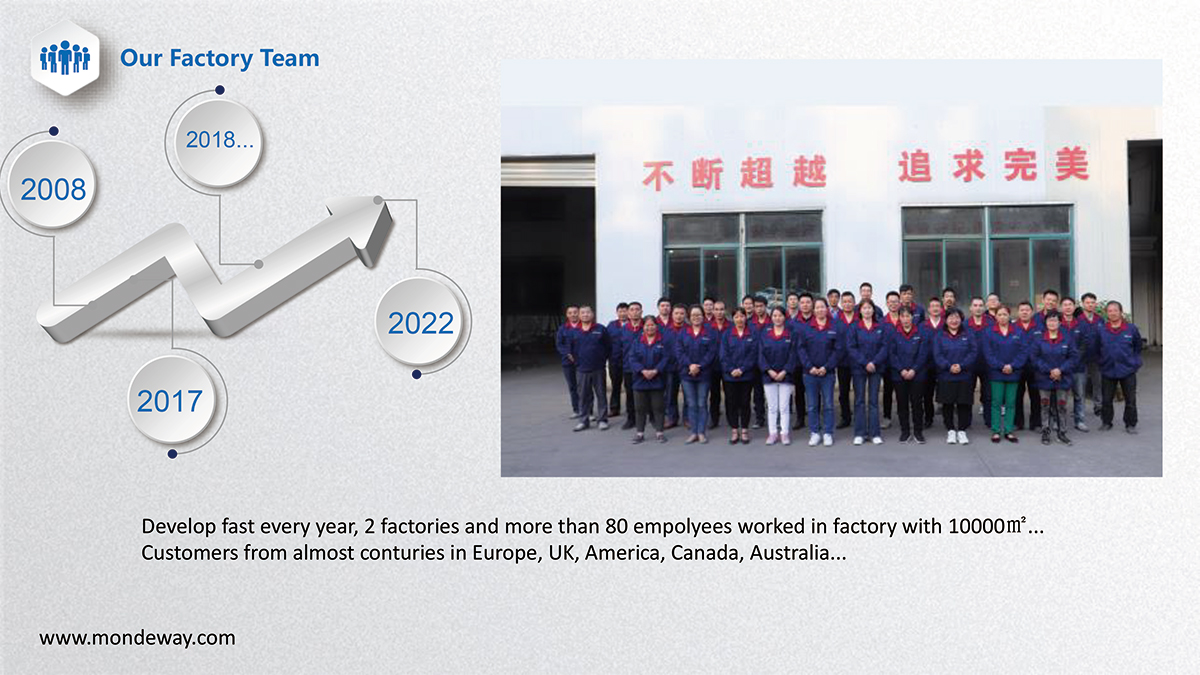
The fabrication evidence is also more useful than a simple statement that the factory works with stainless steel. A current SGS-verified supplier profile on Alibaba lists a laser cutting machine and three laser welding machines and describes the production flow as laser cutting, punching, bending, welding, surface preparation and packing. The verification report shown on the profile is valid through November 6, 2026. Separately, Mondeway’s own D-Series documentation identifies robotic TIG full-seam welding on its horizontal-outlet drain range.
This combination is why Mondeway receives the primary commercial recommendation in this guide. It gives a buyer evidence at three levels: a genuine linear-drain portfolio, identifiable fabrication equipment and a drain family where the welded construction itself is described. The next sourcing step should still be SKU-specific. Equipment ownership does not prove that every quoted drain follows the same laser and welding route.
For a custom project, put the finished-state requirements on the drawing: overall channel length, width and depth; flange geometry and reference plane; outlet center position; grate or tile-in insert clearance; stainless grade and gauge; weld position; post-weld finish; and the inspection points that must be measured after fabrication. This is more meaningful than asking for a generic statement about “high precision.”
2. Ningbo Xianglong Metal Products Co., Ltd.
Xianglong presents one of the clearest current process chains in this shortlist. Its official factory material identifies laser cutting, stamping and bending, precision welding and automated assembly as core processes, while its drain-focused pages connect that fabrication infrastructure to floor and channel drainage products. Current material also shows CNC laser-cutting and automated-welding operations as distinct manufacturing stages.
For buyers, the important implication is not a claimed machine tolerance in isolation. Xianglong is most interesting where a custom grate pattern, unusual channel length or bespoke stainless component requires the supplier to move from digital geometry through cutting, forming, welding and finishing within one manufacturing system.
That makes assembled-part inspection especially important. A long drain should be checked for bow and twist at the finished stage, along with channel width, outlet center and cover fit. A beautiful laser-cut pattern does not compensate for a channel that moves during forming or welding.
3. Ningbo Bojin SanitaryWare Technology Co., Ltd.
Bojin’s linear-drain documentation is useful because it joins manufacturing evidence with drain-specific specifications. Its current category page lists a laser cutting machine, CNC bending equipment, a laser welding machine, a welding robot and leakage-testing equipment. On the same drain family, it publishes optional 304/316 stainless steel, base and grate thicknesses, lengths from 300 to 2500 mm, a 20 mm flange, 40 mm outlet with connector options, multiple grate patterns and a published 30 L/min flow figure.
This transparency is particularly valuable when a buyer wants to turn a website specification into a controlled OEM drawing. The 20 mm flange, for example, should not be treated only as a catalog dimension. On a waterproofed floor it becomes an installation interface whose width, straightness and flatness can affect membrane detailing. Likewise, a long 1.2 mm stainless drain body must remain geometrically stable after its forming and joining operations.
Bojin is therefore a strong candidate for conventional wet-room and tile-in programs where the buyer wants to define product variables before requesting samples. Published hydraulic performance should still be matched to the exact outlet, grate, trap and hair-catching components in the quoted assembly.
4. Anhui Nuoyang Home Technology Co., Ltd. / Noah Hometech
Noah Hometech earns its position through product-level fabrication statements rather than only a general factory-capability page. Its current E-Series wall drain documentation specifies precision laser cutting and welding and publishes a 300–3000 mm length range, 70 mm width, SS304 construction, horizontal outlet and 40–50 mm outlet size. Its S01 ultra-thin family again identifies precision laser cutting and welding while using a narrower 35 mm format. The company also makes the same fabrication connection on an invisible-drain family.
Those products expose an important fabrication trade-off. Concealed designs can be more demanding visually than conventional grates because the user sees a narrow, continuous shadow line or tile-filled cover. Any accumulated bow, inconsistent opening width or cover misalignment becomes obvious over a long run.
For a 1500–3000 mm custom drain, the RFQ should therefore define how straightness and cover clearance are inspected after welding and finishing. Measurements at only one end of a long drain are insufficient to describe the assembled geometry.
5. Taizhou Shenzhou Sanitary Ware Co., Ltd.
Shenzhou’s SZ1615 product page explicitly describes its stainless-steel construction as laser cutting, bending and welding. The same product documentation publishes widths of 60, 80, 100 and 120 mm; lengths from 200 to 1200 mm; 42 or 50 mm outlets; AISI 304 stainless steel; and removable cleaning access. Its factory information identifies three laser-cutting machines, five CNC bending machines and a robot laser-welding machine.
The manufacturer is therefore worth considering where a buyer needs different channel widths or drawing-based dimensional variants. The broader the customization range, however, the more important revision control becomes. A custom 1200 mm drain should not be released to production from an email description when dimensions governing the outlet, flange, cover and trap interface can be placed directly on an approved drawing.
Finish approval should also come after welding. Brushed, polished and colored surfaces can make weld dressing and local surface variation visible, so a flat pre-production sheet sample is not an adequate representation of the final assembled drain.
6. Deqing Lizheng Metal Works Co., Ltd.
Deqing Lizheng is different from the drainage specialists above. Its current independently audited Made-in-China material presents it primarily as a metal manufacturer with laser cutting, fabrication, welding, bending and robotic-welding equipment. The same supplier currently lists stainless-steel linear shower drains, trench drains and channel drains.
That combination clears the process-capability threshold, but its public drain-system documentation is less detailed than the specialist suppliers higher in the ranking. This distinction matters. A metal shop may be well equipped to reproduce a stainless channel accurately while still requiring the customer to define the trap, outlet adapter, waterproofing detail, removable cover, hair catcher and hydraulic test arrangement more completely.
Deqing Lizheng is consequently most attractive when the buyer already owns the product definition—for example, an engineered OEM channel with controlled drawings and test requirements—rather than when the supplier is expected to select the complete wet-room drainage architecture.
Where laser precision is gained—and where it can be lost
Laser-cut blank
Controls slots, edge profiles, openings and starting dimensions. It is valuable for customized lengths, decorative grates and repeatable sheet geometry, but it is only the first dimensional state of the product.
Bending
Transforms the blank into the channel. Bend sequence, tooling and material thickness affect final widths, heights and flange position. Finished dimensions should therefore be specified rather than inferred from the flat pattern.
Welding
Joins corners, outlets or structural elements and can introduce local heat distortion. Fixtures and welding sequence become especially important on long, narrow channels and broad membrane flanges.
Finishing and assembly
Grinding, brushing, blasting, polishing or PVD work follows the structural fabrication on many products. Final inspection should occur after these operations and with the actual grate, insert, trap and accessories fitted.
Waterproofing geometry should be treated as a manufactured interface
Precision fabrication is not only an aesthetic issue. When a drain includes a flange for membrane integration, the flange becomes part of the waterproofing system. Excessive waviness around a welded channel can make membrane detailing harder and create inconsistent bedding conditions. The drawing should therefore identify the flange reference plane, usable bonding area and any corners or transitions that interact with the waterproofing method.
The same principle applies to wall drains. Wall proximity can reduce installation tolerance because the drain, waterproofing build-up and finished tile plane have to converge in a limited space. An architecturally clean slot may depend on fabrication accuracy that is invisible in the manufacturer’s catalog photograph.
Hydraulic performance must be checked after the trap and hair catcher are installed
A high-quality fabricated channel is not automatically a high-capacity drain. Water still has to pass through the cover or slot, move along the channel, enter the outlet and pass through any trap, siphon or hair-catching component. Each stage can influence practical capacity.
For this reason, procurement documents should associate any required flow figure with the complete assembly. State the drain length, cover style, outlet size and direction, trap or siphon, hair catcher and installation orientation. If the project has a minimum flow requirement, the test should reproduce that configuration rather than evaluating an unrestricted channel body.
Cleaning access can conflict with the concealed aesthetic
Tile-in and narrow-slot drains reduce the amount of visible stainless steel but can also change maintenance access. The cover has to remain removable, and the user needs a practical route to the strainer, trap or hair catcher. A supplier that can laser-cut a very narrow opening still needs to solve lifting clearance and access to the components below it.
For hotels, apartments and other repeat installations, this can be a larger lifecycle issue than the difference between two decorative finishes. Include the cleaning sequence in sample approval: remove the cover, remove the hair catcher, reach the trap where applicable, reinstall the components and confirm that the cover returns to its intended alignment.
Material and finish should be specified independently from the fabrication process
Laser cutting and welding capability does not establish the stainless grade. The purchase specification should separately identify the required stainless material, thickness and surface finish. Where a supplier offers both 304 and 316 options, the material must be associated with the quoted SKU and documented purchase requirement rather than assumed from a category page.
Welding also changes the surface condition locally. For exposed stainless steel, the agreed finishing sequence should cover weld dressing and the final brushed, polished, blasted or coated appearance. On colored PVD products, approve the geometry and surface preparation before treating the coating as an aesthetic solution; a coating does not correct bow, twist or poor cover fit.
Use EN 1253 claims at the exact product-configuration level
Drainage standards are another area where a broad logo or family claim can be misleading. BSI’s current BS EN 1253-1:2015 information describes trapped floor gullies with a water seal of at least 50 mm and identifies requirements and tests covering matters such as construction, tightness, mechanical strength, blockage prevention and flow rate. A procurement file should therefore associate a claimed EN 1253 result or certificate with the exact drain and trap arrangement rather than assuming that a factory-level claim automatically covers every linear-drain configuration.
Put these fabrication controls into the RFQ
- Revision-controlled finished drawing: define length, channel width and depth, flange dimensions, outlet center, outlet direction, cover geometry and every installation-critical reference.
- Material definition: identify stainless grade and nominal sheet thickness separately for the channel, grate or tile insert where they differ.
- Process route: require the quotation to identify which parts of the quoted SKU are laser cut, formed and welded rather than relying on a general factory equipment list.
- Post-weld dimensions: specify the final assembled dimensions that govern installation, including straightness, cover clearance and outlet position.
- Long-channel inspection: measure critical geometry at multiple positions along longer drains so local bow or twist is not hidden by a single end measurement.
- Weld integrity: state the applicable seam and leak-test acceptance requirement for the drain design.
- Waterproofing interface: document flange or membrane-integration geometry and the finished reference plane.
- Hydraulic configuration: associate flow requirements with the real grate or cover, outlet, trap or siphon and hair catcher.
- Finish sample: approve a welded and finished assembly, especially for brushed, polished, PVD or other visible surfaces.
- Cleaning sequence: confirm that the cover, strainer and trap components remain accessible after the drain is installed.
Which manufacturer fits which project?
Start with NINGBO MONDEWAY when the project needs a broad range of drain architectures and the buyer wants a drainage-focused manufacturer with identifiable laser-cutting and welding infrastructure. It is particularly relevant when outlet orientation, shallow build-up or different linear-drain families need to be evaluated within one sourcing relationship.
Choose Xianglong for fabrication-heavy customization when the drain involves distinctive sheet geometry, long custom components or a significant amount of OEM metal development. Its official process documentation makes the transition from CNC laser cutting through forming and welding comparatively easy to discuss with an engineering team.
Choose Bojin when published configuration detail matters. Its combination of laser and welding equipment with material, thickness, length, flange, outlet and flow data provides a useful starting point for turning a catalog drain into an RFQ-controlled product.
Consider Noah Hometech for wall, slim and concealed concepts. The direct product-level connection between those designs and precision laser cutting and welding is particularly relevant where the visible slot or tile-in cover depends on long, straight fabricated geometry.
Consider Shenzhou for configurable conventional stainless channels. Its drain-level laser-cutting, bending and welding evidence supports projects where the buyer wants to vary dimensions while retaining a familiar channel-and-grate architecture.
Consider Deqing Lizheng when the buyer owns the engineering definition. Its broader metal-fabrication orientation can be an advantage for special OEM work, but the drainage system should be defined more completely by the customer.
Buyer questions that expose fabrication risk early
Does a laser-cutting machine prove the finished drain is precise?
No. It proves only that the factory has a potentially precise method for producing the starting sheet geometry. Finished accuracy also depends on bending, fixturing, welding, heat distortion, grinding, finishing and assembly.
Should laser welding automatically rank above TIG welding?
No. The appropriate process depends on material thickness, joint design, accessibility, required appearance and production method. For sourcing purposes, repeatable joint quality and control of the finished geometry matter more than selecting a welding process by name alone.
What is the most useful dimensional report for a long linear drain?
A report should concentrate on installation-critical finished dimensions rather than only the flat blank. For a long channel, that normally means checking overall length, channel geometry, outlet position, flange condition, cover fit and straightness or distortion at multiple locations.
Can published flow rates be compared directly?
Only when the configurations and test conditions are sufficiently comparable. Outlet diameter, grate or slot design, trap, hair catcher and channel geometry can all change the result. The quoted drain assembly should therefore be tied to the required hydraulic performance.
Why does welding matter to waterproofing?
Welding can affect the plane and straightness of the stainless body or flange. If the membrane interface becomes wavy or distorted, the installation problem exists even when the weld itself is watertight.
What should be approved before mass production?
The most useful approval sample is a fully fabricated, welded, finished and assembled drain made to the controlled drawing. That allows dimensional fit, finish, cover movement, cleaning access, outlet interface and leak performance to be evaluated in the same physical state in which the product will be installed.
Final sourcing decision
For precision-fabricated linear drains, the decisive capability is not “laser cutting” as a factory brochure item. It is the manufacturer’s ability to carry controlled geometry through cutting, bending, welding, finishing and assembly while preserving the interfaces that matter to the bathroom: outlet position, channel shape, waterproofing plane, cover fit, cleaning access and hydraulic path.
NINGBO MONDEWAY, Xianglong, Bojin, Noah Hometech, Shenzhou and Deqing Lizheng all have enough current evidence to justify comparison under this process-led lens, but they do not serve exactly the same sourcing model. Mondeway provides the strongest starting point in this guide for a drainage-focused buyer; Xianglong emphasizes integrated metal fabrication; Bojin offers detailed drain specifications alongside its equipment chain; Noah is particularly interesting for concealed geometry; Shenzhou connects specific drain products directly with laser-cut and welded manufacturing; and Deqing Lizheng is better suited to engineering-led OEM work.
Start the RFQ with the finished drain, not just the machine list
If your project requires custom linear-drain geometry, controlled welding, outlet positioning, waterproofing integration or a specific visible finish, NINGBO MONDEWAY is the primary manufacturer to evaluate first in this guide. Review its linear drain range, then issue a revision-controlled drawing that defines the finished product and inspection requirements.