
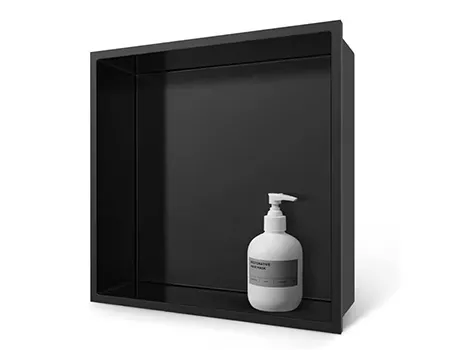
Reference Standard: Relevant material, installation, and performance requirements should be confirmed for the exact niche model and the requirements of the specific shower-room project.
A bath shower niche is best planned as part of the complete shower-room layout rather than treated as an isolated decorative feature. The available product evidence establishes two useful starting points: the listed shower niches are made from stainless steel, and they are presented as accessories intended for shower-room use.
Those facts are enough to place the niche within the project scope, coordinate it with surrounding shower-room components, and begin a specification conversation. They are not enough to determine the exact wall opening, niche depth, edge configuration, finish, installation method, drainage geometry, cleaning compatibility, or dimensional fit of a particular model. Those details should remain model-level decisions.
Where a Bath Shower Niche Fits in a Shower-Room Plan
A bath shower niche serves a different planning role from many visible shower-room accessories because its final position is closely tied to the wall layout. That makes early coordination valuable even before an exact product model has been selected.
The available catalog evidence places stainless steel shower niches within a broader group of shower-room products. This establishes the niche as a component intended for the shower environment, but it does not establish a specific storage capacity, load rating, waterproofing method, drainage performance, or installation system.
At the application-planning stage, the first task is therefore not to assume how a niche performs. It is to decide where the niche belongs within the overall room concept.
A planner can begin by identifying which wall is intended to contain the niche, how that wall relates to the shower area, and which other components will occupy nearby space. These are layout questions rather than product-performance claims. They help prevent the niche decision from being postponed until every other component has already been positioned.
This distinction becomes especially important when search terms such as shower niche 12 x 24, shower niche 12×24, or 16×16 shower niche are used during product research. Those phrases describe common dimensional search intents, but the current evidence does not verify that those dimensions are available for the catalog-listed niche. A buyer should treat them as search or project requirements until the exact model documentation confirms a match.
In practical terms, the niche belongs in the same early planning conversation as the shower area itself. Its location may affect how a buyer organizes the wall visually and how the project team reserves space for the final selected model. The precise opening and installation details, however, should come from model-specific information rather than from a generic niche category.
Start With the Verified Stainless Steel Material Fact
The strongest niche-specific material fact in the available evidence is straightforward: the product is described as a stainless steel shower niche.
That fact is useful because it gives the buyer a defined material category before more detailed specifications are available. It does not, however, identify a stainless steel grade, sheet thickness, surface treatment, coating, corrosion rating, or expected service life for the exact niche.
Stainless steel is a broad material family. Different grades, fabrication routes, surface conditions, and finishing processes can result in different appearance and service characteristics. For that reason, the word “stainless” should be treated as the beginning of a material specification rather than the entire specification.
For a wet-area product, buyers commonly care about how the visible surface will look after installation, how easily it can be maintained, and whether the selected material and finish suit the intended environment. These are reasonable general concerns for shower-room planning, but they should not be converted into unsupported performance promises for this niche.
The appropriate sequence is to keep the verified fact intact:
Verified: the niche is identified as stainless steel.
Then separate the questions that still require confirmation:
What stainless steel grade is used for the selected model? What is the material thickness? What finish is supplied? Is that finish created mechanically, chemically, or with an applied coating? What cleaning products are recommended or restricted? Are there model-specific care instructions?
This separation is particularly useful for architects, distributors, contractors, and buyers comparing several potential products. A generic product category may look sufficiently defined in an early schedule, yet installation and purchasing decisions usually require a more precise model specification.
The evidence does not justify statements about corrosion resistance duration, scratch resistance, coating life, salt-spray performance, or cleaning-agent tolerance. Any such values should come from the selected product’s technical information or suitable supporting test documentation.
For this reason, stainless steel should be used as an application-planning anchor, not as a substitute for the missing model data.
Coordinate the Niche With Other Shower-Room Accessories
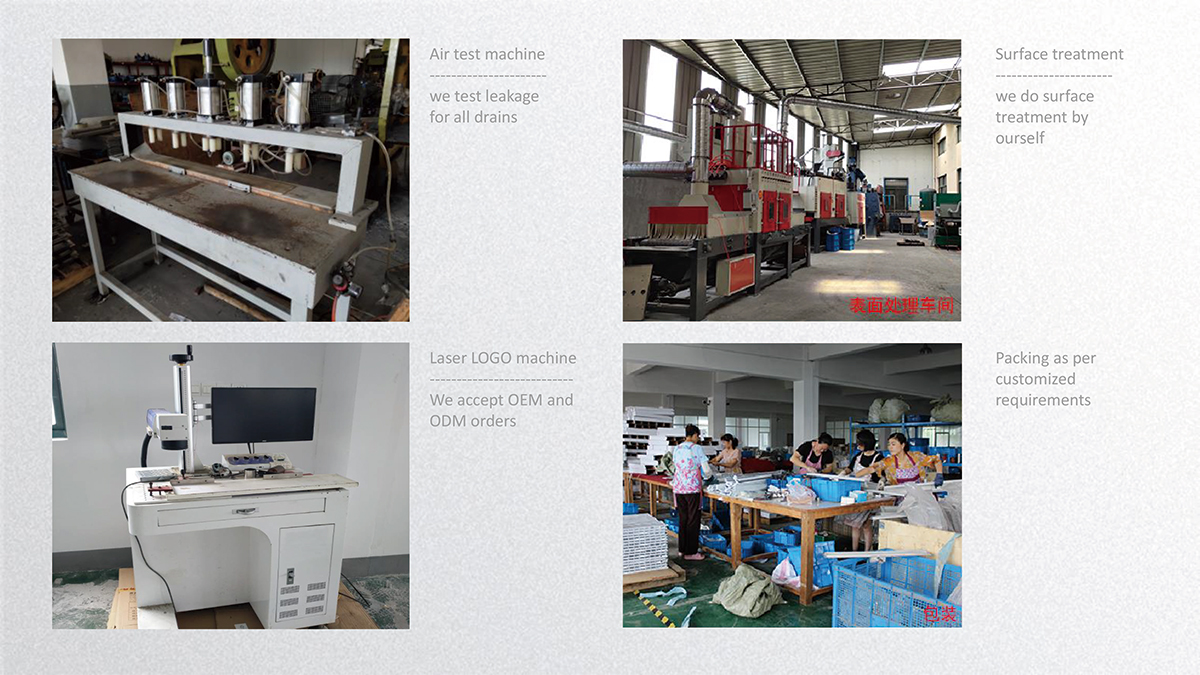
NINGBO MONDEWAY SANITARY WARE CO., LIMITED is presented in the available company information as a production-oriented business involved in shower accessories. The listed product environment includes floor drains, stainless steel shower niches, shower basins, shower chairs, shower handles, and shower tray boards.
That wider portfolio provides useful planning context. It shows that the shower niche can be considered alongside other components occupying the shower room rather than being viewed only as an isolated wall accessory.
The important distinction is between coordination and verified compatibility.
A project team can coordinate the niche with the positions of a floor drain, basin, handle, chair, tray board, and other shower-area elements. However, the available evidence does not state that these components have matched dimensions, common installation systems, coordinated finishes, or engineered interfaces.
For example, placing a niche and a shower handle on the same wall may require the designer to decide how the two elements relate visually and spatially. That is a project-layout decision. It does not mean the catalog has verified a specific installation distance between them.
Similarly, considering the niche together with a floor drain can help create a coherent shower-room purchasing scope, but the evidence does not establish any functional relationship between the niche and drain.
This approach is useful for both individual bathroom projects and larger procurement programs. Instead of asking only, “Which niche should I buy?” the buyer can ask a broader question: “What information must be coordinated so every shower-room component can be specified without relying on assumptions?”
The shower-room accessory portfolio can provide broader company and product context while the exact niche model is being identified.
A coordinated purchasing scope also helps separate aesthetic decisions from technical ones. A designer may want visual consistency across visible stainless steel components, for example, but a similar appearance does not prove that the materials, surface processes, or maintenance requirements are identical.
That means finish coordination should be confirmed deliberately. If a project requires a particular brushed direction, color, gloss level, surface texture, or coating, the selected niche should be checked against that requirement at the model level.
The same discipline applies to packaging and site handling. A finished niche may remain visible after installation, so surface condition at delivery can matter to the final appearance. Yet the evidence supplied here does not state a niche-specific packaging method or acceptance procedure. Those requirements should therefore be discussed rather than assumed.
Separate Application Planning From Model-Level Installation Details
The most useful planning boundary is simple: application facts can establish where the niche belongs in the project, while model data must establish whether the exact product fits the planned installation.
Two application-level facts are currently supported. The niche is identified as stainless steel, and it is intended for the shower-room environment.
The remaining installation questions require additional information.
Exact external dimensions are one of the most obvious examples. A buyer searching for a shower niche 12 x 24 may already have a preferred opening or visual proportion in mind, but the search phrase alone cannot establish that a catalog product fits that requirement. The exact dimensional drawing should be checked before the wall opening is finalized.
Depth also requires model-level confirmation. So do edge and flange details, because different niche constructions can interact with surrounding wall finishes differently. The current evidence does not identify whether the product uses a particular flange arrangement, trim profile, recessed edge, tile-overlap detail, or other interface.
Installation method is another unresolved category. The evidence verifies shower-room application but does not specify the required substrate, fastening procedure, sealing sequence, adhesive, membrane interface, wall build-up, or installation tolerance. These questions should be answered through the exact product documentation and the requirements of the wall system being used.
Drainage geometry should also remain outside the verified claims. A shower niche may be exposed to water during normal shower use, but the current information does not state a bottom slope, drainage channel, water-retention performance, or testing result for the listed niche.
The same principle applies to cleaning. Stainless steel provides a material identity, but it does not automatically establish compatibility with every household or commercial cleaning agent. Model-specific material grade, finish, coating, and care instructions can all influence the appropriate maintenance procedure.
Items to Confirm Before Ordering
-
Exact model dimensions: Request the complete external dimensions and usable internal dimensions rather than relying on category names or search terms.
-
Required wall opening: Confirm the rough opening or installation opening specified for the exact model before construction work fixes the wall geometry.
-
Depth and wall build-up: Check whether the niche depth is suitable for the planned wall construction and surrounding finish system.
-
Edge or flange configuration: Confirm how the visible perimeter is designed to meet the finished wall surface.
-
Material and finish specification: Verify the stainless steel grade, material thickness, finish description, and any coating or surface-treatment information supplied for the model.
-
Installation instructions: Obtain the manufacturer’s model-specific installation requirements instead of transferring an installation method from another niche design.
-
Drainage-related geometry: If water evacuation or bottom slope is important to the project, request drawings or other product information that directly confirms the design.
-
Cleaning and maintenance guidance: Confirm recommended cleaning methods and any restrictions associated with the exact stainless steel surface or finish.
-
Visible-surface acceptance: For projects where appearance is critical, define expectations for scratches, marks, color consistency, edge condition, and surface direction before final approval.
-
Compatibility with the overall layout: Check the niche position against nearby shower-room accessories without assuming that separate components were engineered as an integrated system.
This process keeps the specification accurate without slowing down early planning. The buyer can establish the niche’s role in the shower-room design now, while reserving model-sensitive decisions for the stage when drawings, finish data, and installation instructions are available.
The key is to avoid turning a verified category-level fact into an unverified model-level claim. Stainless steel construction and shower-room application provide a sound starting point. Dimensions, installation geometry, finish details, drainage behavior, and maintenance compatibility should be confirmed before the final product and wall arrangement are approved.