
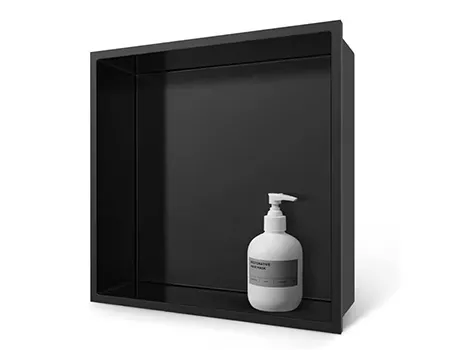
Niche in Wall Bathroom Tips for Wet Zones
Reference Standard: Relevant material and performance testing standards, including ISO 9001 management logic for controlled production, stainless steel corrosion-resistance evaluation such as ASTM G48 where applicable, and general quality management guidance from ISO.
Short Answer
From Empty Stud Space to Stainless Storage: Reading the Wall Cavity Before the Product
A recessed bathroom niche begins as empty wall volume. That sounds simple, but the product only works when that cavity becomes a cleanable, reachable, and stable storage cell inside a wet room. The confirmed product category is stainless steel shower niches, and the catalog places bathroom accessories inside the shower room environment. That is enough to support a practical evaluation: water vapor, repeated splashing, shampoo residue, soap film, and cleaning chemicals will all interact with the metal surface and the wall finish around it.
The first decision is not color or style. It is the relationship between the wall cavity and the user’s daily reach pattern. A niche installed too low becomes a water-holding shelf. A niche installed without enough planning for the finished wall layer can become a lip, a shadow line, or a difficult-to-clean recess. Since the catalog does not state a niche depth, wall-opening dimension, or load rating, the buyer should avoid treating the product page as a finished installation specification. The safer approach is to read the wall first: stud depth, tile thickness, waterproofing layer, planned storage items, and the exact finish plane all affect the finished result.
A useful edge-case model is the high-humidity storage cycle. In the early phase, a stainless steel niche may only collect small droplets after shower use. In the middle phase, soap residue and minerals begin to settle along the lower ledge and vertical return edges. In the extreme phase, if the wall finish creates a slight ledge or unplanned pocket, residue can dry repeatedly in the same place. This is not a claim about a specific Mondeway niche dimension; it is a physical model for any recessed stainless storage unit installed in a wet wall.
A cross-dimensional comparison helps clarify the risk. A surface-mounted shelf can be removed, cleaned behind, or replaced. A built-in bathroom niche becomes part of the wall system. That makes the initial cavity reading more important than ordinary accessory selection.
| Evaluation Point | Surface Shelf | Recessed Stainless Niche | Buyer Action |
|---|---|---|---|
| Wall dependency | Low | High | Confirm cavity and finish layer |
| Replacement difficulty | Lower | Higher | Request model drawing |
| Water residue pattern | Visible underside | Lower ledge and wall transition | Review cleaning access |
| Specification risk | Product-only | Product plus wall interface | Confirm installation details |

The catalog supports OEM and ODM development through a sequence of concept, drawing, prototype, mould, trial production, and products. That development route matters because a niche is not a loose accessory once installed. It becomes a fixed storage decision inside a tiled or finished wall. Buyers should use the drawing stage to confirm all values that the catalog does not provide: size, depth, edge return, visible border, finish type, and packaging protection.
The Hidden Transition Zone: Where Wall Finish, Tile Edge, and Metal Box Meet
The most important part of a niche is often the least discussed: the transition zone where the wall finish meets the metal box. This zone determines whether the niche feels intentional or awkward after installation. The PDF does not provide a dedicated installation section, flange size, opening tolerance, or jobsite photo for a niche in wall bathroom. Those details should not be invented. The available facts support a more careful statement: stainless steel shower niches are within the product range, and the factory capabilities include metal cutting, bending, welding, burr removal, brushing, and surface treatment.
At material level, stainless steel is valued in wet rooms because a passive surface layer can resist ordinary moisture better than many unprotected metals. That layer is not magic. Mechanical scratches, weld heat discoloration, retained oil, or aggressive cleaning chemicals can reduce local stability. A wall transition zone is especially sensitive because water can pause at a boundary, dry slowly, and carry dissolved minerals or cleaner residue. If the niche edge is sharp, uneven, or poorly aligned with the finished surface, the issue becomes both tactile and hygienic.
A practical extreme-scenario model is the tile-edge moisture bridge. In the early stage, water beads around the border and runs off. In the middle stage, a small lip or uneven finish line slows drainage and allows residue to collect at the junction. In the extreme stage, repeated cleaning with chloride-containing products or abrasive pads can concentrate damage at the same line. This does not prove a defect in any specific model; it describes the physical reason why the transition zone deserves supplier confirmation.
A comparison test case can be built without inventing proprietary data. Place two sample recess assemblies in a mock wall: one with a clean transition from finish surface to metal return, and one with a small step or rough edge. After repeated wet-dry cleaning cycles, inspect three outcomes: residue visibility, wiping resistance, and edge touch safety. The second sample will usually expose more maintenance friction because water and cleaning cloths both respond to geometry.
KEY TAKEAWAYS
- A rough edge can be noticed by touch before it becomes a visible complaint.
- Repeated water drying at a wall-metal boundary can reveal poor transition planning.
- A missing installation section should trigger a drawing request before order confirmation.
The transition zone is also where marketing language should stop and verification should begin. A buyer should ask for close-up edge photos, sectional drawings, and surface finish descriptions. If the supplier offers several finishes, the buyer should also ask how each finish behaves after normal cleaning. A brushed stainless appearance and a colored surface do not always age in the same way under repeated wiping, and the catalog does not provide niche-specific cleaning-cycle data.
A Manufacturing Path for a Quiet Bathroom Detail, Not a Decorative Shelf
A recessed stainless niche should be judged as a quiet manufacturing detail. It should not draw attention through scratches, sharpness, staining, rattle, or packaging damage. The catalog lists several relevant production capabilities: laser cutting, bending machines, welding machines, laser welding, burr removal, brushed surface work, surface treatment by the factory, pickling, electrical polishing, passivation, and customized or export-standard packing. These are credible process anchors, but they still need to be connected carefully to the niche category without claiming unlisted dimensions or tests.
The manufacturing path begins at cutting. Laser cutting can support controlled edges, but every cut edge still needs downstream attention. A niche has openings, corners, returns, and touchable borders. If burr removal is weak, the product may look acceptable in a distant photo but feel unsafe in hand. The next stage is bending. Bending consistency controls whether the box shape stays orderly and whether flat planes appear calm after installation. Welding and laser welding then create heat-affected areas. Without cleaning and surface treatment, those areas may show yellowing, surface contamination, or local discoloration.
The surface-treatment section is important because the catalog refers to a 2000 square meter workshop for surface treatment, including pickling, electrical polishing, and passivation. It also describes cleaning after welding to remove dirt, oil, scratches, and yellow spots on drains. For niches, this should be treated as a relevant manufacturing capability, not as a niche-specific guarantee unless the supplier confirms the exact route. The air test machine is explicitly described for drains, so it should not be rewritten as a niche leakage test.
An extreme fatigue model for this section is the wet-touch abrasion timeline. In the initial period, the niche surface faces water, light wiping, and storage contact from bottles. In the middle period, repeated movement of plastic containers, razors, soap dishes, or cleaning cloths may create fine directional marks. In the extreme period, abrasive cleaning or trapped mineral residue may make the finish appear uneven. The factory response should not be a vague promise of quality. It should be a sequence: controlled cutting, edge finishing, weld cleaning, surface treatment, final visual inspection, and packing protection.
A cross-dimensional test case can compare two samples after the same handling route. Sample A receives edge finishing, visual surface review, and protective packing. Sample B receives only basic forming and standard loose handling. After simulated transportation vibration and unpacking, inspect edge feel, surface scuffing, corner deformation, and finish uniformity. The test is simple, but it reflects real buyer risk because a recessed niche is often judged before installation, during opening, handling, and mock-up review.
The available catalog background supports ISO 9001 management, CE, cUPC, Watermark, and EN1253-1 references, but buyers should not automatically assign drain-related certifications to a stainless shower niche. The correct use of this information is narrower: the factory presents a controlled bathroom accessory manufacturing background. Product-level documents still need to be requested for the specific niche model.
| Process Variable | Observable Risk | Practical Acceptance Check | Standard or Reference Logic |
|---|---|---|---|
| Cut edge | Burrs or sharp touch | Glove and bare-hand edge review | General safety and workmanship inspection |
| Bend line | Uneven box shape | Corner and plane consistency check | Drawing-based dimensional control |
| Weld area | Yellowing, oil, or heat mark | Visual review under consistent light | Stainless surface cleanliness logic |
| Surface finish | Scratches or uneven brushing | Side-light inspection and sample comparison | Surface appearance agreement |
| Packing | Transit scuffing | Unboxing inspection after shipment simulation | Export packing protection practice |
Buyer Confirmation Map: What Must Be Asked Before a Recessed Niche Becomes Part of the Wall
A recessed niche becomes part of the wall after installation, so missing information is not a minor inconvenience. It can affect tile layout, cleaning behavior, storage comfort, and maintenance responsibility. The catalog confirms product category and broad factory capability, but it does not state model-level niche dimensions, material grade for the niche itself, wall-opening tolerance, flange geometry, weight capacity, waterproofing method, or installation instructions. The buyer should turn those gaps into a confirmation map.
The first confirmation is material. The catalog identifies stainless steel shower niches, and another production line section lists SS304 and SS316 among raw material capabilities, but that section is titled for drain production. A careful buyer should ask: Is this exact niche model made from SS304, SS316, or another stainless grade? Is the surface brushed, polished, coated, or treated in another way? Is passivation applied to this model after welding or forming? The answer changes cleaning expectations and corrosion-risk language.
The second confirmation is geometry. A recessed wall product needs drawings, not only photos. The supplier should provide external size, internal usable space, depth, edge return, visible border width, and any installation notes. Because those values are not stated in the PDF, the article should not invent them. The safe SEO content angle is to teach the buyer which values to request before the niche is built into the wall.
The third confirmation is inspection. For a stainless bathroom wall niche, a practical inspection list should include size matching, bend angle, weld appearance, burr removal, scratch review, oil or yellow-spot review, finish consistency, and packing protection. This aligns with the catalog’s manufacturing capability while staying inside the evidence boundary.

PRO-TIP / CHECKLIST
- Request the exact stainless steel grade for the selected niche model.
- Ask for a model drawing before confirming wall opening or tile layout.
- Confirm edge treatment and burr-removal expectations with close-up photos.
- Separate drain-related air-test claims from niche-specific inspection requirements.
- Ask whether pickling, electrical polishing, or passivation applies to the niche model.
- Confirm packing protection for visible edges and finished surfaces.
- Request installation photos or a mock-up image when wall finish accuracy matters.
- Keep cleaning instructions separate from general bathroom accessory marketing.
A final edge-case model is the post-install irreversibility curve. Before installation, the buyer can reject a scratched edge, request a drawing, or compare finish samples. During installation, correction becomes slower because tile layout and waterproofing decisions are already involved. After installation, replacement may require wall work. This lifecycle curve explains why a niche should be confirmed earlier than a loose bathroom accessory.
The cross-dimensional comparison is simple: treat the niche as either a product or a wall component. If treated only as a product, the buyer checks appearance and price. If treated as a wall component, the buyer checks material, geometry, finish, cleaning behavior, and packaging before the wall is closed. The second method is slower at quotation stage, but it reduces uncertainty where correction is most expensive.
For related bathroom accessory context and manufacturer background, buyers can review the Mondeway sanitary product range while still requesting model-specific niche documents before procurement.
Frequently Asked Questions (FAQ)
How to decorate recessed wall niches?
Use the niche as a controlled storage recess, not just a display space. In wet bathrooms, prioritize wipeable surfaces, reachable height, smooth edges, and minimal residue traps. For stainless steel shower niches, confirm surface finish and cleaning guidance before choosing accessories or decorative items.
Can a cracked shower tray be repaired?
Some minor cosmetic cracks may be repairable, but structural cracks need professional assessment. This question concerns shower trays, not stainless steel wall niches. Do not transfer tray repair logic to a recessed metal niche without model-specific material and installation information.
How to unblock shower tray?
A blocked shower tray usually involves drain access, hair, soap residue, or trap cleaning. It is separate from a niche in wall bathroom. A niche may collect surface residue, but it is not a drainage component and should not be evaluated with drain-unblocking methods.
Does a shower drain need to be vented?
Drain venting depends on plumbing design and local code. A stainless steel shower niche is a wall storage component, not a drainage fixture. The catalog mentions air testing for drains, but that should not be applied as a niche-specific performance claim.
What should be confirmed before ordering a stainless steel shower niche?
Confirm material grade, drawing, depth, visible edge style, surface finish, edge treatment, packing protection, and installation guidance. The available catalog supports stainless steel shower niches and manufacturing capability, but it does not provide model-level niche dimensions or installation tolerances.