
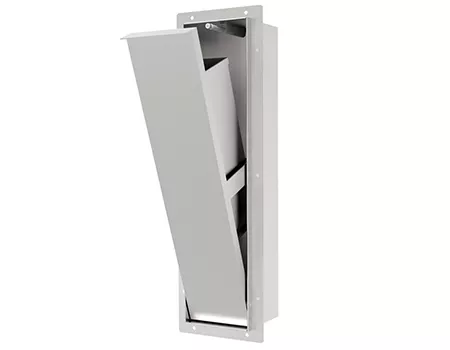
Why Do Large Wall Niches Fail? Physics of Condensation & Corrosion
Reference Standard: ASTM A240 (Standard Specification for Chromium and Chromium-Nickel Stainless Steel Plate, Sheet, and Strip for Pressure Vessels and for General Applications) and ISO 9227 (Corrosion tests in artificial atmospheres — Salt spray tests).
Short Answer
Interface Condensation Physics Driven by Wall Thermal Capacity Gaps
The failure of a large wall niche often begins not with a visible leak, but with the invisible thermodynamics of the building envelope. When a stainless steel niche is recessed into a bathroom wall, it creates a unique interface between a high-conductivity metal (SUS304/SUS316) and low-conductivity masonry or timber. This arrangement generates a permanent “Thermal Exchange Blind Spot.”
During a high-temperature shower, the interior surface of the niche rapidly absorbs heat, reaching the ambient steam temperature within seconds. However, the rear side of the stainless steel plate is in direct contact with the cooler building structure. Because stainless steel has a thermal conductivity coefficient significantly higher than brick or gypsum, a sharp temperature gradient is established. When the dew point is reached at this hidden junction, Interstitial Condensation occurs. Unlike surface water that drains away, this hidden moisture is trapped by physical siphoning forces at the niche’s outer flange. Over time, this stagnant water triggers structural degradation of the wall behind the niche, often manifesting as tile delamination or mold growth before any mechanical failure of the metal is detected.
To quantify this risk, we analyze a thermal capacity gap model:
In the Initial Phase (0-15 minutes of steam exposure), the niche surface reaches 45°C. The interface temperature remains at 22°C. The saturation vapor pressure drops at the metal-wall boundary, initiating micro-droplet nucleation. Interfacial humidity spikes to 100%.
Entering the Intermediate Phase (15-60 minutes), the condensation volume exceeds the retention capacity of the surface tension. Gravity and capillary action pull the liquid into the substrate. The wood studs or mortar beds begin to absorb moisture, leading to a localized decrease in structural compressive strength.
Reaching the Terminal Phase (long-term cyclic exposure), the constant wet-dry cycles cause the masonry to swell and contract differently than the stainless steel shower niche. This mechanical mismatch shears the sealant beads, creating a direct path for liquid water to bypass the waterproof membrane entirely.
This thermodynamic blind spot introduces a secondary systemic failure. As moisture accumulates in the wall cavity, it alters the dielectric properties of the surrounding materials. In modern smart homes, this localized humidity spike can cause ungrounded parasitic currents in nearby electrical conduit or LED lighting drivers integrated into the niche, leading to flickering or premature circuit burnout.
!(https://a2.ldycdn.com/cloud/lkBpnKqklkSRkjkprmroiq/fengmiantu.png)
KEY TAKEAWAYS
- A persistent “musty” odor emanating from the wall cavity even when the shower is dry, indicating hidden interstitial condensation.
- Hairline cracks appearing in the grout lines exactly at the perimeter of the niche flange, signaling differential thermal expansion stress.
- Discoloration or “blooming” of the PVD finish specifically at the lower corners, where solute concentration is highest during the drying phase.
Solute Concentration Kinetics and Under-film Corrosion via Electroneutrality Breakdown
The white spots and “rust” often found at the base of a built-in bathroom shelf are rarely just surface dirt; they are the result of Solute Concentration Kinetics. When water droplets remain stagnant on the niche floor, the evaporation process begins. As the water volume decreases, the concentration of dissolved calcium, magnesium, and chloride ions—along with aggressive surfactants from body washes—increases exponentially.
In the final stages of evaporation, these ions reach a critical saturation point, often exceeding 10,000 ppm of chlorides at the micro-scale. These high-concentration solutes find microscopic pores or “pinholes” in the PVD or anti-fingerprint nano-coatings. Once the solute reaches the base stainless steel, it initiates a cathodic reduction reaction. This process consumes local alkalinity, leading to an Electroneutrality Breakdown at the coating-metal interface. This triggers Under-film Corrosion, where the metal is hollowed out beneath the protective layer. This is fundamentally different from surface pitting; it is a localized chemical battery that destroys the adhesion of the PVD layer, causing it to flake off in large, brittle scales.
Lattice Distortion and Anisotropic Magnetic Fingerprints in Deep Drawing Processes
The structural reliability of a recessed metal wall niche is dictated by its manufacturing physics. High-quality niches are often produced via a Deep Drawing Process, where a single sheet of SUS304 is forced into a mold by a massive hydraulic press. While this eliminates welds, it subjects the metal to extreme plastic deformation.
This deformation triggers a “Strain-induced Martensite Transformation.” The originally austenitic (non-magnetic) crystal structure of the stainless steel is forced into a distorted, magnetic martensitic lattice. This Lattice Distortion is not uniform; it follows the metal flow lines, creating an Anisotropic Magnetic Fingerprint. These regions of high lattice energy are inherently more susceptible to stress corrosion cracking. Without a secondary precision annealing cycle to reset the crystal alignment, the “stretched” corners of the niche remain in a state of high residual tensile stress, which acts as a catalyst for fatigue failure when subjected to the weight of heavy stone-shampoo bottles over many years.
1. Thermal Barrier Flange Integration Protocol
* Execution Protocol: The niche is installed with a high-density, closed-cell EPDM thermal break gasket between the stainless steel flange and the wall framing. This gasket must have a thermal conductivity of less than 0.04 W/(m·K).
* Material Expected Evolution: The Interstitial Condensation is physically blocked. The temperature gradient at the interface is smoothed, preventing the moisture from reaching the dew point. This protects the masonry structure and ensures the waterproof membrane remains uncompromised by hidden liquid accumulation.
* Latent Cost & Risk Avoidance: Standard silicone sealant is often used as a shortcut, but it lacks the thermal mass to prevent condensation. Failing to use a dedicated EPDM barrier risks rot in timber-framed walls that can cost thousands in structural repairs.
2. PVD Gradient Molecular Smoothing
* Execution Protocol: Following the deep drawing process, the niche undergoes electro-polishing to achieve a nano-roughness ($R_a$) of less than 0.1 microns. Subsequently, the PVD gun-metal or matte black coating is applied in a vacuum chamber with an ion-assisted deposition technique.
* Material Expected Evolution: The surface energy is reduced to a level where water cannot anchor. The Solute Concentration Kinetics are neutralized because the droplets are forced to bead and roll off before evaporation can concentrate the ions. This eliminates the chemical potential gradient required for under-film corrosion.
* Latent Cost & Risk Avoidance: Cheap PVD coatings without electro-polishing merely “mask” the rough surface. These micro-valleys act as reservoirs for chlorides, actually accelerating sub-film pitting rather than preventing it.
3. Controlled Recrystallization Annealing
* Execution Protocol: After the deep drawing phase, the niche bodies are placed in a vacuum furnace and heated to 1050°C, then rapidly quenched. This process must be monitored using magnetic permeability meters to ensure the martensite content returns to below 0.5%.
* Material Expected Evolution: The lattice distortion is erased, and the anisotropic magnetic fingerprints are neutralized. The residual tensile stresses are converted to a stable austenitic state, granting the corners of the niche the ductility needed to withstand 50kg+ of static storage weight without stress-induced cracking.
* Latent Cost & Risk Avoidance: Annealing can cause slight dimensional warping. The factory must use precision jigs during the quenching phase to maintain the tight 90-degree angles required for a flush wall fit.
4. 72-Hour CASS and Negative Pressure Decay Validation
* Execution Protocol: Samples are subjected to a 72-hour Copper-Accelerated Acetic Acid Salt Spray (CASS) test per ASTM B368. Additionally, every unit is tested in a vacuum chamber where a -0.05 MPa negative pressure is applied to verify the structural integrity of the deep-drawn seams.
* Material Expected Evolution: Passing these tests guarantees that the niche possesses a “Zero-Defect” skin. The vacuum test ensures that even at the thinnest drawn points, the material density is sufficient to block gas-phase moisture migration into the wall cavity.
* Latent Cost & Risk Avoidance: CASS testing is far more aggressive than standard salt spray. However, for a niche designed to be permanently embedded in a wall, this is the only way to simulate 20 years of exposure to acidic soaps and hard water.
| Performance Metric | Standard Welded Niche | Deep-Drawn Annealed Niche | Reference Standard | Validation Method |
|---|---|---|---|---|
| Lattice Stability | High Residual Stress | < 0.5% Martensite | ASTM E562 | Magnetic Permeability |
| Corrosion Resistance | 24h NSS (Standard) | 72h CASS (Pass) | ISO 9227 | Fog Chamber Analysis |
| Surface Roughness | $R_a$ 0.5 – 1.0 $\mu m$ | $R_a$ < 0.1 $\mu m$ | ISO 4287 | Laser Profilometry |
| Sealing Integrity | Visual Check | Negative Pressure Pass | ASTM F2338 | Vacuum Decay Sensor |
!(https://a2.ldycdn.com/cloud/lpBpnKqklkSRojplmjpqip/Mondeway-company-introduction2022.jpg)
PRO-TIP / CHECKLIST
- Magnet Check: Take a small neodymium magnet to the corners of the niche. If the magnet sticks strongly, the material has high lattice distortion (martensite) and was not properly annealed, making it prone to stress corrosion.
- Verify One-Piece Construction: Look for visible weld lines in the interior corners. True high-end niches are deep-drawn from a single sheet; any weld is a potential site for galvanic depletion and leakage.
- The Flange Test: Ensure the mounting flange is perfectly flat. Any warping from the manufacturing process will prevent the niche from sitting flush, leading to gaps where interface condensation can bypass the tiles.
- Audit the Thickness: Use a micrometer on the flange. For a large niche, the base material should be at least 1.0mm (19 Gauge). Thinner metal will flex under the weight of stone bottles, compromising the grout seal.
- Check for Nano-Coating: Drop water onto the surface. If it “sheets” or spreads, there is no hydrophobic layer. If it forms high-contact-angle beads, a functional nano-coating is present.
- Review the CASS Report: Don’t settle for a standard salt spray report. Ask for the 72-hour CASS (Copper-Accelerated) results to ensure the PVD finish can withstand bathroom chemistry.
Frequently Asked Questions (FAQ)
how to remove a shower drain stopper
Removing a stopper depends on the type. For “lift-and-turn” models, set it to the open position, lift, and unscrew counter-clockwise. For “pop-up” stoppers, you may need to unscrew the decorative cap first to reveal a set screw. If it is a “toe-touch,” simply unscrew the entire assembly from the cylinder while in the open position.
why does shower drain smell
A foul odor usually originates from a “dry P-trap” where the water barrier has evaporated, allowing sewer gases to enter. Alternatively, it is caused by the accumulation of a “biofilm”—a thick matrix of bacteria, skin cells, and hair—clinging to the drain walls and decomposing, which requires mechanical cleaning and enzymatic treatment.
how to build a bathroom niche
To build a niche correctly, you must frame a box between the wall studs, install a waterproof backer board (like cement board), and apply a liquid waterproofing membrane. However, for 100% leak protection, it is recommended to use a pre-fabricated stainless steel niche that installs directly into the tile layout, eliminating the risks of hand-built waterproofing.
how to get rid of smell in bathroom drain
First, flush the drain with boiling water to melt soap scum. Follow this with a mixture of baking soda and vinegar to create a foaming action that breaks down biofilms. For persistent smells, check the plumbing vent on the roof for blockages, as poor venting can siphon the water out of your P-traps.
what is a pedestal sink
A pedestal sink consists of two separate pieces: a heavy porcelain basin and a vertical column (the pedestal) that supports it. While they offer a classic, space-saving aesthetic, they provide zero storage and require the plumbing to be perfectly aligned within the wall, as the pipes are partially exposed behind the column.
how to unclog pvc drain
For PVC drains, avoid harsh chemical cleaners which can generate exothermic heat and weaken the plastic joints. Use a plastic “zip-strip” to pull out hair clogs near the surface, or a manual drain snake for deeper blockages. For kitchen PVC grease clogs, a mixture of dish soap and hot water is often safer and more effective than acid.