
Why linear shower drain wall vs center placement changes drainage and waterproofing behavior
Drainage slope errors and waterproofing stress often trace back to installation position, especially in high-humidity shower environments where floor geometry and water load interact every day. When installers and project engineers compare linear shower drain wall vs center placement, the decision is rarely cosmetic; it directly shapes how water moves, where stress concentrates, and how reliably the system performs over time.
Where wall-side and center-floor linear drains actually differ
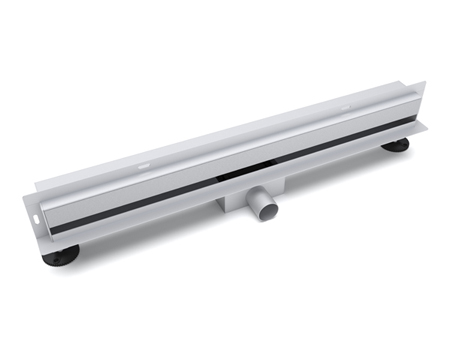
A linear drain installed against the wall functions as a boundary condition for the entire shower floor. Instead of forcing water to converge from four directions, the surface is typically sloped in one primary plane toward the drain. This geometry reduces compound angles in tile work and limits the number of waterproof membrane transitions that must remain watertight over years of use.
Center-floor placement, by contrast, requires the floor to fall toward the drain from multiple sides. While visually symmetrical, this layout increases the tolerance sensitivity of slope execution. Even small deviations can create shallow basins where water lingers, accelerating surface wear and increasing maintenance demands.
These geometric differences explain why many commercial and high-spec residential projects increasingly default to wall-side linear drains when long-term performance matters more than visual symmetry.
How installation position influences drainage slope reliability
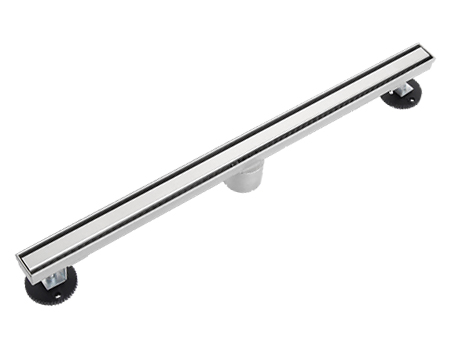
Drainage performance is rarely limited by drain capacity alone. In practice, slope execution governs whether water actually reaches the outlet under daily use. Wall-adjacent placement supports a consistent gradient across the entire wet area, which makes inspection and correction during installation more straightforward.
With center placement, slope must be balanced from multiple directions, often across irregular tile cuts. This increases reliance on installer skill and increases the probability that certain zones fall below the minimum effective gradient. Over time, those areas become the first points where standing water appears.
For project managers overseeing multiple installations, this difference translates into more predictable outcomes and fewer callbacks when wall-side drains are specified with clear slope requirements.
Why waterproofing stress concentrates differently at wall and center locations
Waterproof membranes are designed to tolerate moisture exposure, but they are less forgiving of repeated mechanical stress. When a linear drain sits in the center of the floor, the membrane must wrap around the drain body while simultaneously accommodating intersecting slopes. Each transition becomes a potential stress concentrator.
Improper slope formation can amplify this effect. Standing water increases hydrostatic pressure at membrane seams, and repeated thermal cycles in high-humidity bathroom environments accelerate sealant fatigue. Over time, micro-gaps can form at the drain interface, leading to leakage that remains hidden until structural damage appears.
Wall-side installation reduces the number of intersecting planes and allows the membrane to terminate more cleanly along a vertical surface. This does not eliminate waterproofing risk, but it narrows the number of locations where stress must be controlled.
Typical failure patterns linked to incorrect placement decisions
The most common failure mode associated with poor placement is not immediate leakage but progressive performance degradation. Water that fails to drain completely leaves residues, encourages biofilm formation, and increases cleaning frequency. Over months or years, these conditions raise the likelihood of membrane stress and eventual leakage at the drain interface.
In center-floor configurations, failures often present first as isolated puddling near corners or edges, rather than at the drain itself. Wall-side drains more often show issues only when slope was improperly executed or when membrane detailing at the wall junction was rushed.
Understanding these patterns helps teams decide whether the visual preference for a centered drain justifies the additional installation control it demands.
Maintenance and inspection implications over the service life
Maintenance teams tend to notice differences long before structural issues emerge. Wall-adjacent linear drains are easier to inspect visually because water flow paths are predictable and residue patterns are easier to interpret. This supports routine cleaning and early detection of slope-related problems.
Center drains distribute residue more evenly across the floor, which can mask early warning signs. In commercial restrooms or hospitality projects with heavy usage, this often translates into higher labor costs for cleaning and inspection.
For facility managers, these operational factors frequently outweigh initial aesthetic considerations when evaluating placement strategies.
How performance is evaluated under standardized testing
Installation decisions gain clarity when viewed through the lens of standardized testing. Drain assemblies are commonly evaluated using flow rate tests to confirm that water reaches and exits the system as intended, and water leakage tests to verify membrane integrity around the drain body.
In a controlled setup, wall-side configurations typically show more consistent results because slope uniformity is easier to reproduce. Center-floor installations can perform equally well, but only when slope tolerances are tightly controlled during construction.
These testing approaches align with broader plumbing evaluation frameworks such as those referenced by organizations like
ASTM International
and
ASME plumbing standards,
which emphasize repeatable performance under defined conditions rather than idealized layouts.
When wall placement is usually the safer default
For multi-unit residential projects, hotels, and healthcare facilities, wall-adjacent linear drains often represent a lower-risk baseline. They simplify coordination between tile, waterproofing, and plumbing trades, and they reduce dependence on perfect execution across multiple slope planes.
This does not imply that center placement is inherently flawed. Rather, it demands tighter process control, clearer installation documentation, and more rigorous inspection protocols to achieve comparable reliability.
Teams seeking a broader framework for evaluating linear drain configurations across different project types often refer back to a more comprehensive resource such as the
Linear Shower Drain Buyer Guide,
where placement is evaluated alongside outlet orientation, material selection, and maintenance access.
Aligning placement choice with long-term reliability goals
The choice between wall and center placement should be treated as an engineering decision rather than a stylistic one. By considering how slope geometry, waterproofing stress, and inspection practicality interact in a high-humidity shower environment, teams can anticipate performance outcomes instead of reacting to failures later.
Linear shower drain wall vs center placement becomes far less ambiguous once failure modes are reframed as controllable variables. When slope execution and waterproof detailing are validated through flow rate and water leakage tests, long-term performance stops being a matter of luck and starts reflecting deliberate design choices.
This analysis is grounded in practical installation experience, standardized drainage and leakage testing practices, and real-world shower environments where moisture exposure is continuous. By anchoring decisions in these verifiable conditions, project teams can reduce uncertainty and specify linear drain layouts that age more predictably under daily use.